 Alon Lischinsky
At the #ResearchingTheRainbow day conference on #LGBTQ+ issues in #HigherEducation hosted by the #UniversityOfGreenwich! Will be live-tooting papers through the day

First, Luca Tasciotti (https://scholar.google.com/citations?user=m8sDSagAAAAJ) looks at whether the Ugandan anti-LGBTQ+ legislation has deterred international aid, as donors threatened to do when life prisión for same-sex activity was first prepared
The paper applies the Synthetic Control Method to evaluate the shift in aid inflow after the passing of the bill (in a nutshell, comparing the real data with a hypothetical control built from aid data from comparable countries)
Reader, the threats were empty
Despite some exceptions, amti-LGBTQ legislation did not generally reduce international aid, and in some cases (most notably the US) money actually increased
Tasciotti: "pro-LGBTQ+ rhetoric does not necessarily translate to actual carrot-and-stick economic measures"
We now move to Paula Kuzbit's narrative inquiry on the experiences of lesbians living with cancer (https://www.canterbury.ac.uk/people/paula-kuzbit)
Her focus today is on the notion of queering the sick room in the context of a health care system that assumes straightness and imposes cis-heteronormativity on records, policy and treatment
Even research on LGBTQ+ needs tends to unhelpfully homogenise the lived experience of different groups
Kuzbit takes a #QueerPhenomenology approach to explore how lesbian lives disrupt a system that assumes heteronormativity, and to what extent the system allows itself to be reorientated to accommodate these experiences, or instead does violence to them
For Kuzbit's participants, choosing to live an openly lesbian life had been a key decision, offsetting the internalised homophobia rampant in their upbringing
For example, some participants deliberately chose to forego breast reconstruction — but kept being pressured into it by healthcare professionals who had internalised hetero norms of attractiveness
Professionals' orientation to the sickroom norms is disturbed by queer experiences — for example, by women who are sexually active and yet don't require contraception, because they are in lesbian relationships
Queer participants report being destabilised by the lack of safety and the judgemental nature of the double-takes that their lesbian experiences and partners caused in the sickroom
Professionals' power over the sickroom means these disorientations do not have the same effects
(I'm up after the break, so you'll have to hope for someone else to livetoot, or else go for my slides at https://alon.lischinsky.net/RtR2024/)
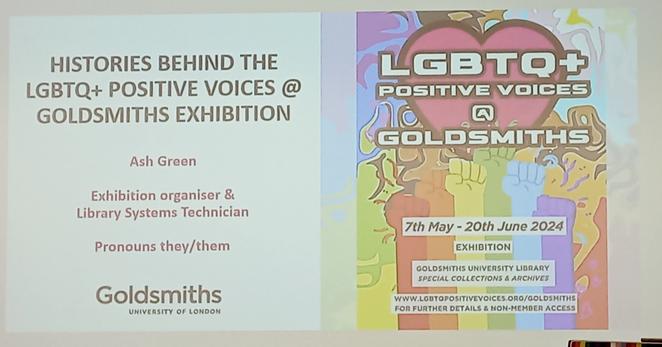
Now Ash Green (https://librariesrewired.org.uk/?speaker=ash-green) is presenting about the LGBTQ+ Positive Voices exhibition they have curated for Goldsmitgs, covering examples of positive political and cultural representation of queer people across the world
relationships
Daniel Marsden (https://www.canterbury.ac.uk/people/daniel-marsden) now discusses experiences at the intersection of autism, trans identity and learning disability (a dimension rarely considered in this research), examined thorough an #InterpretativePhenomenologicalAnalysis lens
Interviews identified some common themes: key discoveries in transition, complex responses from family, work and education, and accessing care
People who are trans, who are autistic and who have learning disabilities are often infantilised by a healthcare system that denies them agency over themselves and autonomy in determining their needs
Recruitment for the project was made especially hard by the understandable hesitancy of participants this had sparked
Last talk of the day: Hao Tian (https://www.southampton.ac.uk/people/62qllx/mr-hao-tian) looks at how responses to the leak of medical information about #AIDS treatment in China led to a witch hunt against gay men driven by established homophobic stereotypes
His project interviewed both victims and perpetrators of the witch hunt to explore not only its impact but its motivations
The goal is not just to understand how queer people (re)build and maintain safe spaces online in the face of active hostility, but also to develop policy that can help prevent it
