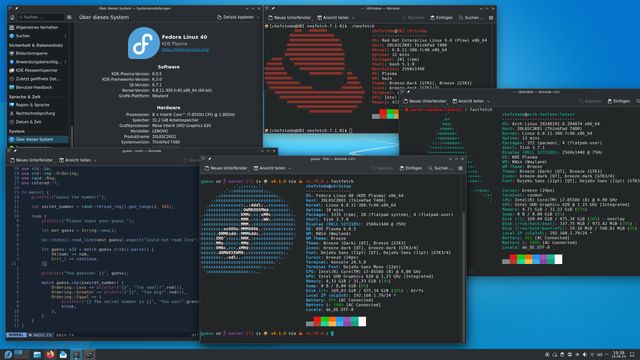

My current #linux system in 06/2024:

Hardware: ThinkPad T480 with Intel i7 from 2018, dual internal batteries, 512 GB SSD, 32GB RAM and a #Nitrokey 3 as a hardware security token.

OS: #Fedora 40  #KDE Edition  

Terminal: #Konsole
Terminal-prompt: Starship
Editor: Neovim  
dotfile Management: #chezmoi
Shell: #fish shell 🐠
Synchronized shell history: #atuin
Container-Engine: #Podman  

Dev-Containers: #Distrobox (With #RHEL and #Arch Linux (btw))
Modern "ls" replacement: #eza
GPG/SSH-Keys: openpgp-card-ssh-agent and oct (https://codeberg.org/openpgp-card/)
Mail/PIM: #KMail/#KOrganizer
Notes: #KleverNotes
Mastodon Client: #Tokodon
File-Synchronization: #Nextcloud
Gaming: Steam  , Bottles and ProtonUP-QT

openpgp-card

A set of Rust client libraries for OpenPGP card devices (https://en.wikipedia.org/wiki/OpenPGP_card), and tools based on these libraries.

Codeberg.org
@Larvitz how'd you get RHEL in distrobox? 🤔 ... does subscription-manager work?
@maxamillion Thats an UBI Container Image, which doesn't need subscription-manager
@Larvitz ohhh okay, UBI isn't *really* RHEL ... it's kinda RHEL ... if you squint and ignore ~70% of the package repo 😉
@maxamillion it’s the closest there is as an official container image 🤷🏻‍♂️. And for my use-case (testing python Django applications under EL), it’s totally enough.
@maxamillion @Larvitz Fun fact, if you subscribe the host machine (yes even Fedora) then UBI containers automatically upgrade to full RHEL containers.
Feature RHEL chroots

A ‘simple’ chroot build environment manager for building RPMs.

Mock
Carl George :fedora: :centos: (@[email protected])

I regularly see folks state that they use a RHEL rebuild distro because managing RHEL subscriptions is too painful. 5 years or so ago, I might have been inclined to agree with them. That said, things can improve over time, so let's check out the current state. The most notable improvement in the last few years is a thing called Simple Content Access (SCA). #RHEL #RedHat https://access.redhat.com/articles/simple-content-access

Fosstodon
@carlwgeorge @Larvitz wait, I didn't know that worked on Fedora???? 🤔🤔🤔

@maxamillion @carlwgeorge @Larvitz

I also didn’t not know it worked on Fedora!

I’ve always wondered, in these scenarios, does host meta get transferred into the container if I use the package manager to access its repos?

@komish @maxamillion @carlwgeorge

I tried it out today and when I started my UBI9 after subscribing my Fedora host with subscription-manager, all the real RHEL9 repositories were there and I could install packages from them.

From the technical side, I saw that the entitlement certificates from the host were supposedly mounted to /etc/pki/entitlement-host and I guess dnf is then using them to access the Red Hat CDN. Also there's a repolist file generated in /etc/yum.repos.d with the Red Hat Repositories.

That's just my impression from the observations, I made when fiddling around with it.

@Larvitz @maxamillion @carlwgeorge oh, oh, oh - it’s a *subscribed* fedora host. Well that makes much more sense to me.
@komish @maxamillion @carlwgeorge Yes, I installed subscription-manager on the fedora host and subscribed it. Then UBI9 containers, run on that Fedora system could access all the RHEL packages.

@komish @maxamillion @carlwgeorge

Ah, found it.

~ ❯ cat /usr/share/containers/mounts.conf
/usr/share/rhel/secrets:/run/secrets

The /usr/share/containers/mounts.conf (on the host) defines a mount, so all the data needed for subscription-manager are mounted into Podman containers to /run/secrets