
I am excited to finally share our recent paper "Filtering After Shading With Stochastic Texture Filtering" (with @mattpharr @marcosalvi and Marcos Fajardo), published at ACM I3D'24 / PACM CGIT, where we won the best paper award! 1/N

@BartWronski ah, I remember a year or two ago you were asking around about Unreal jittered sampling and other “strange” texture filtering approaches. Now we know where all that went! Really nice!

@aras yes, we had a tech report with our initial findings and a ton of folks reported some great precedents in old games. We knew of all the academic literature, but game developers just use them and often not even report. :)
The coolest example was this old Star Trek game and the first Unreal, we had no idea! This helped us a lot to contextualize our research. :)

Game developers, please report your findings and even "hacks"! :)
@aras Even if writing a full paper might seem intimidating and a ton of work (plus sometimes dealing with gatekeeping reviewers), GDC or Siggraph "Advances" presentations, blog posts, JCGT articles or arXiv tech reports are good enough to find and reference and much easier to write. :)
@BartWronski there’s at least 10x effort (and prestige?) difference between a blog post and a GDC/Siggraph talk, but yes even a blog post is 1000x better than nothing. From personal experience though, “hey I found a gross hack!” the first instinct is to *not* write about it :) But of course you have no idea if your “gross hack” is actually a sensible application of a theory that has not been formulated yet.
@BartWronski your paper is a perfect blend of “proper literature” and “documenting gamedev practices” by the way. The latter is very often not well documented or even understood (I’m sure you are aware of a million reasons why :)). But it is curious that production environment sometimes stumbles upon actually sound theory by accident, without realizing it.
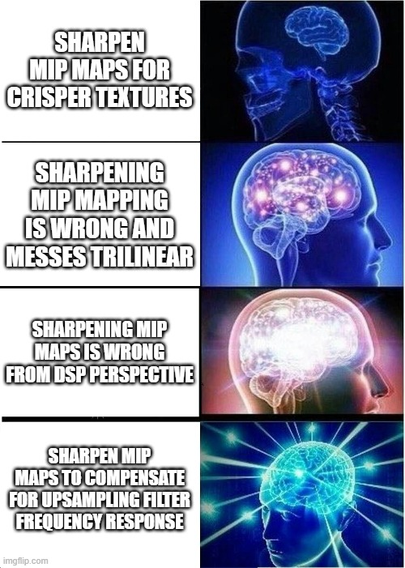
@aras I had this observation in an older blog post of mine that artists manually sharpening mipmaps (which seemed like a gross hack) is actually an intuitive compensation for ugly bilinear filter and correct, best-fit optimization-based solution gives similar results :) https://bartwronski.com/2021/07/20/processing-aware-image-filtering-compensating-for-the-upsampling/
Processing aware image filtering: compensating for the upsampling

This post summarizes some thoughts and experiments on “filtering aware image filtering” I’ve been doing for a while. The core idea is simple – if you have some “fixed” step at the…

Bart Wronski
@BartWronski @aras artists are smarter than we give them credit for. I'm pretty sure incorrect lighting falloff was making up for the renders not being sRGB correct :P
@demofox @BartWronski definitely. But my point is, in gamedev (or generally outside of "research"), many of these things are not because someone wanted to find a theory; they are because someone wanted to save half a millisecond. I'm 99% sure stochastic mip sampling happened in gamedev only because of in a virtual texturing system manually doing full trilinear is very costly. Someone had an idea of random mip choice, and went "hey that does not look too bad!" and so it shipped.
@demofox @BartWronski which again is why I'm very happy for paper like this (and a handful of others) that "bring industries together". I think Bart mentioned it too, but many graphics people are blissfully unaware of most of signal processing things done by audio people, for example. It might be useful! (or it might not, lol)
@demofox @BartWronski I'm totally fanboying Bart here though -- since you have experience in gamedev *and* research *and* music -- 🤯 -- excellent! ❤️
@aras @demofox thank you, it means a ton coming from you :) I am nerdy about some niche and mostly useless things, but sometimes, they turn out to be useful after all 😅