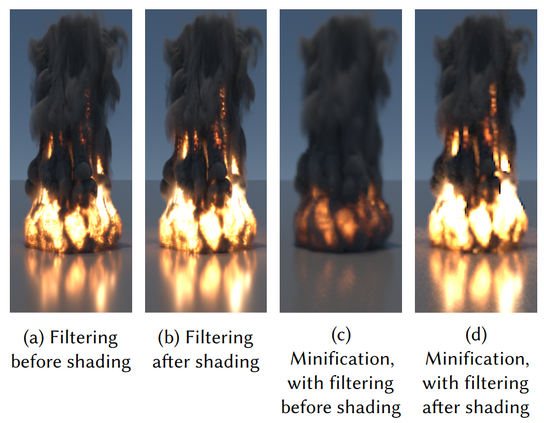
I am excited to finally share our recent paper "Filtering After Shading With Stochastic Texture Filtering" (with @mattpharr @marcosalvi and Marcos Fajardo), published at ACM I3D'24 / PACM CGIT, where we won the best paper award! 1/N

"Everyone" knows blending and filtering do not commute with non-linear functions.
However, this is how texture filtering is taught and applied - we filter textures, then "shade" (apply non-linear functions). This introduces bias and error and often destroys the appearance. 2/N
@BartWronski I'm gonna be honest I didn't know that
@aeva @BartWronski Didn't know either! I wonder why this isn't communicated *anywhere*, seems like a pretty important detail.
@jesta88 @aeva @BartWronski I agree that this point has been under-emphasized/not-mentioned (including in other things I've written myself!). I think it's just one of those things where much of the time it doesn't cause any trouble, and when it does it's easy to think "well, there's nothing that can be be done about it" or "it's probably not too much error anyway". I definitely agree with Bart that going through another cycle to clarify these observations was a really good thing for the paper...

@mattpharr @jesta88 @aeva I put this "everyone" in quotation as tongue-in-cheek suggestion that it's not really everyone, and it's not that obvious - because of the way we teach and practice it. :)
"Bilinear is free? Sure, I'll use it! Everyone uses it? It must be the right thing to do!"

Once it's not free (our motivation - filtering under a new compression format) and you see the different outcome, you are starting to question yourself and everything you know - "which way is correct?!" :)

@BartWronski @mattpharr @jesta88 oh yeah I figured the scare quotes were because it referred only to the set of people who knew this particular thing