 Molly White
I spent a long time experimenting with AI before finally writing about it in depth. It can be pretty useful — but is it worth it?

 Marty J. Wolf
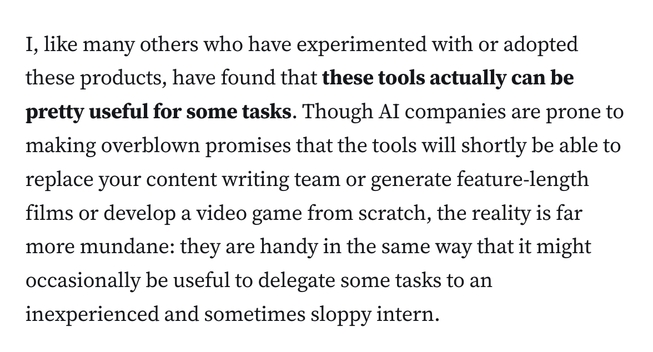
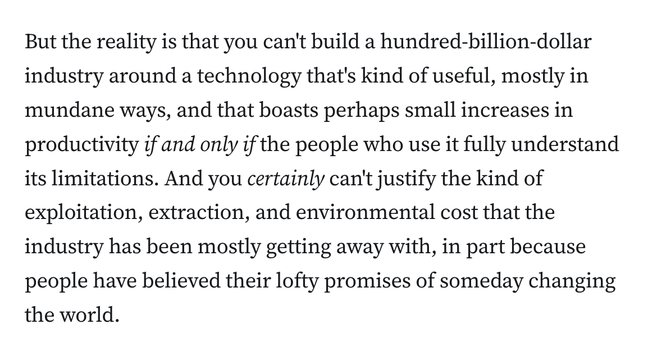
When I boil it down, I find my feelings about AI are actually pretty similar to my feelings about blockchains.

If you liked this essay, consider signing up for a pay-what-you-want subscription.
My writing is never paywalled, but your support is what helps me keep doing this.

 Brad Koehn
@molly0xfff Nice marketing. Seriously, that’s good work. Curious to learn how well it works.
 Matt Wilcox
@molly0xfff It also doesn't help when "normals" see the grift and hate the products. For example, this rant by IronMouse, who has nothing to do with tech. https://mstdn.social/@mattwilcox/112277570122352261
Matt Wilcox (@[email protected])
The AI stuff isn’t convincing to “normals” either. IronMouse absolutely rinsing Twitter’s “AI” features here, nail on the head. “Reads like when I was at school padding out a bullshit essay with loads of words and not saying anything”. “AI artists?” *laughing* “get that shit out of my art tags. I don’t want to see it.” AI is going to implode so hard in the next 12 months, when the over-valuations of speculative futures adjust to a reality where no one is liking it. https://www.twitch.tv/videos/2120071913?t=2242s
 David Frew
@molly0xfff Hi,
If I use my GBP Credit Card, I'll get a $2 currency charge?
Do you know if "LINK" allows billing in non USD currencies? I've never heard of or used "LINK".
If I use my GBP Credit Card, I'll get a $2 currency charge?
Do you know if "LINK" allows billing in non USD currencies? I've never heard of or used "LINK".
@Dr_Von2 hi! shoot me an email with the tier you're hoping for and i can give you a GBP payment link. [email protected]
 George Liquor, American
@molly0xfff You distill it down perfectly.
 Jay 🆘
Jay 🆘@molly0xfff If only people in Silicon Valley weren’t primarily motivated by becoming billionaires.
This isn’t even an indictment of capitalist success, just…lop off a few zeros there.
You can still get rich quietly making moderately useful things.
 Darrin West
@molly0xfff It sure uses a lot of power and cooling water to do a meh-job. Maybe using an intern (or fiverr) would be a better choice because it also helps a person.
 Andrew Benedict-Nelson
@obviousdwest @molly0xfff not to mention that many of these AI applications have in the end depended on low-paid labor somewhere on the other side of the world
 number137
@molly0xfff I just pictured Refreshmentbot from Futurama as AI replacement for a sloppy intern

 Emily 🏳️⚧️ (Sad Music Era)
@molly0xfff AI is following the same tech hype train I have seen my entire life in tech.
And like every other hype in tech, it's about 80% greed trying to make money selling a 'perfect future', and 20% true believers who should really, really REALLY know better and yet somehow have become converts to a technical concept or tool whose flaws they are professionally trained and experienced to spot, but are blinded to.
My MS is in machine learning. I know how chatGPT works under the hood (just as I knew how blockchain worked on a technical basis) and I cannot understand some of the people who ALSO know how it works treating LLMs like they think or understand.
I can see how it can fool people who don't have a glimpse under the hood, but even they should start to notice they're talking to a literal Chinese Room example.
Words in, most statistically likely words out in the most likely pattern, zero thought or comprehension.
 wololo
@EmilyGB2023 Glad to hear that my intuition wasn't too far off! Still, thanks for the insight.
 Arne Martin
@molly0xfff Extremely well put 🙌
 Zate 🦘🇦🇺
@molly0xfff oohh.. cmon now.. i havent met a blockchain that can create me endless pictures of fairies riding corgis. #AI has its uses.
 Tinyrabbit ✅
 Cali
Cali@molly0xfff I suppose the difference would be that people can lose a lot of money on / with the blockchain.. oh wait…
@molly0xfff same here
 david
david@molly0xfff I appreciate the nuanced view, and think you nailed it.
And the costs are indeed staggeringly high!
 Shantara
@molly0xfff Interesting read! It aligns really well with my own opinion about the AI.
Sadly, the companies are rushing to automate the kinds of creative work that people enjoy doing, like writing, coding and drawing, instead of automating the dangerous and boring work that no one is excited about.
 Ideal CH
@molly0xfff
Interesting.
Incidentally, I find that care in terminology is a good way to take apart overhyped tech. I'd avoid conflating "blockchain" and "consensus through proof-of-work". The issues of speed and cost stem from the latter.
@ideal_CH speed and cost issues are pretty universal to blockchains. POW is worse, sure
@molly0xfff I mean, git or ssb use "blockchains". It does not help understanding to include consensus into the definition of "blockchain".
@ideal_CH git and SSB do not use blockchains
 Velvet
@molly0xfff At least blockchain doesn't first require the theft of tons of people's works to be functional 
Both of them still suck massively though.
 Dio9sys
@rgbunny @molly0xfff [NFTs based on stolen artwork have entered the chat]
 gary
gary@molly0xfff it is going to be 5 years until real open source ai hits smb sector so they have time to both get worse and better at the same time - my op
 JaxxAI
@molly0xfff I find the whole AI thing a bit of a smoke and mirrors trick. The image generators are clever but asking it to generate code or anything complex turns out to be rubbish and error prone. It's not much cop for coding, most of what it generates is trash. Also ask it to write an article and it clearly makes up stuff which is blantanly wrong. I guess people think it's amazing because it 'looks' amazing but dig deeper and it's a bit rubbish really.
 Cassandrich
@molly0xfff Not surprising considering it's the exact same scammers behind both, and even the same business model (selling GPUs/compute time to do utterly pointless shit to fools who think they'll make money on it).
 Tim Ward ⭐🇪🇺🔶 #FBPE
@molly0xfff You use AI every time you make or receive a payment. Without it there would be a lot more fraud undetected and a lot more false positives (legitimate transactions wrongly declined).
 Simon Lucy
The misuse of the term destroys discourse about it. MML about patterns of transactional behaviour hasn't any real overlap with MML using Large Language Models.
There's no intelligence involved in processing the models. There's considerably more precision in financial transactions than loose English language models. That doesn't necessarily mean they're more accurate but the provenance of the data and its mapping is much simpler.
@simon_lucy @molly0xfff Yeah, that was my point really. "AI" as a marketing term covers a wide range of things, some of which are more useful than others.
And I should have used ML, Machine Learning, rather than MML which has all sorts of meanings.
Being able to show the workings out is a necessary requirement, where did the data come from and how were the results produced.
Provenance, 'reasoning' and training sets aren't available for LLM. Making them available wouldn't help users directly but it would enable third party verification.
@simon_lucy @molly0xfff Getting systems to explain *individual decisions* is still, I'm told, a research topic.
It doesn't look as if it's moved on very far in the past 7 years (which is the last time I thought seriously about it) but it is tractable.
It lacks proper incentive and motivation. If the use of results required generating sufficient markers to enable Explain before the product was released then real work would be done.
Right now it's put down as being too expensive, do it later. So it will never be done.
@simon_lucy @molly0xfff I understand it's an active research field because companies in the business expect (or should that be "fear") that financial service regulators will eventually require explainability.
I think it's a lot simpler for financial transactions but they probably think their risk valuation, and the heuristics they apply for fraud are secret sauce.
But the regular kind of disclosure would be audit so controlled not public.
If they were treated as disclosable by someone bringing a well formed suit then that's still manageable and not disclosing would have far worse consequences.
It would help being in a multi-state regulatory authority.
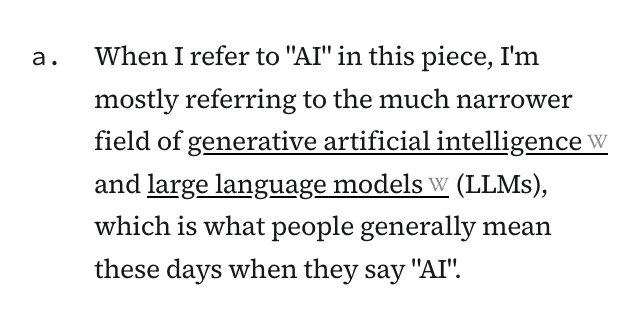
@TimWardCam indeed, and i have a footnote in the first sentence clarifying the terminology i use throughout the piece
 Jayne
Jayne@molly0xfff Your entire essay is excellent but especially salient point: "do we even want to be doing these things? If all you want out of a meeting is the AI-generated summary, maybe that meeting could've been an email. If you're using AI to write your emails, and your recipient is using AI to read them, could you maybe cut out the whole thing entirely?"
A thousand times yes!
 gretared
@molly0xfff add illegal in there and 💋
 Max S. New ⚜️
@molly0xfff surely blockchain costs were much worse in terms of energy usage though right?
 Alexander Dyas
@molly0xfff Excellent summary, thanks!
 9579cfc2-3e7d-35c7-af3b-cddda26f71bd
@molly0xfff
both of them are tools, but the truth is there's usually a better tool for the job, and the few things they are uniquely good at, aren't necessary something that is beneficial to society.
both of them are tools, but the truth is there's usually a better tool for the job, and the few things they are uniquely good at, aren't necessary something that is beneficial to society.
 LambdaDuck
@molly0xfff is think the way AI has been most “useful” is for churning out low quality garbage (slop) that you can fool people into clicking on to generate ad revenue. it’s not a good thing, but it’s something that people have managed to monetize. not sure how long time profitable it will be though.
it has also been fairly successful at deepfakes for scams as well. so i guess being most useful for scammers is another thing that it has in common with blockchain