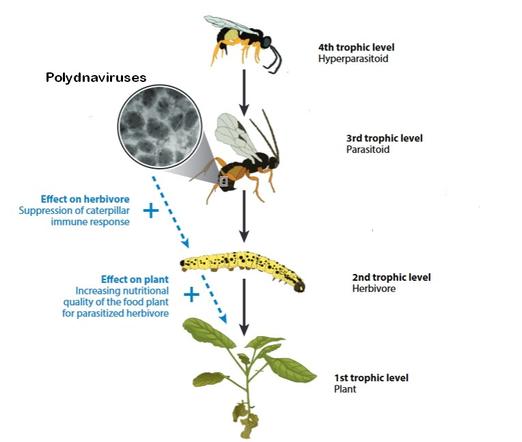
Some wasps are called 'parasitoids' because they lay their eggs in still-living caterpillars. The eggs develop into larvae that eat the caterpillar from the inside.

But turnabout is fair play. Sometimes, other wasps called 'hyperparasitoids' lay their eggs in the larvae of these parasitoids!

The caterpillars also fight back. Their immune system detects the wasp's eggs, and they will do things like surround the eggs in a layer of tissue that chokes them.

But many parasitoid wasps have a trick to stop this. They deploy viruses that infect the caterpillar and affect its behavior in various ways - for example, slowing its immune response to the implanted eggs.

These viruses can become so deeply symbiotic with the wasps that their genetic code becomes part of the wasp's DNA. So every wasp comes *born* with the ability to produce these viruses. They're called 'polydnaviruses'.

In fact some wasps are symbiotic with *two kinds* of virus. One kind, on its own, would quickly kill the caterpillar - not good for the wasp. The other kind keeps the first kind under control.

And I'm immensely simplifying things here. There are over 25,000 species of parasitoid wasps, so there's a huge variety of things that happen, which scientists are just starting to understand! I had fun reading this:

• Marcel Dicke, Antonino Cusumano and Erik H. Poelman, Microbial symbionts of parasitoids, Annual Review of Entomology, https://doi.org/10.1146/annurev-ento-011019-024939

Why such diversity? I think it's just that there are so many plants! So insect larvae like caterpillars naturally tend to feed on them... in turn providing a big food source for parasitoids, and so on.
@johncarlosbaez Nature is both horrifying and amazing at the same time.
@Lazarou - yes, it's horrifying when we imagine these things happening to us. But some of us reading and being horrified may be having breakfast, happily eating eggs. And all of us are full of microbes and viruses.

@johncarlosbaez

Somebody is going to use that plot twist in the next zombie movie.

@nyrath @johncarlosbaez Star Trek: Voyager ending does something a bit like that (not sure if the Borg count as zombies, but they sure are scary; in fact, they're about half as scary as these wasps).

@nyrath @johncarlosbaez

If I ever write a parody of The 3-Body Problem, the Trisolarians are just going to turn around and go back to their hell planet after they find out about the wasps. NOPE!

As much as I really like the idea of "downsizing", the basic problem is that wasps exist. NOPE!

@isaackuo @nyrath - and I didn't get into the wasps that use viruses to zombify the caterpillars!

"Other parasitoid-associated symbionts may also manipulate their insect host by infecting the host’s brain. For example, zombie-like behavior is displayed by some caterpillars attacked by braconid parasitoids. Pieris brassicae caterpillars protect their parasitoids after the parasitoid larvae have egressed from their caterpillar host by spinning a layer of silk over the parasitoid brood and wriggling intensively when enemies of the parasitoids approach the brood."

https://doi.org/10.1146/annurev-ento-011019-024939

@johncarlosbaez @isaackuo @nyrath Wasps are not the worst! Let me introduce you to Placobdelloides jaegerskioeldi, the hippo arse leech: https://www.wired.com/2015/08/absurd-creature-of-the-week-hippo-butt-leech-placobdelloides-jaegerskioeldi/

Animal behaviourists wondered why hippos expell their liquishit violently downriver and twirl their tails to fling it far away from them. The existence of a leech—which only feeds and reproduces in the warm moist interior of a hippo's rectum—provided the explanation. Can you imagine the itching?!?

Absurd Creature of the Week: Um, This Leech Feeds on Hippo Rectums

The year was 2003, and Mark Siddall was in South Africa a-hunting the elusive hippo rectum leech.

WIRED
@nyrath @johncarlosbaez Yeah, with all the wasps about, we’re lucky that none parasitize humans…yet.
Parasitoid wasp targeting humans: which tissue would they target?

Parasitoid wasps are kind of a nightmarish bug: they lay eggs in their target, usually a caterpillar; the eggs hatch and the larvae grow inside the body of the target, feeding on non essential tiss...

Worldbuilding Stack Exchange
@johncarlosbaez The funniest part is that this is just an example of something that "complex". A million lifetimes and we would still not catch up. The persistent phenomenon we call life is just damn mindblowing! And then some more

@johncarlosbaez

Given that pretty much all insect species, and beyond into spiders and more, are attacked by parasitoid wasps, and that for most hosts there are both host-specific and generic parasitoid wasp species, it’s been estimated that there are more parasitoid wasps than all other insect species combined. Their usually cryptic larval life stages and often brief adult stages may be behind the severe undercounting.

See:
"Quantifying the unquantifiable: why Hymenoptera, not Coleoptera, is the most speciose animal order", Forbes et al. 2018 https://doi.org/10.1186/s12898-018-0176-x

#wasplove #parasitoids #Hymenoptera

Quantifying the unquantifiable: why Hymenoptera, not Coleoptera, is the most speciose animal order - BMC Ecology

Background We challenge the oft-repeated claim that the beetles (Coleoptera) are the most species-rich order of animals. Instead, we assert that another order of insects, the Hymenoptera, is more speciose, due in large part to the massively diverse but relatively poorly known parasitoid wasps. The idea that the beetles have more species than other orders is primarily based on their respective collection histories and the relative availability of taxonomic resources, which both disfavor parasitoid wasps. Though it is unreasonable to directly compare numbers of described species in each order, the ecology of parasitic wasps—specifically, their intimate interactions with their hosts—allows for estimation of relative richness. Results We present a simple logical model that shows how the specialization of many parasitic wasps on their hosts suggests few scenarios in which there would be more beetle species than parasitic wasp species. We couple this model with an accounting of what we call the “genus-specific parasitoid–host ratio” from four well-studied genera of insect hosts, a metric by which to generate extremely conservative estimates of the average number of parasitic wasp species attacking a given beetle or other insect host species. Conclusions Synthesis of our model with data from real host systems suggests that the Hymenoptera may have 2.5–3.2× more species than the Coleoptera. While there are more described species of beetles than all other animals, the Hymenoptera are almost certainly the larger order.

BioMed Central
These Butterflies Full of Wasps Full of Microwasps Are a Science Nightmare

Accidentally released on a Finnish island 30 years ago, the parasites are spreading.

Atlas Obscura
@trashpanda_x @johncarlosbaez Fantastic! Reminds me of how the armored scale insects carry their bacterial symbionts:
https://www.ncbi.nlm.nih.gov/pmc/articles/PMC368156/
The Strange Case of the Armored Scale Insect and Its Bacteriome

Armored scale insects are unusual in that a part of their bodies is genetically distinct from the rest. This extraordinary phenomenon challenges the notion of identity

PubMed Central (PMC)
@johncarlosbaez I’ve known many Wasps over the years and I can affirm they are a parasitic bunch, occasionally decent, but more often than not they suck the blood out of most of the “other”.
@johncarlosbaez That is just mind-blowing. Such amazing complexity.

@michaelgemar - yes! Parasitoid wasp fossils have been found that are 47 million years old, so if they play this game once a year, all the players have had at least 47 million tries to develop their strategies... and their lives depend on getting good.

But it's possible they've been at it much longer! The earliest flowering plants are at least 130 million years old.

https://journals.plos.org/plosone/article?id=10.1371/journal.pone.0197477

Seven remarkable new fossil species of parasitoid wasps (Hymenoptera, Ichneumonidae) from the Eocene Messel Pit

Parasitoid wasps of the family Ichneumonidae are one of the most diverse and species-rich groups of organisms with a worldwide distribution. We here describe seven new ichneumonid fossil species and two new genera from a remarkable insect fossil site, the Eocene Messel Pit in Germany (~47Ma). The unique fossil preservation allows us to place five out of the seven new species unequivocally in extant subfamilies and genera. For the first time, lobed claws which are a clear synapomorphy for the subfamily Pimplinae, are observed in a fossil, making the newly described Scambus fossilobus sp. nov. the oldest unequivocal representative of the group. We also describe a fossil of Labeninae (Trigonator macrocheirus gen. et sp. nov.), an ichneumonid subfamily that was until now believed to be an exclusively Gondwanan element. Furthermore, the newly described Rhyssella vera sp. nov., Xanthopimpla messelensis sp. nov., and X. praeclara sp. nov. provide evidence that these extant genera date back as far as the Early/Middle Eocene. In contrast to the clear placement of most of the newly described species, we were unable to place Polyhelictes bipolarus gen. et sp. nov. and Mesornatus markovici gen. et sp. nov. in an ichneumonid subfamily, mostly due to the high levels of homoplasy found in this group. These findings on the one hand demonstrate the need for a more rigorous approach in the taxonomic placement of fossil ichneumonids, and on the other hand provide more precise minimum ages for several ichneumonid genera and subfamilies.

@johncarlosbaez nature and evolution is so incredibly interesting, but also really fucked up and weird at times.
@johncarlosbaez that DOI link failed to resolve, thanks for a more complete citation! https://doi.org/10.1146/annurev-ento-011019-024939
Microbial Symbionts of Parasitoids | Annual Reviews

Parasitoids depend on other insects for the development of their offspring. Their eggs are laid in or on a host insect that is consumed during juvenile development. Parasitoids harbor a diversity of microbial symbionts including viruses, bacteria, and fungi. In contrast to symbionts of herbivorous and hematophagous insects, parasitoid symbionts do not provide nutrients. Instead, they are involved in parasitoid reproduction, suppression of host immune responses, and manipulation of the behavior of herbivorous hosts. Moreover, recent research has shown that parasitoid symbionts such as polydnaviruses may also influence plant-mediated interactions among members of plant-associated communities at different trophic levels, such as herbivores, parasitoids, and hyperparasitoids. This implies that these symbionts have a much more extended phenotype than previously thought. This review focuses on the effects of parasitoid symbionts on direct and indirect species interactions and the consequences for community ecology.

@gretyl - thanks for catching that problem! I've fixed the link so it works now. Lots of people are liking and boosting this post but you seem to be the first one who liked it enough to read more. 😏