
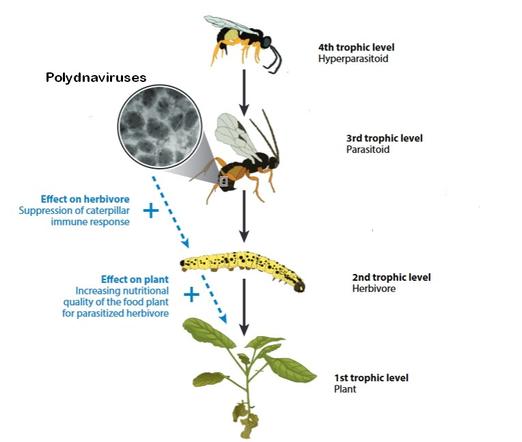
Some wasps are called 'parasitoids' because they lay their eggs in still-living caterpillars. The eggs develop into larvae that eat the caterpillar from the inside.

But turnabout is fair play. Sometimes, other wasps called 'hyperparasitoids' lay their eggs in the larvae of these parasitoids!

The caterpillars also fight back. Their immune system detects the wasp's eggs, and they will do things like surround the eggs in a layer of tissue that chokes them.

But many parasitoid wasps have a trick to stop this. They deploy viruses that infect the caterpillar and affect its behavior in various ways - for example, slowing its immune response to the implanted eggs.

These viruses can become so deeply symbiotic with the wasps that their genetic code becomes part of the wasp's DNA. So every wasp comes *born* with the ability to produce these viruses. They're called 'polydnaviruses'.

In fact some wasps are symbiotic with *two kinds* of virus. One kind, on its own, would quickly kill the caterpillar - not good for the wasp. The other kind keeps the first kind under control.

And I'm immensely simplifying things here. There are over 25,000 species of parasitoid wasps, so there's a huge variety of things that happen, which scientists are just starting to understand! I had fun reading this:

• Marcel Dicke, Antonino Cusumano and Erik H. Poelman, Microbial symbionts of parasitoids, Annual Review of Entomology, https://doi.org/10.1146/annurev-ento-011019-024939

Why such diversity? I think it's just that there are so many plants! So insect larvae like caterpillars naturally tend to feed on them... in turn providing a big food source for parasitoids, and so on.

@johncarlosbaez

Given that pretty much all insect species, and beyond into spiders and more, are attacked by parasitoid wasps, and that for most hosts there are both host-specific and generic parasitoid wasp species, it’s been estimated that there are more parasitoid wasps than all other insect species combined. Their usually cryptic larval life stages and often brief adult stages may be behind the severe undercounting.

See:
"Quantifying the unquantifiable: why Hymenoptera, not Coleoptera, is the most speciose animal order", Forbes et al. 2018 https://doi.org/10.1186/s12898-018-0176-x

#wasplove #parasitoids #Hymenoptera

Quantifying the unquantifiable: why Hymenoptera, not Coleoptera, is the most speciose animal order - BMC Ecology

Background We challenge the oft-repeated claim that the beetles (Coleoptera) are the most species-rich order of animals. Instead, we assert that another order of insects, the Hymenoptera, is more speciose, due in large part to the massively diverse but relatively poorly known parasitoid wasps. The idea that the beetles have more species than other orders is primarily based on their respective collection histories and the relative availability of taxonomic resources, which both disfavor parasitoid wasps. Though it is unreasonable to directly compare numbers of described species in each order, the ecology of parasitic wasps—specifically, their intimate interactions with their hosts—allows for estimation of relative richness. Results We present a simple logical model that shows how the specialization of many parasitic wasps on their hosts suggests few scenarios in which there would be more beetle species than parasitic wasp species. We couple this model with an accounting of what we call the “genus-specific parasitoid–host ratio” from four well-studied genera of insect hosts, a metric by which to generate extremely conservative estimates of the average number of parasitic wasp species attacking a given beetle or other insect host species. Conclusions Synthesis of our model with data from real host systems suggests that the Hymenoptera may have 2.5–3.2× more species than the Coleoptera. While there are more described species of beetles than all other animals, the Hymenoptera are almost certainly the larger order.

BioMed Central