I went down a Voyager rabbit hole again. And I came up with a factoid that entertains me.

The original Grand Tour program was canceled in late 1971, due to congressional pressure over cost. Voyager was the cheaper mission to just Jupiter and Saturn.

Voyager and its team are incredible, and they managed to pull off the entire grand tour anyway, and then 34 years and counting more science after that.

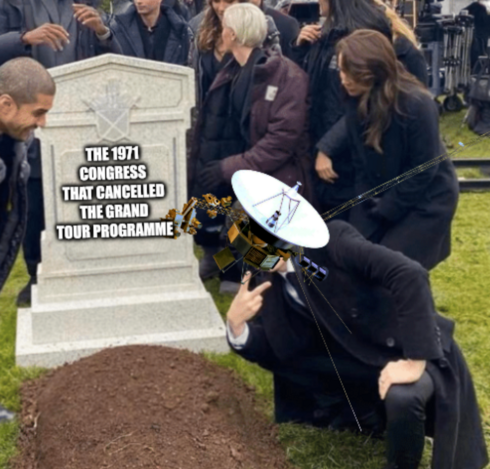
There's a good chance Voyager might outlive the entire congress that killed the grand tour.

It's not clinched yet, but of the 534 members of the congress who chose to pass on a once-in-history opportunity for exploration, 24 are still alive. And the actuaries don't have _great_ news for those who remain.

Meanwhile, the Voyagers have another 1-6 years of science mission left, and could well keep returning engineering data until 2036, at which point they'll be too far away for the DSN to communicate with them.

So... I'd say it's game on, really.

It's now definitely my tongue in cheek headcanon that the Voyagers in fact have two power sources on board: a radioisotope thermoelectric generator, but also a vast reservoir of pure spite that drives them to keep sending magnetometer readings for as long as the 92nd congress still bears witness.

The day after the last senator kicks the bucket, the DSN will receive a short, puzzling message: "No YOU'RE canceled. At last, we can rest."

@danderson
Hang on, I think I've got this....
@danderson @darac "We are the furthest manmade item from earth... how much further do you think we can get, and do you think someone from Ohio will be jealous how far we have managed to get away from Ohio..." ;)
@danderson This is a great theory! Wikidata knows about 476/535 members of the 92nd Congress, and all but 26 have died (it says 490 but that's because some members have multiple dates of death apparently): https://w.wiki/9U4S
@gaurav Strictly speaking it's 24 not 26, because 2 of the surviving members were elected after the decision to cancel the grand tour. I'm assuming that Voyager is a merciful god and doesn't hold a grudge against those two 😂
@danderson clearly the solution is to build an even bigger dish in orbit for twice the cost of the Voyager project to keep communications going just out of spite.
@Polychrome Correct. Disregard tradeoffs, build a dish the size of Texas.
@danderson @Polychrome but shouldn't the orbital dish be more sensitive than the terrestrial one? Away from the electromagnetic noise and air. So, it probably shouldn't be that big.
@bonkers @danderson @Polychrome
Let's build a refurbished Aricibo dish in a crater on the far side of the moon. That should avoid human interference pretty well.
@danderson that also says that the budget proposed for the original Grand Tour was greatly overestimated.

@hyc not so. Even though Voyager accomplished more than promised, it was still less than the original grand tour. Two spacecraft instead of four, a more limited set of science, and they had to drop Pluto from the tour, delaying it's observation until New Horizons 30 years later.

Voyager accomplished a lot with little, and should be celebrated for that... But we still lost out on what could have been.

@danderson *Almost the entire Grand Tour. It wasn't technically done until 2015, as Pluto was part of the original Grand Tour proposal.

Now if we can only get Congress to allow a return to Uranus...

@danderson I recall there was open talk from early on of routing Voyager 2 to Uranus and Neptune, but since they weren't official targets, they were prioritized below Titan--the line was that if Voyager 1 failed to get close pictures of Titan, Voyager 2 would be re-routed to get it at the expense of Uranus and Neptune.

Well, Voyager 1 did get close pictures of Titan but its atmosphere was frustratingly opaque to the instruments Voyager 1 had. Still, that was enough to go ahead to the outer planets with Voyager 2.

@danderson (Decades later, someone used heavy, heavy digital processing to extract what surface information they could from Voyager's Titan pictures and actually got blurry images of the brightness features now called Shangri-La and Xanadu, which I believe are thought to be a dune region and a highland. But they weren't identified from the photos at the time.)