Material Design

Build beautiful, usable products faster. Material Design is an adaptable system—backed by open-source code—that helps teams build high quality digital experiences.

Material Design

About a third of the way in, it just suddenly introduces "Serif or sans serif typefaces work well for headlines, especially at smaller sizes." from out of nowhere.

There is no introduction explaining categories of typefaces. And reading further doesn't clear matters up.

By contrast, here's a well written document that starts with "There are five basic classifications of typefaces:"
https://www.toptal.com/designers/typography/typeface-classification#:~:text=There%20are%20five%20basic%20classifications,are%20only%20used%20for%20headlines.
Understanding the Nuances of Typeface Classification | Toptal®

Virtually all designers, from brand designers to UI designers to dedicated typography designers, can benefit from expanding their knowledge of typography. Possibly with the exception of color, the typeface styles used in a design have a greater impact on user perception than virtually any other individual design ele...

Toptal Design Blog
To a naive reader, there are precisely two categories of fonts: "serif" and "sans serif" which meant that the Material Design article was nonsensical.

It'd be easy to _fix_ the m2 article by adding a paragraph explaining what world view it's envisioning. But there isn't any indication of how to provide feedback on this document.

#ShoutingToTheVoid

> Button text can be sentence case, sans serif, or serif.

This "sentence" needs a lot of love. Is "sentence case" another font family?

Is it saying button text must be "sentence case"?

Is it saying that you can only use sentence case if your font family is neither sans nor sans serif? (Or that you must choose sentence case if your font family is neither sans nor sans serif?)
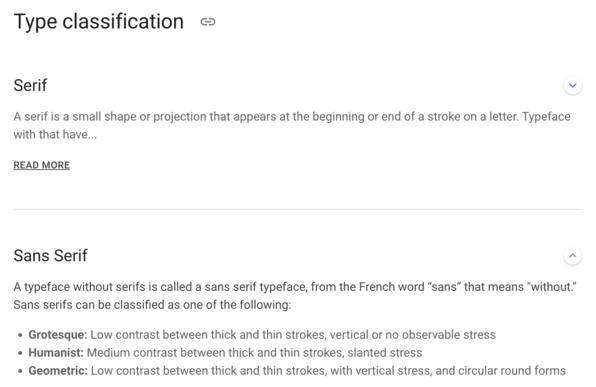
For the curious, the type classification stuff came _after_ the preceding article (which is a problem for people actually trying to read documentation according to its directed order!):
https://m2.material.io/design/typography/understanding-typography.html#type-classification
Material Design

Build beautiful, usable products faster. Material Design is an adaptable system—backed by open-source code—that helps teams build high quality digital experiences.

Material Design
Don't ask me why `Serif Fonts` and `Sans Serif fonts` are written the way they are here. It doesn't make any sense!
No, I can't explain why Sans Serif fonts, Monospace Fonts, Handwriting Fonts, and Display Fonts are in the Serif section under Type classification. But I can prove they are by collapsing the section!
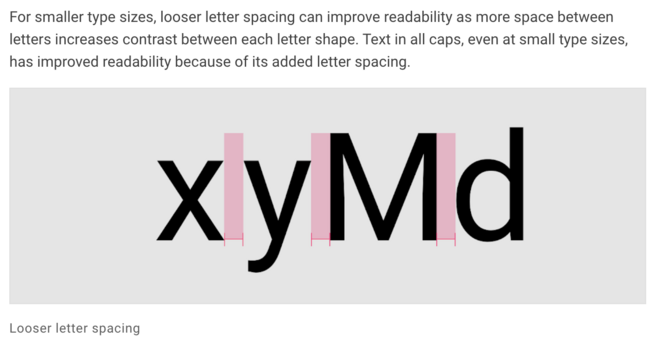
Here's a great example of an example not following the context of a document. Note that the pictured text is not in small caps and is not in uppercase: https://m2.material.io/design/typography/understanding-typography.html#readability
Material Design

Build beautiful, usable products faster. Material Design is an adaptable system—backed by open-source code—that helps teams build high quality digital experiences.

Material Design

@jsoref I'm not sure if I understand the complaint here. That image is one of a deliberate set of three, and the three of them together illustrate what is meant by more-or-less interletter space.

The surrounding text comments on 'some contexts where one or the other would be preferable' so to speak. But showing _every_ possible permutation would be cluttered, visually. I don't think the choice made for the page miscommunicates.


@n8 the last content in the paragraph talks about all caps, which means that's what the reader will be thinking about when they run into the picture.
@jsoref Well, that behavior might happen for a reader who reads that paragraph in isolation, but I do not agree that it's been established that a significant number of readers (or most) would interact with that paragraph without having read the preceding. It's not a glossary-entry format; I don't think you're applying the applicable tests here.
@n8 For the record, I'm reading this content start to finish, top to bottom. I've always been fairly literal and strict in my processing, but apparently I'm now in a new #a11y category...