"Uncertainty about the future and concerns about the ecological impact of the growing human #population were key factors also identified by research.

But concerns also differed in different parts of the world, Dillarstone said. “There was a concern that came out only in Zambia and Ethiopia, which was about a family’s ability to subsist and acquire resources,” she said."
https://www.theguardian.com/environment/2023/nov/09/more-people-not-having-children-due-to-climate-breakdown-fears-finds-research

More people not having children due to climate breakdown fears, finds research

Analysis finds concerns about environment key factor in having fewer or no children – but reasons differ around world

The Guardian

Back in the 1960s and 1970s, the "population bomb" was a Thing.
Now, not so much.

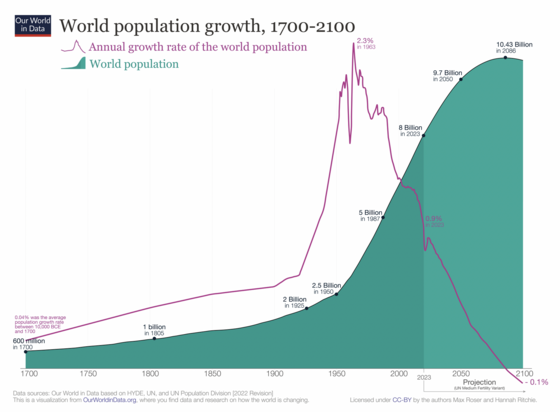
Yes, the world population is still growing. But the *rate* of growth is decreasing fast, and most demographers predict a population peak this century.

One of the best places for a reality check is this #OurWorldInData page:
https://ourworldindata.org/population-growth

Includes a link to visualisations, some interactive.

https://ourworldindata.org/population-growth-over-time

Population Growth

Explore global and national data on population growth, demography, and how they are changing.

Our World in Data

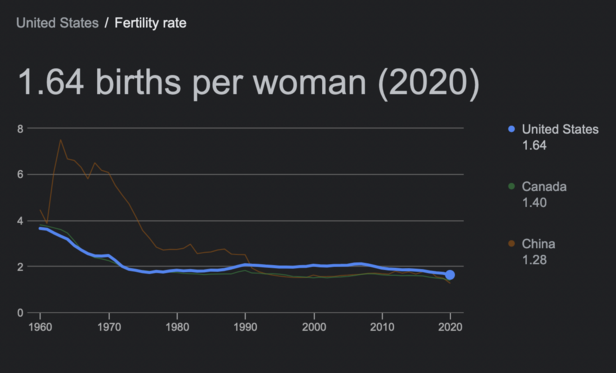
Population growth varies across the planet. You can look it up for a specific place by searching for #TotalFertilityRate (the average number of babies per woman) for that place.

The graph below shows that TFR is
1.64 United States
1.40 Canada
1.28 China

For a stable population, TFR = 2.1. Meaning, the US population is growing slightly only because of immigration.

In South Korea, TFR = 0.84.

I learned about population, growth, and total fertility rate from this TED talk by the late Hans Rosling, a scientist with an irrepressible way of talking about statistics as not only interesting but exciting and funny.

It's from 2006 but the trends in population growth have continued since then.

https://www.ted.com/talks/hans_rosling_the_best_stats_you_ve_ever_seen?language=en

Hans Rosling: The best stats you've ever seen

TED

Global Population Crash Isn't Sci-Fi Anymore

"The European Commission’s Centre of Expertise on #Population and Migration projects that the global population will peak at 9.8 billion in the 2070s.

It is simply because, all over the world, the #TotalFertilityRate (TFR) — the number of live children the average woman bears in her lifetime — has been falling since the 1970s. In one country after another, it has dropped under the 2.1 value of the 'replacement rate'."

https://www.bloomberg.com/opinion/articles/2024-03-10/global-population-collapse-isn-t-sci-fi-anymore-niall-ferguson

Global Population Collapse Isn't Sci-Fi Anymore: Niall Ferguson

We used to worry about the planet getting too crowded, but there are plenty of downsides to a shrinking humanity as well.

Bloomberg
@CelloMomOnCars I don’t see this as a bad thing at all. Can’t grow the population on this planet forever

@glasspusher

There are still people shouting "Overpopulation!!" and calling for birth control, like it's still the 1970s.

Things have changed since then. One could wish it happened one generation earlier, but here we all are, we'll have to make the best of it together.

The change won't come without some pain. Certain things are planned *assuming* a growing population, e.g. pay-as-you-go social security.

@CelloMomOnCars yeah, don't want to turn it off like a switch, but imagine a world with 2 billion people with a decent standard of living and all being able to contribute…

Turning the ship around should not be done abruptly, but it should be done.

@glasspusher

But that's exactly the point of this article: once TFR < 2 the population can go down as quickly as it went kablooie during the "population bomb".

And TFR = 1.7 in the US
1.5 in Europe
1.3 in China.

It will go pretty fast once it kicks in.

@CelloMomOnCars It’ll be interesting to see. I remain skeptical that it’ll go poof as quickly as it went kablooie, but being an expert in that ain't my jam, so I guess I'll watch from the sidelines.

When have we ever been good, as a species, at a smooth landing? 😉

@glasspusher

The time scale is a generation, so 2-3 decades, a time scale that makes it hard to plan. Until one day we wake up and the whole place looks like those deserted villages in Italy or Japan today: lots of empty houses, and the ones that are occupied have mostly older people living in them. Who will take care of them?

@CelloMomOnCars

Any dislocation in demographic distribution is going to require a change. 150 years ago we started addressing infant and childhood mortality. Now we're going to have to deal with taking care of an aging population.

Who's taking care of our aging population now? It's a, pardon the term, growth industry.

https://finance.yahoo.com/news/us-elderly-care-market-reach-185000100.html

The US Elderly Care Market to Reach Revenue of Over USD 651.48 Billion by 2029, More than $200 Billion Opportunities in the Next 6 Years - Focus Report by Arizton

According to Arizton's latest research report, the US elderly care services market will grow at a CAGR of 6.15% from 2022 to 2029.

Yahoo Finance

@glasspusher

Yes, and that change will not come without pain. Japan is so desperate that they've even allowing an increase of work permits for - gasp - foreigners ! as caretakers for older people.
They're SO desperate that they're even encouraging women to join the workforce. Women!

In the US, we should all be watching in fear and trepidation while private equity takes over elderly care homes. Expect tragic outcomes, not too long from now.

@CelloMomOnCars

I wouldn't wish private equity takeovers on anyone or any industry.

Japan is doing something about their situation. That’s a positive.