Thread of papers from last boost: https://astrodon.social/@TMEubanks/111869966667933015

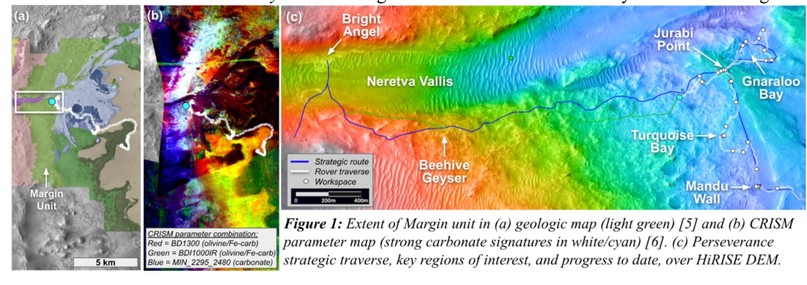
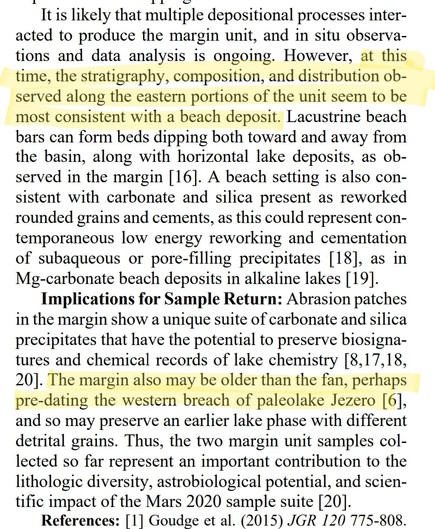
Horgan et al, "Campaign Overview and Initial Results from Exploration of the Margin Unit in Jezero Crater by the Perseverance Rover"
https://www.hou.usra.edu/meetings/lpsc2024/pdf/2624.pdf
#JezeroDeltaScience

Marshall Eubanks (@[email protected])

LPSC program is now out with abstracts https://www.hou.usra.edu/meetings/lpsc2024/program/
Astrodon - The Astro Community

Fries: "Will MSR Samples Cached on the Martian Surface Experience Significantly Greater Thermal Degradation than Samples Retained in the Rover?"
https://www.hou.usra.edu/meetings/lpsc2024/pdf/2244.pdf

"The Mars 2020 rover collects samples for Mars Sample Return (MSR). Half are stored in the rover and half on the ground. This paper explores reaction rates within the samples. Samples stored on the ground can see significantly faster reaction rates."

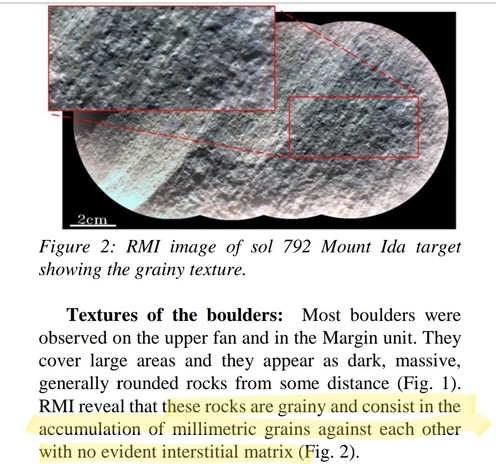
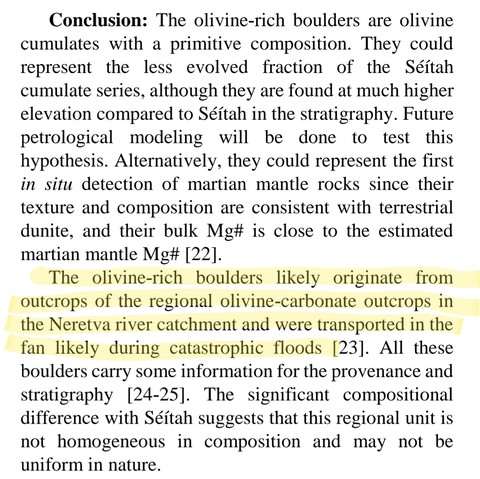
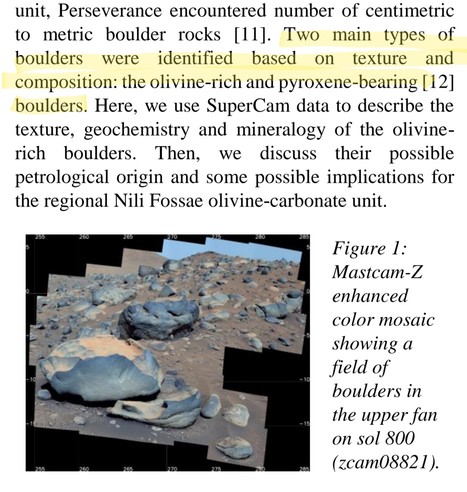
Beyssac et al : "What Are the Olivine-Rich Boulders in the Upper Fan and Margin Unit at Jezero Crater, Mars?"
https://www.hou.usra.edu/meetings/lpsc2024/pdf/1493.pdf

"We detail the chemistry and mineralogy of olivine-rich boulders found on the upper fan at Jezero Crater using SuperCam data. These rocks are an olivine-rich cumulate and we discuss their origin."

#JezeroDeltaScience

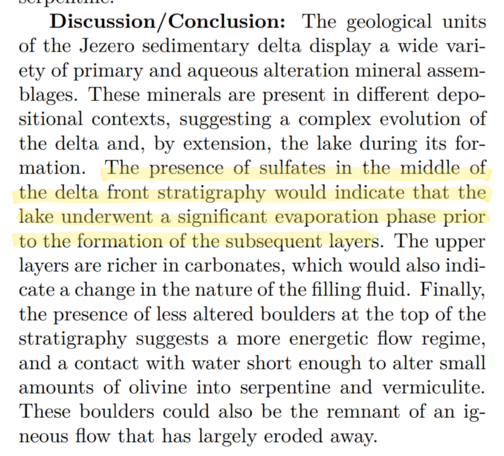
Royer et al : "Mineral Composition of Jezero Crater Western Fan Derived by SuperCam/Mars2020 Infrared Spectroscopy and Spectral Modeling"
https://www.hou.usra.edu/meetings/lpsc2024/pdf/1370.pdf

#JezeroDeltaScience

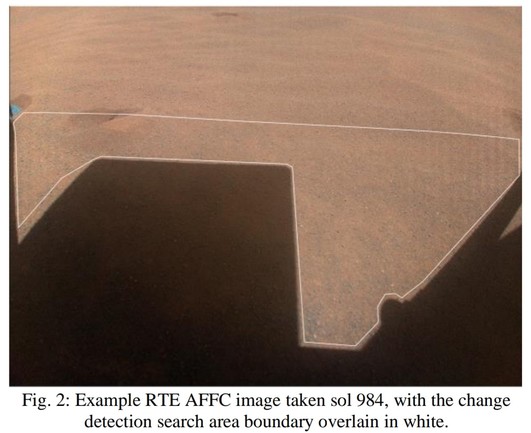
One for #Ingenuity in the "Active Mars: Winds, Flows, and Gravity" session (https://www.hou.usra.edu/meetings/lpsc2024/technical_program/?session_no=652), haiku included 😀

Williams et al: "Aeolian Change Detection Experiment by the Mars Helicopter Ingenuity"
https://www.hou.usra.edu/meetings/lpsc2024/pdf/2681.pdf

"Mars Heli watches / Wind blowing sand particles / And cleaning off dust."
LPSC 2024 - Lunar and Planetary Science Conference

The 55th Lunar and Planetary Science Conference (LPSC) will be held on March 11‒15, 2024.

LPSC 2024 - Lunar and Planetary Science Conference

Another spin on the margin unit composition and formation (re: 1st thread post), coming from a completely different conference session, Organic and Inorganic Carbon on Mars (https://www.hou.usra.edu/meetings/lpsc2024/technical_program/?session_no=452)

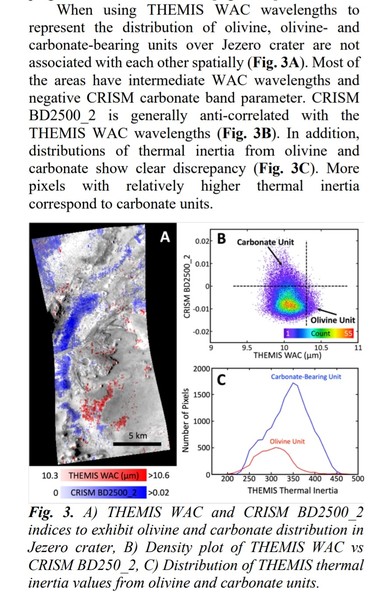
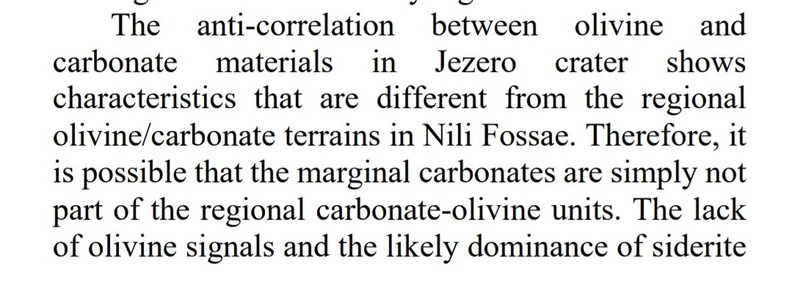
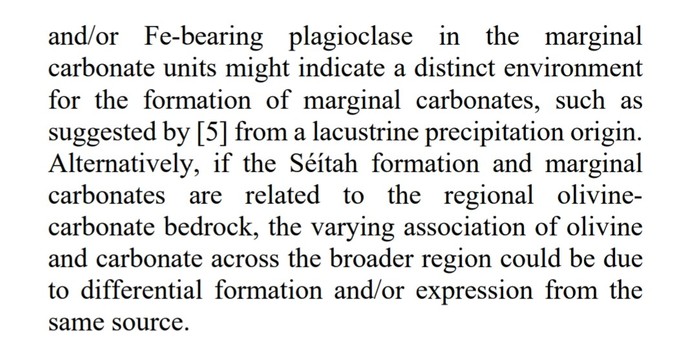
Ye et al: "Anti-Correlation Between Olivine and Carbonate Enrichments in Jezero Crater from Orbital Observations"
https://www.hou.usra.edu/meetings/lpsc2024/pdf/2381.pdf

#JezeroDeltaScience

LPSC 2024 - Lunar and Planetary Science Conference

The 55th Lunar and Planetary Science Conference (LPSC) will be held on March 11‒15, 2024.

LPSC 2024 - Lunar and Planetary Science Conference

Mineral-rich (pun intended) one page summary of PIXL data

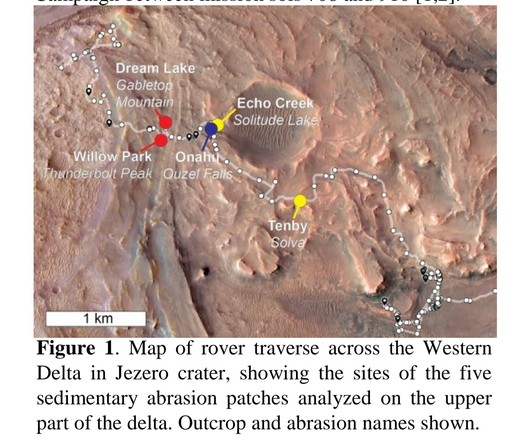
Tice et al: "Regional Paleoenvironments Recorded in Sedimentary Rocks of the Western Fan-Delta"
https://www.hou.usra.edu/meetings/lpsc2024/pdf/2181.pdf

"Delta sands reveal / Jezero climate deltas / Ancient drying lakes."

#JezeroDeltaScience

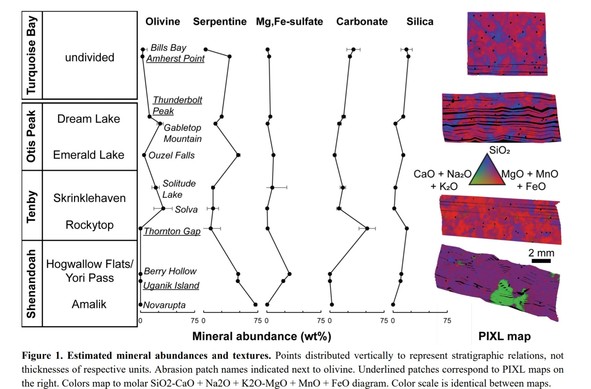
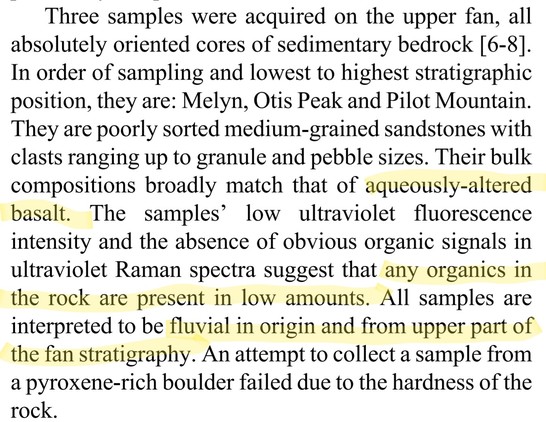
More PIXL for the upper delta, summarized in one sentence: "Upper Fan sedimentary rocks originate from a slightly altered olivine-rich basaltic protolith and are cemented by Fe-Mg carbonates, sulfates, and silica."

Siebach et al: "PIXL Analyses of Sedimentary Rocks in the Mars 2020 Perseverance Upper Fan Campaign in Jezero Crater"
https://www.hou.usra.edu/meetings/lpsc2024/pdf/2365.pdf

"Jezero delta / Olivine-rich sands glued by / Salts, altered products."

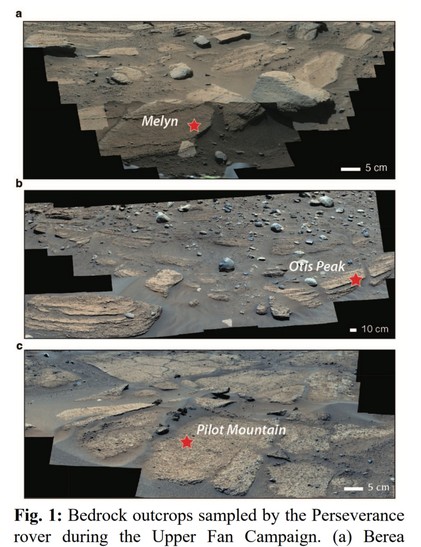
Preliminary analysis of the samples picked on that same region.

Weiss et al: "Perseverance Samples from the Jezero Upper Fan"
https://www.hou.usra.edu/meetings/lpsc2024/pdf/1843.pdf

"Perseverance samples of the upper Jezero fan contain materials from the earliest period of martian history and the youngest fluvial activity in the crater."

Mid-thread intermission!!!

Disclaimers:

- #IAmNotAGeologistTMBut
- these are preliminary summaries for a conference, peer-review unknown
- the press release headlines when LPSC starts will most likely tell a completely different story (hype? 😉)
- the thread is for my own reference, but it hopefully helps you too
- adding them in no specific order, I have a long backlog to go through yet

Still haven't even gotten to the session I'm most interested in, sediments & stratigraphy 😀

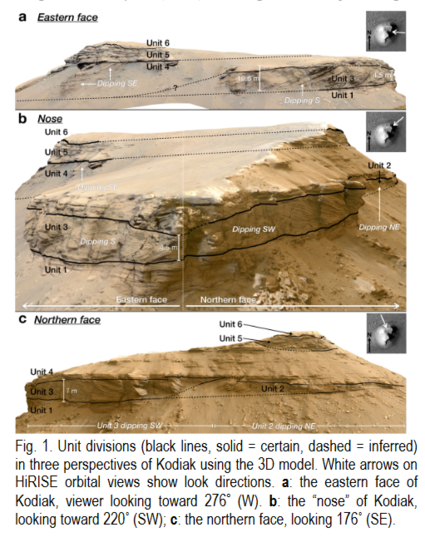
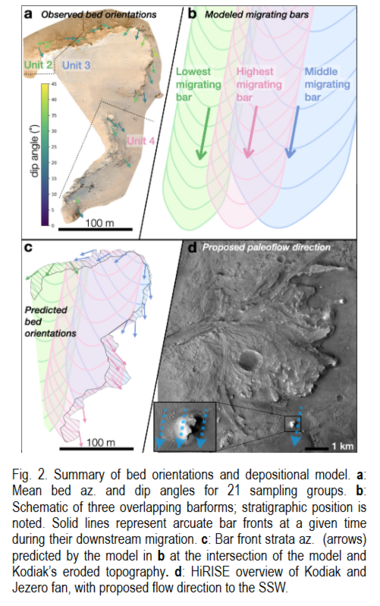
I'm still on this thread (conf not coming until mid March), but I got kind of shocked by this one on #KodiakButte, and ended up in a rabbit hole, still grokking it 😉

Kanine et al: "Paleoenvironmental Analysis of Jezero Crater, Mars from Stratigraphy and Sedimentology of Kodiak Butte"
https://www.hou.usra.edu/meetings/lpsc2024/pdf/1211.pdf

A Kodiak 3D model
https://skfb.ly/oB6r8

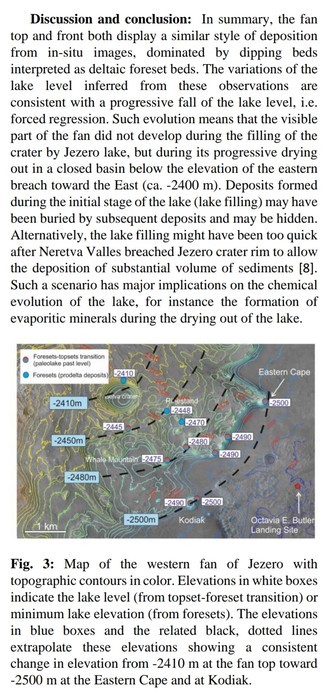
Another one doumbfounding me quite some

Mangold et al: "Past Variations of Water Level of Jezero Paleolake"
https://www.hou.usra.edu/meetings/lpsc2024/pdf/1555.pdf

"Geometries of topset and foreset strata observed on the front and top of Jezero crater western fan are typical of progradation during forced regression due to the decrease of the water level"

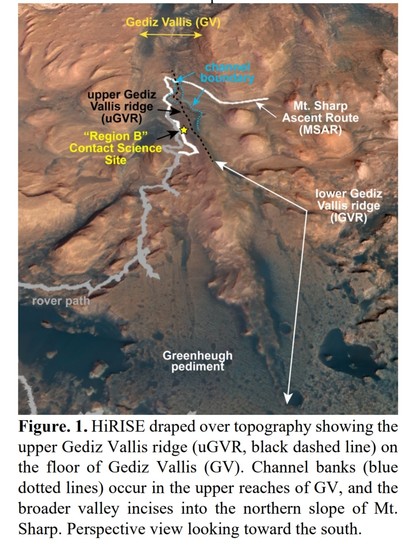
The sedimentary session (https://www.hou.usra.edu/meetings/lpsc2024/technical_program/?session_no=602) is mostly about Gale. I don't follow Curiosity as much, so I enjoyed this view of the recent traverse to grasp the geological context.

Wilson et al : "The Nature and Location of the Upper Gediz Vallis Ridge Basal Contact in Gale Crater"
https://www.hou.usra.edu/meetings/lpsc2024/pdf/2224.pdf

LPSC 2024 - Lunar and Planetary Science Conference

The 55th Lunar and Planetary Science Conference (LPSC) will be held on March 11‒15, 2024.

LPSC 2024 - Lunar and Planetary Science Conference

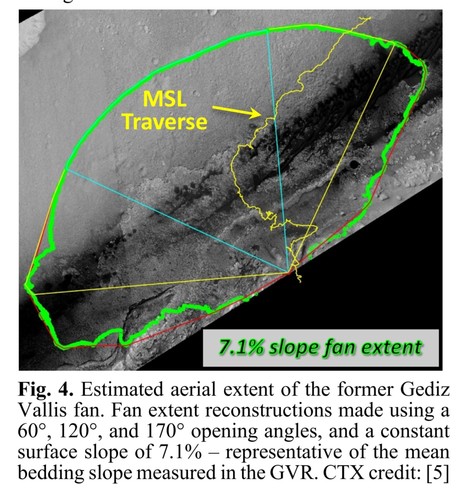
Estimated Gediz Vallis alluvial fan, emanating from Mount Sharp towards the crater floor and long eroded by winds

Bryk et al: "In Situ Investigations of the Gediz Vallis Ridge: A Remnant Late-Stage Debris Flow Dominated Fan Deposit in Gale Crater"
https://www.hou.usra.edu/meetings/lpsc2024/pdf/1770.pdf

Look around in MUTED https://muted.wwu.de/?x=137.380&y=-4.751&z=36.3&d=102

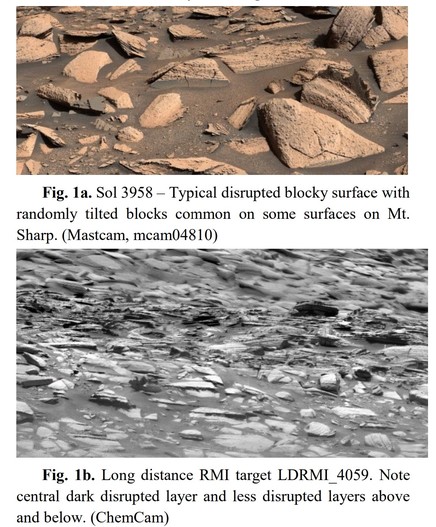
This one lists possible processes for those tilted blocks Perseverance has also seen (https://mastodon.social/@sharponlooker/111965398862530418)

Newsom et al: "Gale Crater Block Fields — Role of Dissolution & Other Processes"
https://www.hou.usra.edu/meetings/lpsc2024/pdf/2156.pdf

"Some exposed stratigraphic layers in Gale crater, Mars, consist of tilted blocks of formerly flat-lying sediments. The processes responsible could involve a combination of dissolution, periglacial, aeolian lag formation, & lacustrine wave action."

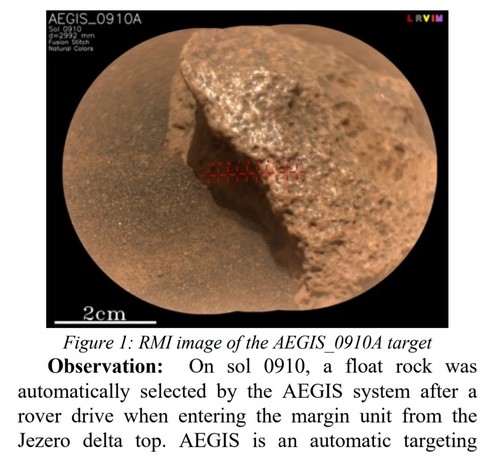
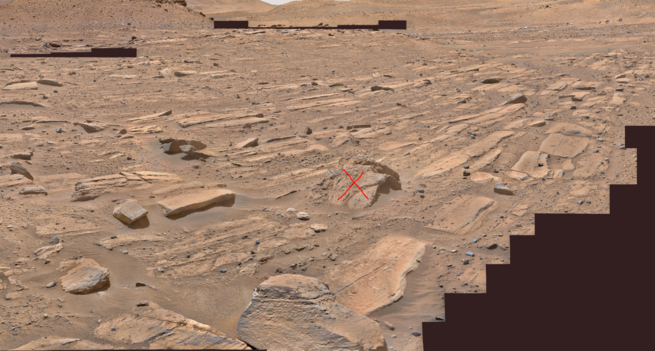
This rock photographed by Perseverance recently, was special enough to deserve its own paper

Beck et al : SuperCam Detections of Hydrated-Silica in the Jezero Crater 
https://www.hou.usra.edu/meetings/lpsc2024/pdf/1304.pdf

"We present the identification of a hydrated-silica rich float rock by SuperCam within the Jezero crater."

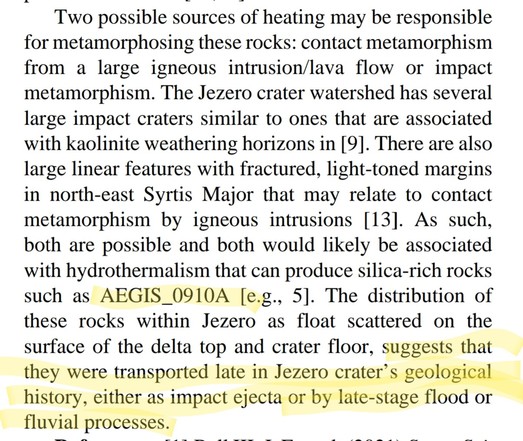
... and it's also highlighted here

Beck et al: "Discovery of Light-Toned Float Rocks in Jezero Crater: A Tale of Aqueous Alteration and High-Temperature Metamorphism"
https://www.hou.usra.edu/meetings/lpsc2024/pdf/2221.pdf

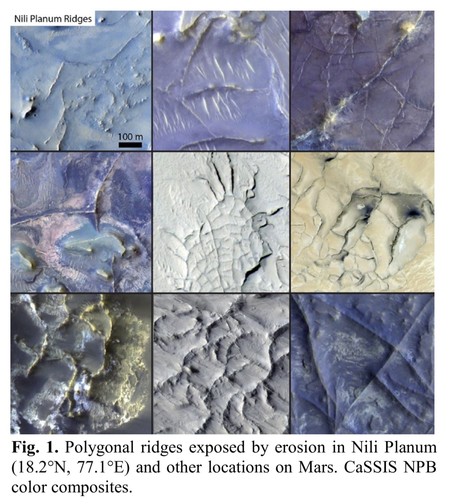
Interesting one, Perseverance may visit polygonal ridges after leaving Jezero. This reminds me of the Zooniverse "Planet Four: Ridges" project, @megschwamb , were there any results published?

Valantinas et al : "‘Windows’ into Mars’ Potentially Habitable Subsurface in the Context of NASA’s Perseverance Extended Mission"
https://www.hou.usra.edu/meetings/lpsc2024/pdf/2377.pdf

"We explore the potential of ancient biosignatures in Nili Planum and on Mars by studying polygonal ridges using deep learning and spectroscopy."

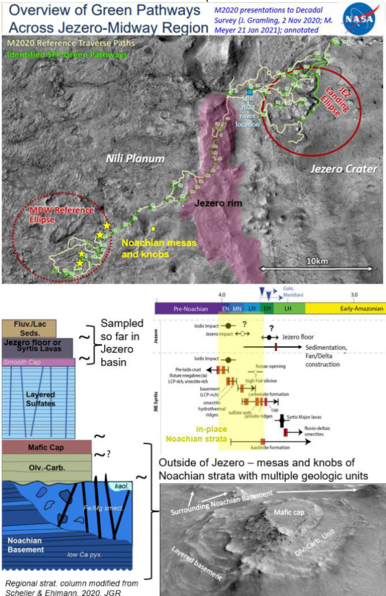
Banging the drum for the necessity of continuing the sampling outside of Jezero and making sure MSR goes all the way, despite difficulties.

Ehlmann et al: "Decadal Science from Mars Sample Return: The Importance of Sampling In-Place Nili Planum Noachian Strata Accessible Outside Jezero Crater for Priority Planetary Science Questions"
https://www.hou.usra.edu/meetings/lpsc2024/pdf/2599.pdf

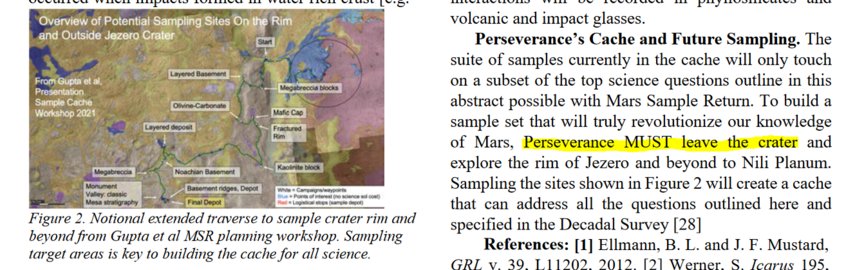
Another one in the same theme

Mustard J. F. : "Critical Geologic Record of the First Billion Years of Mars History Accessible by Perseverance for Mars Sample Return"
https://www.hou.usra.edu/meetings/lpsc2024/pdf/2079.pdf

"The suite of samples currently on Perseverance will only touch on a subset of the top science questions possible from the site. The set that will truly revolutionize Mars science MUST include samples from Jezero’s rim and beyond to Nili Planum. "

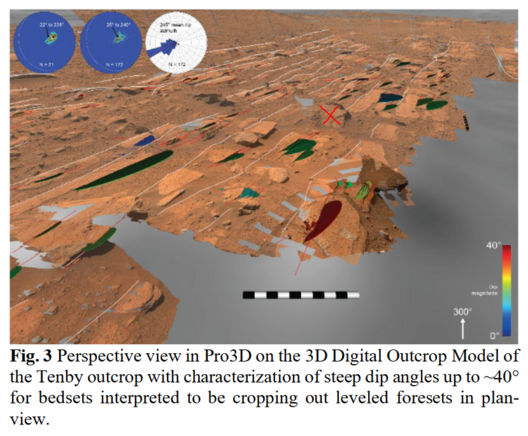
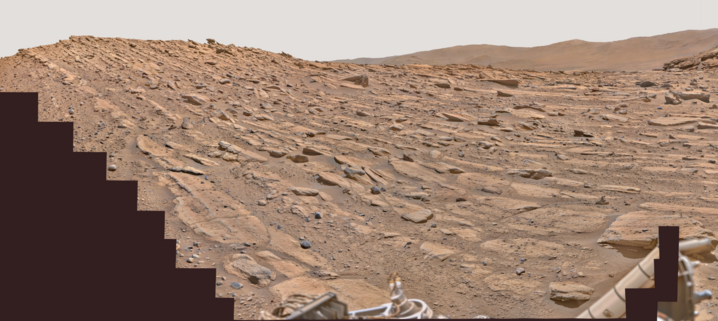
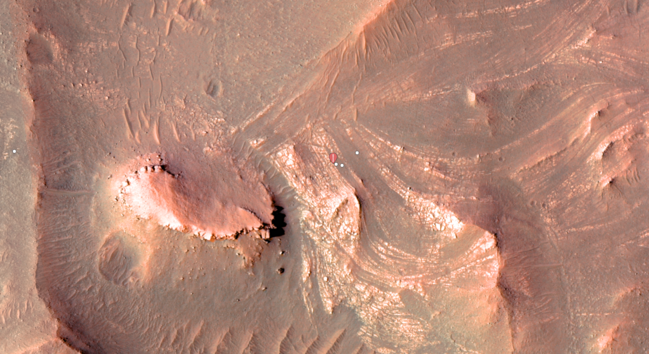
Another shock for me. Having read interpretations of the "curvilinear unit" based on space observations (https://mastodon.social/@sharponlooker/110924062453366227), it took me a while to grasp what this paper says abt Tenby

Caravaca et al: SURFACE EXPRESSION AND GEOMETRIES OF DELTAIC DEPOSITS OF JEZERO WESTERN FAN TOP
https://www.hou.usra.edu/meetings/lpsc2024/pdf/1246.pdf

In the absence of the 3D model, I looked at the same spot in NeV-T's gigapan (http://www.gigapan.com/gigapans/232028), and only by looking towards the opposite direction, does the penny start to drop.

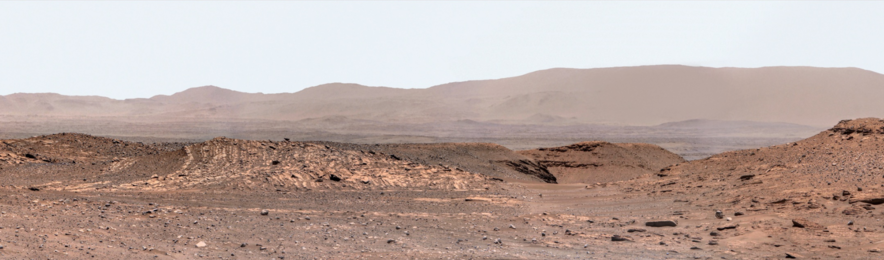
Another context view, snapshot of @NeV_T 's gigapan for sol 762. The top of Kodiak is also visible in the background

http://www.gigapan.com/gigapans/232177

PERSEVERANCE 762-E

PERSEVERANCE 762-E © NASA/JPL-Caltech/MSSS/ASU/NeV-T Gigapan - http://www.gigapan.org/gigapans/232177 GIGAmacro - https://viewer.gigamacro.com/view/vRK5e4QzYhsVFkyT?x1=58711.60&y1=-7219.96&res1=42.79&rot1=0.00 Flickr - https://www.flickr.com/photos/nev-t/52816048910/sizes/6k/ Raw Images - https://mars.nasa.gov/mars2020/multimedia/raw-images/?order=sol+desc%2Cinstrument_sort+asc%2Csample_type_sort+asc%2C+date_taken+desc&per_page=50&page=0&mission=msl&begin_sol=...

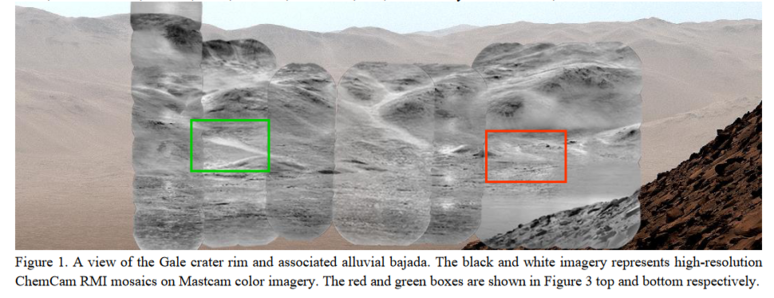
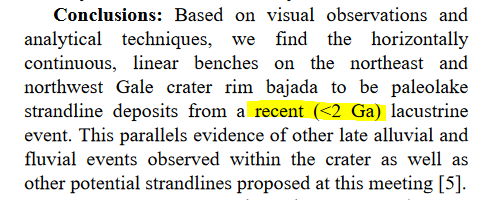
Here's a potential improvement target for image wizards, that mosaic of Curiosity's RMI snaps could be better?

Gallegos et al: "Evidence of strandlines from a late lacustrine event within Gale crater"
https://www.hou.usra.edu/meetings/lpsc2024/pdf/2556.pdf

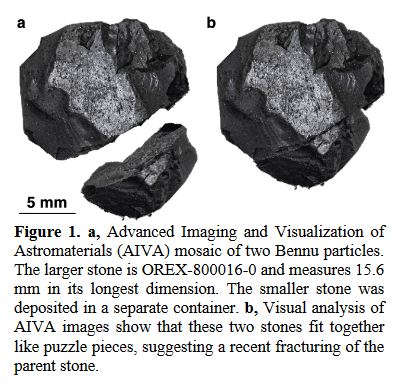
Who said it's nice and cozy inside those sample return capsules? 🙃

Ballouz et al: "Investigating the Physical Modification of the Bennu Sample During Entry, Descent, and Landing"
https://www.hou.usra.edu/meetings/lpsc2024/pdf/2346.pdf

I think I went through all the papers I wanted covered, from now on, it's peer-reviewed research 😉

https://mastodon.social/@sharponlooker/111965338761963638

For LPSC completeness, here's the Lucy/Dinkinesh thread

https://mastodon.social/@sharponlooker/111884612490841560

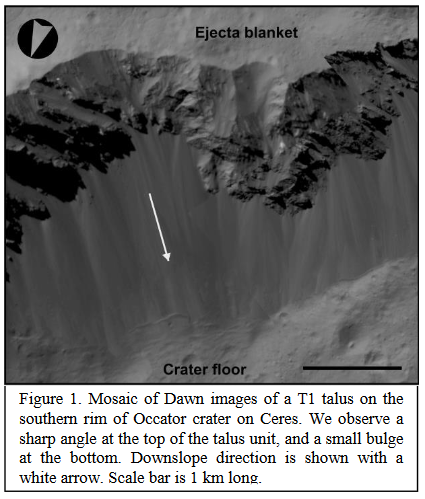
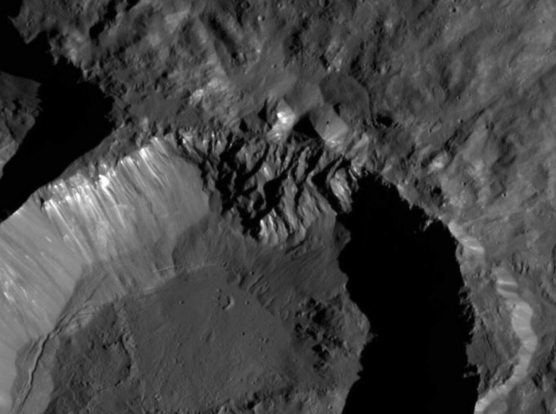
Let me finish this #LPSC2024 thread with a #DwarfPlanetCeres paper, covering features I always found amusing in #DawnMission photos. Attached is one of my favs, in Kupalo crater (right "besides" Juling) https://photojournal.jpl.nasa.gov/jpeg/PIA20944.jpg

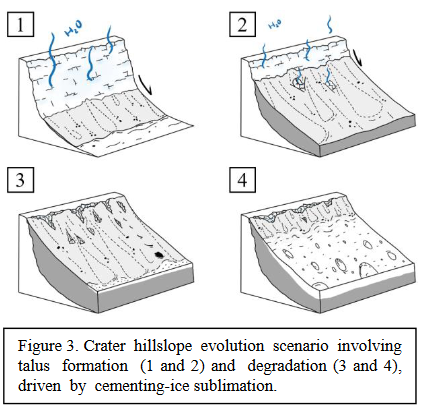
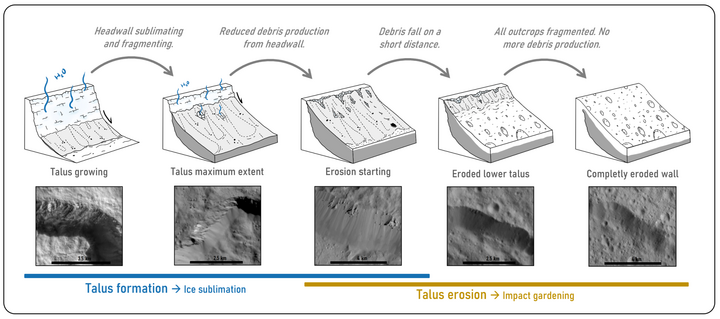
Le Becq et al: "A new model of crater degradation on Ceres involving ice sublimation"
https://www.hou.usra.edu/meetings/lpsc2024/pdf/1195.pdf

Thread start: https://mastodon.social/@sharponlooker/111870153396426610

Another Le Becq's summary of this new model, now on "Planetary Geomorphology Image of the Month"

https://planetarygeomorphology.wordpress.com/2024/04/02/the-effect-of-ice-on-the-degradation-of-impact-craters-on-ceres/

#DwarfPlanetCeres

The effect of ice on the degradation of impact craters on Ceres

Post contributed by Noé Le Becq, PhD candidate, Laboratoire de Planétologie et Géosciences, Nantes (France) Ceres was discovered in 1801 by Giuseppe Piazzi and is located in the main asteroid belt …

Planetary Geomorphology Image of the Month