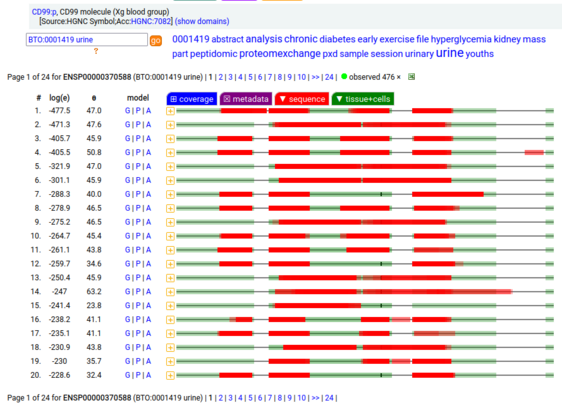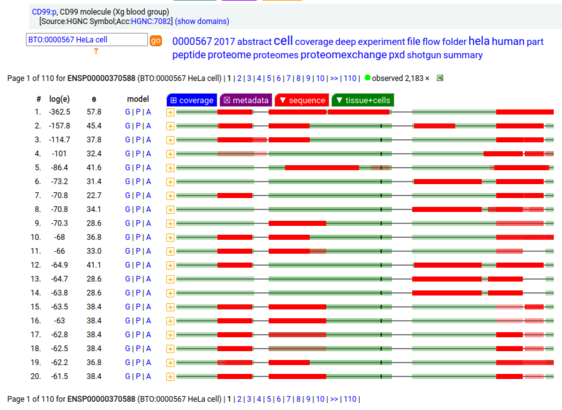
Part of the largely forgotten XG blood group of antigens, this one is a type I membrane protein without any extracellular structure. Signal peptide: (1-21); extracellular region: (22-125); TM domain (126-148); intracellular ST-phospho-IDR (149-185); T41, S48+glycosyl. The soluble form in urine has no signals cward of V135.

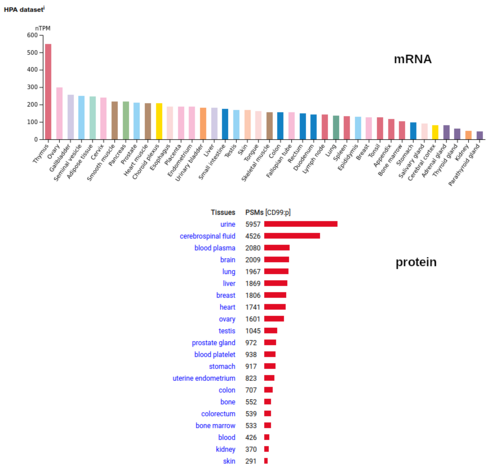
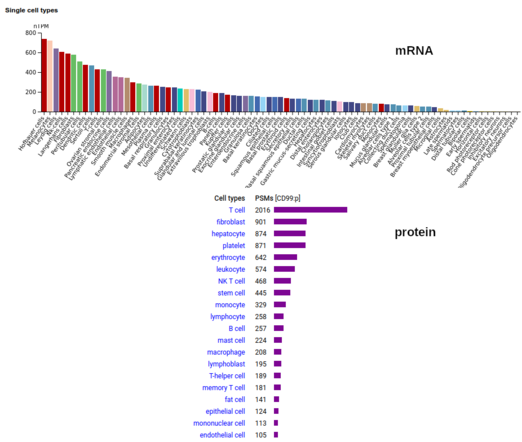
Human cluster of differentiation member 99 (#CD99:p)―HPA mRNA tissue + cell type distributions & GPMDB protein tissue + cell type tabbulations. #proteomics #sources_sinks
The coverage diagrams for "urine" vs "HeLa" demonstrates a soluble form that is truncated at the TM domain. The TM domain here is part of an observable tryptic peptide (117-150) that is eluted just before the gradient ends in many common LC methods:

k . EGEEADAPGVIPGIVGAVVVAVAGAISSFIAYQK . k

CD99 has produced quite a bit of phenomenology in the 'zines, although the details of its function remains illusive. It belongs to the small subset of human genes that are pseudoautosomosal: there is a good copy of the gene on both the X & Y chromosomes. https://pubmed.ncbi.nlm.nih.gov/?linkname=gene_pubmed&from_uid=4267
PubMed for id: 4267 - Search Results - PubMed

PubMed for id: 4267 - Search Results - PubMed

PubMed
It may be worth noting that the other Xg blood group antigen (XG:p) has never been detected using MS/MS proteomics methods on any cell type, except for a small number of very weak signals from fibroblast samples.