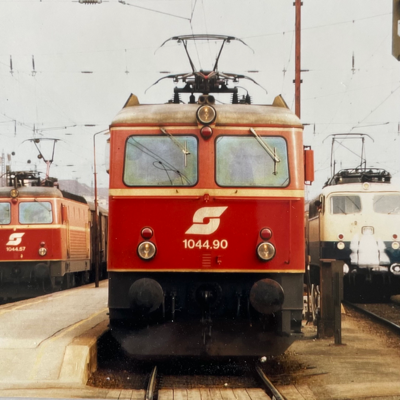
A photo taken one evening at #Dijon 🇫🇷 in August 2019: an #SNCF #BB22200 dual-voltage electric and a rake of #Corail carriages forming a #TER regional train. 40 years earlier these “Nez cassé” locos and Corail cars could be seen on the country’s most prestigious #Rapide services.
@andreaswiedenhoff It’s not just me, this pantograph arrangement is weird, right?
@partim @andreaswiedenhoff that's normal under 1,5 kV (direct current). Due to the high intensity of current, locos need to accelerate from 0 km/h with two pantos up.
@claudsch @andreaswiedenhoff I was thrown by both pantographs pointing the same direction. I’m used to the double pantograph from the Dutch 1700.
@partim @claudsch @jon the front pantograph is for use under 1.5 kV DC, the rear one for 25kV AC. When starting to move under 1.5kV DC with a heavy payload, both pantos are up for the first few metres. (Afterwards only the DC one is operating, Dijon being electrified with 1.5kV DC.) The NS 1600/1700/1800 are 3kVDC only, like the SNCF BB7200, single-voltage only (1.5 kvDC).
@andreaswiedenhoff We know that :-) We wonder why one pantograph is backwards. @partim @claudsch (and I spend a lot of time changing trains in Dijon, so have seen this plenty)
@jon @partim @claudsch sorry Jon, I only saw your post after having typed my reply ... and yes, I know you are a Dijon "frequent traveller" ;-)
@andreaswiedenhoff @partim @claudsch My suspicion is it must be that some of the dual voltage equipment on the roof limits space for the mounting of what's normally the ac pantograph, and hence on that series it is mounted backwards. On later BB26000 and BB36000 it is not the case.
@jon @andreaswiedenhoff @claudsch It’s weird that none of the Wikipedia articles find this worth mentioning.