
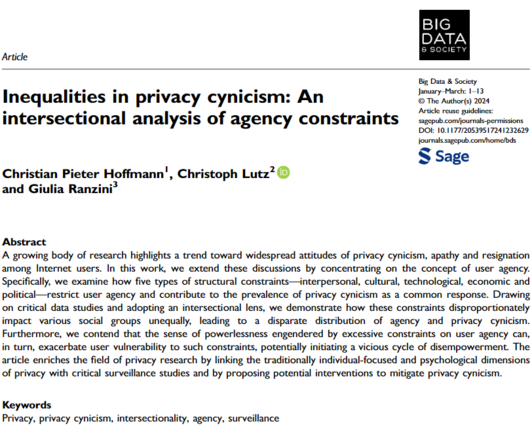
✨ Excited to share our new paper, "Inequalities in Privacy Cynicism: An Intersectional Analysis of Agency Constraints," which was just published in Big Data & Society!

Christian P. Hoffmann, Giulia Ranzini and I examine how structural constraints limit user agency, leading to widespread privacy cynicism. Using an intersectional lens, we show the unequal impact constraints have on different social groups, thus shaping digital inequality. The article is freely available: https://lnkd.in/ehAYBT3B

LinkedIn

This link will take you to a page that’s not on LinkedIn

@lutzid
A fascinating read. Refreshing to see the subject of privacy discussed with a level of abstraction that I feel is sorely lacking in popular discourse. It certainly helped me get a grip on some amorphous ideas that have been rattling around my brain for a while.

Your reasoning seems solid, and I think there's opportunity for empirical testing. If I understand correctly, agency should be correlated to making decisions according to privacy calculus, and I suspect that it would be possible to distinguish aspects of privacy calculus along social, technological, economic axes.

I would expect that people with a lot of —for instance— financial agency will act more in line with privacy calculus than people with less agency, and this effect will be strongest in scenarios where the privacy calculus is mostly concerned with money.

I think that could be operationalized and tested.

@Lu_Tze Thank you very much for the kind and thoughtful feedback! My co-authors and I greatly appreciate it. This response is mostly based on Christian Hoffmann's thoughts (he's not on Mastodon) but reflects my view too.

Yes, those with more agency are more free to follow their privacy calculus. So if someone experiences less financial constraints, they are at more liberty to choose their subjectively ideal trade-off between providing data and enjoying services.

@Lu_Tze We haven’t thought about the dimensionality of the privacy calculus itself though, so your comment is helpful. Are there cultural, economic, technological dimensions to the calculus, and do specific (e.g. economic) constrains relate more strongly to specific (e.g. economic) dimensions of the privacy calculus? That would be an interesting line to follow up and test empirically, maybe with a contextual comparison where the calculus takes place. Happy to hear your further thoughts!