New from 404 Media: inside the underground site where "neural networks" churn out fake IDs
- I tested the service, called OnlyFake, made two IDs in minutes
- I then used one to successfully bypass the identity verification check on a cryptocurrency exchange
- Massive implications for crime, cybersecurity. What does it mean for us when fake IDs are a mouse click away?
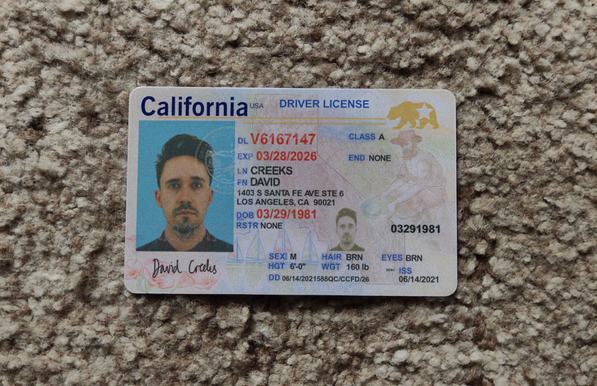
https://www.404media.co/inside-the-underground-site-where-ai-neural-networks-churns-out-fake-ids-onlyfake/

Inside the Underground Site Where ‘Neural Networks’ Churn Out Fake IDs

The site, called OnlyFake, threatens to streamline everything from bank fraud to money laundering, and has implications for cybersecurity writ large.

404 Media

Here is how I used it to bypass identity verification on the cryptocurrency service OKX:
- asks for passport
- take photo of this one I made on OnlyFake
- site reviews it
- success

https://www.404media.co/inside-the-underground-site-where-ai-neural-networks-churns-out-fake-ids-onlyfake/

Inside the Underground Site Where ‘Neural Networks’ Churn Out Fake IDs

The site, called OnlyFake, threatens to streamline everything from bank fraud to money laundering, and has implications for cybersecurity writ large.

404 Media
Update: @RonWyden comments on our investigation into neural networks + fake IDs. Says it shows the need for secure, authenticated IDs https://www.404media.co/inside-the-underground-site-where-ai-neural-networks-churns-out-fake-ids-onlyfake/
Inside the Underground Site Where ‘Neural Networks’ Churn Out Fake IDs

The site, called OnlyFake, threatens to streamline everything from bank fraud to money laundering, and has implications for cybersecurity writ large.

404 Media
@josephcox That's not even the correct layout for a British Passport.

@josephcox This kind of identify "verification" is such a joke. There are right ways of doing online ID verification and this isn't it.

A bunch of countries here in Europe have government-issued digital IDs that we use to sign in to all kinds of things. It's the only way to sign in to government services, banks, even your phone company. It's the only way to sign contracts online too. Protected by biometrics, of course.

There's no excuse for this not being implemented worldwide.

@mroach @josephcox so much this. We've had proper cryptographic ID verification in Sweden since the early 00s. If the implications of pictures of IDs getting easier to generate is that the US stops pretending that JPEGs are IDs, then this is a net positive.
@nyancient @josephcox Once you’ve used BankID (or MitID on this side of the Øresund) you can’t imagine a society functioning without. And, they don’t, really.
@josephcox ain’t this like… borderline financial fraud?
@josephcox Simply brutal, I wonder how online services will manage the triage of "faked" kyc identifications.

@josephcox Sites offering physical fake id’s, and images, aren’t something new. What is fairly recent though is we’ve reached a tipping point where image quality has become so good that even expert forensic review of an image can fail to spot that it’s fake.

What comes next is financial services no longer accepting an image of an ID as proof of identity. Instead, there will be a growth in the use of trusted eID’ tokens (e.g. BankID, Singpass, NDID, LuxTrust etc. )

@josephcox Shit... I expect to hear real-time video calls to verify identity will become trivial to bypass in the coming months.

The world isn't ready for this crap

@josephcox It looks like that it is a fake "SecureID" version of the California license, yet I don't see the pattern of holes that go all the way through the plastic. Does the fake card have the UV features? (Kinda hard to view via a photo. ;-)
@karlauerbach @josephcox if I understood the article correctly, what it is offering is a picture of the card, not the card itself. That's enough for a lot of online ID "verification" systems, but not something you could use IRL where the UV is an issue.

@luis_in_brief @josephcox Thanks, that explains a lot.

Years back when we were making credit cards (legit ones) we used random metal particles in the plastic base. We would read the pattern of those particles - unique for every card and quite difficult to replicate - and use that as a form validation, but it required special readers.

(Apple // used a similar scheme, using the random flaws in floppy disk media in various forms of copy protection.)

@josephcox the concerns are quite legitimate, but I’m also definitely going to use this to do research and build socks….
@josephcox it means that this stupid video ident process is finally done. 👍
(It’s to be expected they will find another „fix“ for this issue)
@josephcox The real implication here is that dumb bastards must stop requesting people to take photos of their documents ASAP. we in Europe have eID. It’s cryptographically secure. Use it!
@josephcox So this is what women will need to get out of Texas, Idaho, South Dakota, etc.
@josephcox I regularly see fake UK Driving licences for sale on Farcebook Meerkatplace. Clearly they don't care.
@josephcox this is gonna push more states to do electronic IDs, or more verification with sites like clear, I tried to upload mine on Google Wallet and NY isn't supported yet.
@josephcox I get why people put scare quotes around "AI", but why are we doing it for "neural networks" now?
@josephcox Okay... this can be horrifying but the comments... I learned so much 👀

@josephcox I'm glad for developments like this. Mandating ID photos online should not be legal outside of government and financial websites, and making IDs vulnerable to image counterfeiting weakens their utility as an easy option for something like age validation.

We deserve privacy. Government and banks can do in-person validation when it's truly needed.

@josephcox What bothers me most about this that I've known biometrics — both the fancy version, and the original "someone looks at the picture printed on your government-issued ID card" version — were a bad idea for years. I'll admit that back then, I was thinking more about how it would handle i.e. haircuts and body modification — yay being bad at faces on the best day — but this sort of scenario did cross my mind. And I'm sure many, many other tech people had the same sorts of thoughts.

And yet, here we are, trusting pictures and voices that can now be easily forged.

Why are we always _reacting_ to the future instead of anticipating and preempting it?

@josephcox
If the OnlyFakes "documents" fool KYC-checks then these checks are bad.
Typical Video based services used by banks I know check for a physical card and the flip hologram etc.. No bank I know will accept an alleged photo of an ID card on a carpet. It may of course be possible to forge IDs which fool Video-Ident and similar services but that will need at least some printing etc. So right now it means: This will just force real weak identity verification checks to get a littel smarter.
@Ann_Effes @josephcox Video-Ident was hacked, too. And, according to the clever people at CCC, it was not too hard:
https://www.ccc.de/de/updates/2022/chaos-computer-club-hackt-video-ident
(English version available.)
In the end, waving identity tokens in front of a camera is a hack. The person doing the verification does not control the setup, and has very little time to do any verification. The attacker controls the whole process, can plan ahead, and can add social engineering skills to achieve his goal.
CCC | Chaos Computer Club hackt Video-Ident

Der Chaos Computer Club ist eine galaktische Gemeinschaft von Lebewesen für Informationsfreiheit und Technikfolgenabschätzung.

@ketchup71 @josephcox

Yes.

I did not say though that Video-Ident is not hackable or was not hacked.

I said that pictures of ID cards generated by some AI will pass only the simplest checks and will not pass Video-Ident.

The Video-Ident hack does need much more than just some printed picture. It is (in opposite to what CCC states - somewhat puffery) way more complicated than the discussed ID generation by AI. Ordering a fake ID which would pass KYC checks would be indeed a big threat.

@Ann_Effes @josephcox Agreed. Mostly. 😁

The whole AI angle is BS. IDs are very formal, there is no point in using image generators. Best use regular image manipulation, I guess. The real problem is that they can pump them out in numbers.

Still, since the video isn’t hack is basically video manipulation and social engineering, it works work with those fake IDs as well. 🙂

@Ann_Effes @josephcox However, the point is: it is an unreliable, expensive method, depending on highly trained, motivated employees. Who are working in a call center setup, so they are probably not overpaid, and on a per-case basis. 🤷‍♂️
@Ann_Effes @josephcox There is a more secure way to do that. The ID had a chip embedded, and this can and should be used for proof of ownership of the ID card. And yet, last time I was at my bank, the photo-copied my ID. Basically the most fakeable part of the ID. Totally ignoring the chip.
All they had to do was make me enter the pin, and note the ID serial. Which would proof it is my ID, and the ID is real.
But it’s a bank. 🤷‍♂️

@ketchup71 @josephcox

Yeah, but I commented just one aspect:

Are AI generated ID Pictures a particular threat?

And my answer was: No, even Video-Ident can't be fooled by those alone. If an ID check can be fooled by those AI generated IDcard-photos than that procedure is particularly unsuitable.

What you say beyond that is correct, but was not the subject of the post or my answer.

@Ann_Effes Sorry, I probably mistook your comment and answer as „video ident would prevent that“, and wanted to provide a counter example to dampen expectations.

Also: I agree the AI part is irrelevant for the fake card. It may help to create a large number of unique backdrops, which will help keeping the picture service alive, but is probably mostly to hype the service.

Anyway, there is no way around a cryptographic solution, sind everything else is way too easy to compromise. 🙂

@Ann_Effes Also: why do I write this in English?!? 🤦‍♂️😂