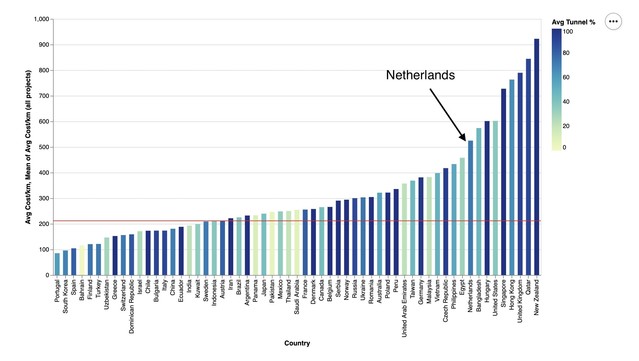
A new Boston Consulting report on #infrastructure costs has found that while UK build costs for infrastructure are around the same as the US, they are well above comparable projects in #Europe (but interestingly less expensive than #Australia).

Is there something about the #business model (or type of #capitalism) in these three countries that makes such project more expensive than in Europe?

Three terms come to mind:
#financialisation
#rentiercapitalism, &
#neoliberalism (not a term I like)

@ChrisMayLA6 I’m sure you’ve seen this, looks like a good analysis: Why Britain’s infrastructure is too expensive

https://www.samdumitriu.com/p/britains-infrastructure-is-too-expensive

Britain's infrastructure is too expensive

Railways, Trams, and Roads all cost more to build in Britain

Notes on Growth

@richardknott

actually I hadn't - on a quick skim through looks really interesting - thanks (and have boosted)

@ChrisMayLA6 outsourcing it to private corporations with the most insane cost structures.
Major Sydney roads and highways are given to private companies to build with the right to charge tolls.
In one instance, the company that built the eastern distributor broke even 5 years after its completion and is now just maintaining it. Cleaning, replacing burst lights, managing road-base.
I forget the details, but they can continue to collect the toll almost in perpetuity. The govt has therefore no expense to show on the balance sheet, and motorists are paying for the very handsome salaries of the execs of the company that built the thing. Those are cumulative costs. Over the course of its lifespan, the tolls will cover the cost of building many times over.
Last time I travelled through it, it looked like the walls were dark grey, though I know they are clad in a sand coloured veneer of sorts.
Neoconservatism that wants the govt to do little, is costing tax payers and in this instance road users very much more than it would have cost if the govt had built it (like they used to, until some greedy cunt came up with that plan).
There is almost no transit route or highway through and around Sydney that is not owned by private equity.
On one instance they are collecting $28 from each truck that uses the North Connex tunnel. Since it has been opened, it's been illegal for trucks to use the surface road.
Illegal.
Cars and motorcycles have that choice still. If they use the tunnel they pay just under $10.
The tunnel is 9km long (just over 5 miles).
There is almost no goods transport via rail in and around Sydney. It's all on trucks.
28 bucks each trip for 10 km of the only way (there is no other) of carting goods from the northern parts of the metropolitan area into the city and beyond.
#WelcomeToCapitalism

@ChrisMayLA6 yes, there is a difference in how projects work and the role of government in the anglosphere and the rest of the world.

I follow this blog on public transport and I’ve been trying to find a post that goes into detail but this might do as an intro: https://pedestrianobservations.com/2023/08/27/britain-remades-report-on-construction-costs/

In the anglosphere government buys the design and implementation of the infrastructure but in other countries the government

1/

Britain Remade’s Report on Construction Costs

The group Britain Remade dropped a report criticizing Britain for its high infrastructure construction costs three days ago. I recommend everyone read Sam Dumitriu and Ben Hopkinson’s post on…

Pedestrian Observations

@ChrisMayLA6 in other countries the government do the design and have companies bid on the implementation.

This means the government retain knowledge on what good construction is and can say no to things that might increase the price but a non-professional might not know about.

It also makes the government long term responsible instead of just short term with an external firm.

Complex issue but I suggest going through the blog for examples

@amalgam_ @ChrisMayLA6 the Anglosphere methodology also transfers more wealth to the rich, powerful and privileged. It's a key driver of the choice by those who benefit most from it.

@Dave42W @ChrisMayLA6 yes, this is by design to transfer state money (which is also your tax) into private owners pockets.

Very sad to see Sweden go this direction but it is not by accident, it’s intentional.

@amalgam_ @ChrisMayLA6 another loss for most people is that this also shifts spending geographically to where the rich, powerful and privileged live & work to the detriment of everyone else

@ChrisMayLA6 found one about the Nordic examples. https://pedestrianobservations.com/2022/08/29/nordic-costs-and-institutional-knowledge/

It’s worth noting that Sweden is currently transitioning into the anglosphere model which will increase costs.

Also worth noting that Greece, Italy, and Turkey, countries that the north often think of as inefficient, have the cheapest construction costs even when controlled for labor costs (source: same blog above)

#sweden #publictransport

Nordic Costs and Institutional Knowledge

Institutional knowledge at agencies that build infrastructure shapes up to be an important factor behind how well they handle projects. Good agencies build up a knowledge base over time that lets t…

Pedestrian Observations
@amalgam_ @ChrisMayLA6 are you speaking about the real costs or about the planned costs? In the Netherlands all the budgets are too small beforehand and the real costs are much higher.

@EvelineSulman @ChrisMayLA6 The project i'm referring to (https://transitcosts.com/new-data/) deals with real costs of projects.

Its not uncommon, more like expected, that projects run over budget. But there are still big differences between countries and how the governments (national or local) functions. You can read the authors analysis about why here: https://transitcosts.com/wp-content/uploads/TCP_Final_Report.pdf

Overall, the netherlands are in the upper segment of rail cost:

New Data

What the data is telling us Most recent update: 10/21/2022 Here are some visualizations of our data. The data covers only a portion of rail projects in each city/country and, in many instances, is not representative of all the lines constructed in that city/country. Similarly, Phase information refers to the number of phases of a project that

Transit Costs Project