Okay, I just couldn’t let this rest in my head. I've done a few simple simulations, comparing:

- relative change in net revenue (what you keep after fees)
- for developers staying INSIDE the App Store
- using Apple's In-App Purchases

under the new EU rule compared to the old App Store model.

[a thread]
#DMA #AppStore

Let's start with some base parameters:

- 100k annual downloads (aka first-time installs)
- 10k paying users
- $50 annual price

I feel this is representative of a well-doing freemium app that's been around for a couple of years. Doesn't matter if this is EU data or worldwide, it's about the relations.

From our own data (albeit a different business model) a few harder-to-come-by numbers:

- 40/60 split for 1st year and long-time subscribers
- 40% of annual installs are first-time

Based on that, we can derive a few more numbers:

100k first-time installs and 40% first-time install rate
-> 250k annual installs

400k net revenue with 30%/15% App Store fees and 40/60 user distribution (ignoring taxes for now)
-> ~510k gross revenue

250k annual first installs and 10k paying users
-> 4% paid install rate

510k gross revenue and 10k paying users
-> ~$51 gross revenue per user
(plus taxes this would be the end-user price)

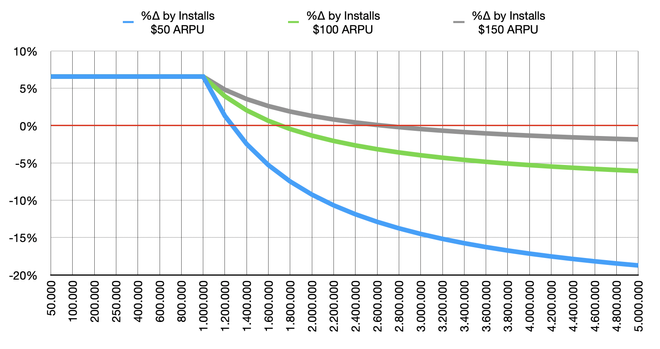
[Chart 1/3] Given that 4% paid install rate, how does the new model compare to the old one, in percent of total revenue change?

Comparing using $50, $100 and $150 gross revenue per user (blue, green and grey):
- Net revenue sees +7% for everything up to 1M installs

BUT:
- At $50 revenue per user, anything above 1.2M installs you're making a loss
- At $100, this is 1.8M
- At $150, this is at 2.6M

Here, 1.2M installs equates to 480k first-time installs per year and just 48k paying users. 😳

[Chart 2/3] Given 2M annual first installs…

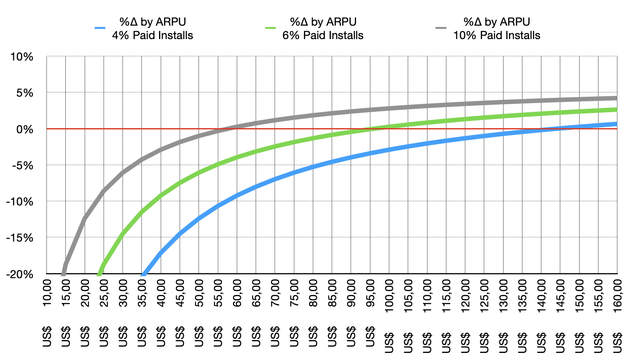
Comparing using 4%, 6% and 10% paid install rate, the percentage of installs you have paying users for (blue, green and grey):

- At 4% paid rate, you're better off only ABOVE $120 revenue per user
- At 6%, only from $80
- At 10%, only from $50

NOTE: 2M annual installs translate to 800k downloads per year (given the app is not new). So, a 4% paid install rate translates to 80k paying users and so on.

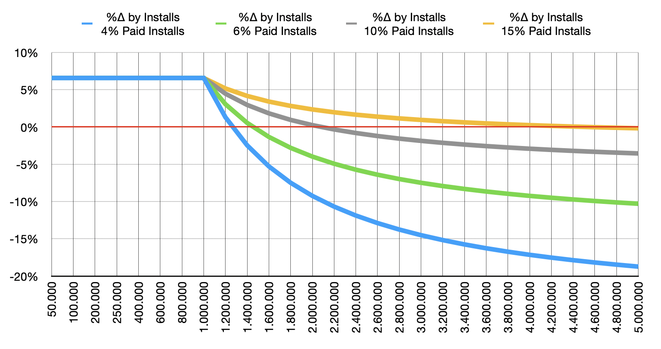
[Chart 3/3] Given $50 gross per paying user…

Comparing 4%, 6%, 10% and 15% paid install rate (blue, green, grey and yellow)…

- Above 1.2M installs, you’ll need more than 4% paid install rate
- Above 1.5M installs, over 6%
- Above 2.1M installs, over 10%
- Above 4.5M installs, over 15%

This means the more successful you get (installs), the more effective you’ll need to be at capitalizing your users. ‼️

You should be aware that:

⚠️ Apps stay installed forever, because people never delete apps. So they will update for years (until user switches devices, I guess). And you’ll pay the core platform fee all this time.

⚠️ These paid install rates are NOT paid user rates. 10% paid install rate translates to a whopping 25% paying users per annual new download. (yes, comparing apples and pears) Given there's churn at so many stages, you'll need phenomenal conversion and retention rates to get there!

Seeing this, I'm convinced this is an intentionally rigged game and actually also a honey pot. A trap for new developers to sign up for a mode that might (will?) eventually kill them. You cannot revert from this new model.

‼️ The new model requires you to IMPROVE your download to paid ratio as you get MORE downloads.

Everybody will tell you it's usually the opposite. It's impossible to grow and win using these rules. It's like a drug scheme – easy entry but killing you over time.

In the end, this is what everybody was expecting Apple to do: don't budge but make new rules that essentially change nothing and just make them more money. Same as in the US for external payment providers.

It's a mathematically hidden way of saying „Fuck You“ to regulators and the industry. Dressing up nicely and acting like your friend, but coming for you once you bite, inescapable. Basically, a trojan horse.

[end]

PS: Happy to hear your thoughts. And please correct me if I'm wrong!

@macguru17 Please please please turn this into a blog post so people can link to it. Regulators will never see this on Mastodon.
@DazeEnd I know. Tho I no longer have a blog, so this is a bit of work. Will do if there’s enough interest 👍