I'm rather taken with this elegant visualization of @ClimateChange from the BBC. Particularly as it clearly shows how anomalous 2023 was.

It's a Ridgeline plot (also sometimes called a joyplot, after the iconic album cover from the band #JoyDivision).

I just wish they'd used a pre-industrial average as the baseline. 2023 was 1.48°C warmer than pre-industrial times according to the Copernicus data.

@steve this is the French tricolour we do *not* want

@steve
Gorgeous, gorgeous plot!

But I agree, the appropriate baseline is not a WMO 30 year sliding baseline such as this one, 1991-2020. Correct interpretation might require the baseline be the last 10,000 years.

Perspective is everything.

https://earth.org/data_visualization/a-brief-history-of-co2/ #climatechange

A Graphical History of Atmospheric CO2 Levels Over Time | Earth.Org

As the most abundant greenhouse gas in our atmosphere, CO2 levels have varied widely over the course of the Earth’s 4.54 billion year history.

Earth.Org

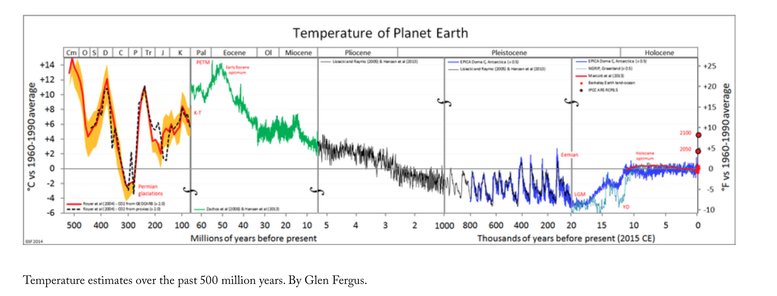
@ScottAkenhead @steve To me, the amazing thing is how stable Earth's temperature has been. Millions of years, never outside the range that can support carbon-water based life.

Perhaps this is one planet in billions. Perhaps any number of things could have made us like Mars or Venus. But we are like a gambler who has flipped a coin and it has come up heads 100 times in a row. If it had ever come up tails, we wouldn't be here thinking 100 heads in a row is normal.

#climatechange

@Paul_Friesen @ScottAkenhead @steve IIRC if it weren’t for the evolution of life Earth’s atmosphere would be like that of Mars
@stuvx @Paul_Friesen @ScottAkenhead @steve and we have a magnetic field which Mars really doesn't have.

@steve

Très chic!
I quite like 1991-2020 as climatological baseline. With the air over the Northern Hemisphere landmass so polluted with anthropogenic #aerosols from the Wirtschaftswunder 1950ff, and the measurement network only really becoming dense after WWII, an earlier baseline than 1991-2020 would inevitably reflect the pre-Montreal-protocol #geoengineering in the Northern Hemisphere. An interesting phase, particularly for Africa because our industrial aerosol load drove the rainbelt south, causing famines, wars and genocides in the 1980s and 1990s.
But the coolant also destroyed the continuous warming trend in the temperature records.
And a baseline in the 18hundreds for global temperature averages is more difficult to defend due to gaps in the measurements network. 1991-2020 can't be contested in this regard at all. And still clearly shows the huge increase. 🙂

@steve So, what exactly is being plotted in each year? A histogram of daily global temperatures, relative to the same day in the baseline?

@gpk
Yes, exactly. Climate scientists like to measure "temperature anomalies" rather than actual temperatures. In this case they're measuring daily anomalies - the global average temperature on each day, compared to the baseline average for that day of the year.

It removes seasonal effects - northern hemisphere summers make global temperatures higher anyway, because of all that landmass getting more direct sunlight.

More charts here, for context:
https://www.bbc.com/news/science-environment-67861954

2023 confirmed as world's hottest year on record

Climate records tumbled "like dominoes" in 2023, with temperatures far above any recorded level.

BBC News

@steve “I just wish they'd used a pre-industrial average as the baseline.”

👆This! Humans have short memories, but why should we institutionalise this with our data vis??? 🤦‍♂️

@jni

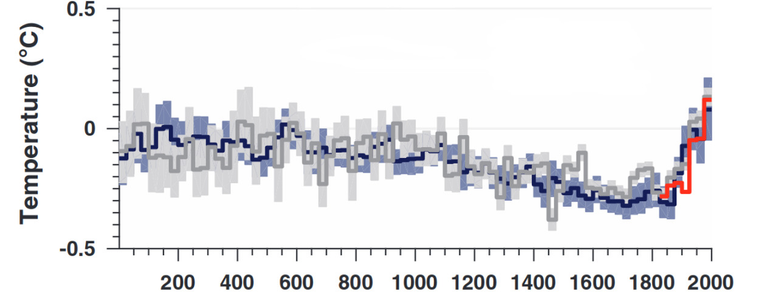
Whichever date is chosen is going to be referred to as cherry picking. The mid 1800s ("pre-industrial") were globally on the cold side compared other earlier time periods.

@steve

@steve Uncertainty in the pre-industrial baseline is roughly a quarter of a degree, varies with season and isn't well constrained for daily temperatures.

@micefearboggis
True, but irrelevant.

The lede in the article is 2023 was 1.48°C warmer than pre-industrial (3 significant figures!). Then all the graphics use a different baseline. That's a mess.

For a news article, I don't see any problem generating a pre-industrial baseline from the same model, and then addressing the uncertainty in a footnote. Sure, you wouldn't do this in a paper for Nature, but this is a very different audience. Simple clear messaging matters.

https://www.bbc.com/news/science-environment-67861954

2023 confirmed as world's hottest year on record

Climate records tumbled "like dominoes" in 2023, with temperatures far above any recorded level.

BBC News

@steve Simple clear messaging *that's in line with the underlying science* matters. The 1.48C in the lede is missing an uncertainty estimate too.

The difficulty for the plot is, which pre-industrial baseline do you pick? The dataset Copernicus produce only goes back to 1940, so the BBC would have to choose a method for converting to a pre-industrial baseline. There are multiple methods. The method you choose changes the message.

See https://diagrammonkey.wordpress.com/2023/11/22/will-we-reach-1-5c-in-2023-or-2c-on-tuesday/ for a more detailed analysis

Will we reach 1.5°C in 2023 or 2°C on Tuesday?

The short answer to this question, at least if we’re thinking in terms of the Paris Agreement, is no. The Paris Agreement limits at 1.5°C and 2°C above pre-industrial are typically considered to be…

Diagram Monkey

@micefearboggis Yeah, but no journalist is ever going to put an uncertainty estimate in their lede. Nor on their charts, to be honest, largely because it would confuse most of their audience.

Talking of which, the differences from choice of baseline are also largely irrelevant for this audience, so your method 3 (shifting the axis by 0.69°C) would be a perfectly reasonable choice for a BBC article, and is scientifically defensible, especially if it's noted somewhere in the caption.

@micefearboggis But I have a more interesting question for you. In your (great!) blog post you say: "For any particular threshold, there will likely be a period of time when it is not clear whether we are above or below it"

The threshold should also have an uncertainty range on it. Which means the question shouldn't be whether we are "above or below" it , but: "above, within the uncertainty range, or below".

Wouldn't that be much better messaging as we approach the 1.5°C ±X threshold?

@steve No journalist would of course. An uncertainty range would confuse their audience. But not providing one misleads them. Tomorrow, five other groups will release their numbers and they will all be different. It's the work of one sentence to clarify all that.

Your suggestion for a fuzzy threshold is an interesting one (and thanks for the kind words about the blog post). It acknowledges the uncertainty, which is great. Whether it's practical, I don't know.

@steve One can imagine the confusion caused by replying to the question "have we passed 1.5C?" by saying "maybe" for ten years. Or more.

@micefearboggis well we’re going to be saying maybe for a decade anyway. My argument is instead of saying maybe, we say we’ve entered the threshold (or some such form of words)

On the threshold?
In the 1.5 degree zone?
On the cusp?

The key will be to communicate that it will take a number of years to pass through the threshold. Ie it’s not an instantaneous thing.

@steve I agree absolutely. I think that to do that, we need to communicate uncertainty in global temperature before we get into that situation.