I'm rather taken with this elegant visualization of @ClimateChange from the BBC. Particularly as it clearly shows how anomalous 2023 was.

It's a Ridgeline plot (also sometimes called a joyplot, after the iconic album cover from the band #JoyDivision).

I just wish they'd used a pre-industrial average as the baseline. 2023 was 1.48°C warmer than pre-industrial times according to the Copernicus data.


@steve
Gorgeous, gorgeous plot!

But I agree, the appropriate baseline is not a WMO 30 year sliding baseline such as this one, 1991-2020. Correct interpretation might require the baseline be the last 10,000 years.

Perspective is everything.

https://earth.org/data_visualization/a-brief-history-of-co2/ #climatechange

A Graphical History of Atmospheric CO2 Levels Over Time | Earth.Org

As the most abundant greenhouse gas in our atmosphere, CO2 levels have varied widely over the course of the Earth’s 4.54 billion year history.

Earth.Org

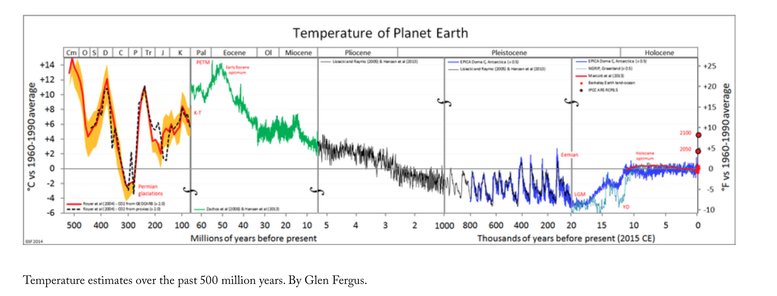
@ScottAkenhead @steve To me, the amazing thing is how stable Earth's temperature has been. Millions of years, never outside the range that can support carbon-water based life.

Perhaps this is one planet in billions. Perhaps any number of things could have made us like Mars or Venus. But we are like a gambler who has flipped a coin and it has come up heads 100 times in a row. If it had ever come up tails, we wouldn't be here thinking 100 heads in a row is normal.

#climatechange

@Paul_Friesen @ScottAkenhead @steve IIRC if it weren’t for the evolution of life Earth’s atmosphere would be like that of Mars
@stuvx @Paul_Friesen @ScottAkenhead @steve and we have a magnetic field which Mars really doesn't have.