I had an "ah ha" moment when thinking about the angry responses to yesterday's blog post.

(This one, if you missed it.) https://terikanefield.com/section-3-and-the-spirit-of-liberty/

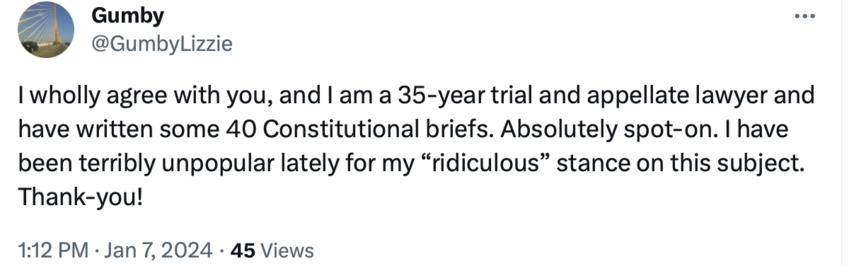
First, I'll share a positive response. (Screenshot #1)

(Screenshot #2 was typical of the angry responses.)

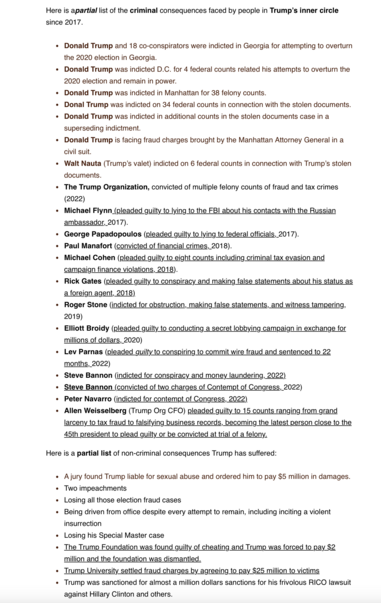
About 5 years ago, I took the tact of responding to "there are never any consequences" by listing the consequences.

I figured, you know, facts. For example, see #3

1/
Section 3 of the Fourteenth Amendment and the Spirit of Liberty - Teri Kanefield

I am updating this page with new analysis of the new briefing that has been filed. Since I wrote this page, the following briefs have been filed:  Trump’s brief is here (January 18). An Amicus Brief filed by 17 members of Congress is here (January 18). An Amicus Brief by a group of election lawyers […]
Teri Kanefield

People pushed back against my list with complaints that the consequences were not harsh enough and what about all the other horrible people? "Huh, Teri? What about them? Well?"

For about 2 years, I updated my list of consequences, and when the usual chorus of "there are never any consequences" would show my list.

I stopped when I realized it didn't matter how long the list was, the chorus of "there are never any consequences" would continue.

2/

Another tactic I tried was explaining that the criminal justice system cannot solve a political problem. I did things like cite the evidence about deterrence.

When people insisted that putting them all in jail would solve the problem, I explined that (1) not everything bad is a crime (2) bad things also happen in prison (3) prison sentences have limits and people often come out more hardened.

This only frustrated people more.

3/

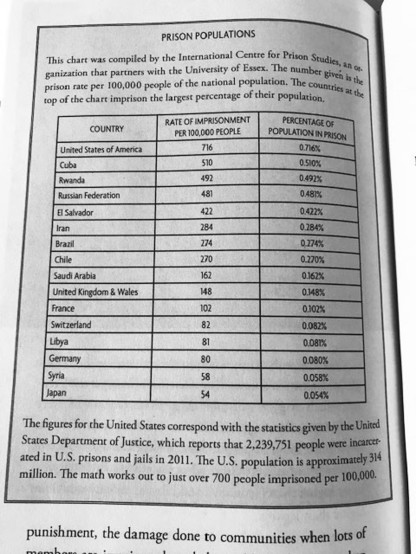
An irony was that people were adopting the conservative "tough on crime" rhetoric that led to a corporate prison system.

I showed this chart:

The chorus continued.

Now I get it. (Me = 💡 ) At least I think I do.

People look around and see bad guys who keep being bad.

They see people who are anti-democratic.

One person told me that people who are anti-democratic shouldn't be allowed to run for office.

The opposition, the GOP, is anti-democratic.

4/

Peter Thiel even said he no longer believes that "freedom and democracy are compatible.”

(The Learned Hand quotation in my weekend blog post explains what he means.)

https://www.cato-unbound.org/2009/04/13/peter-thiel/education-libertarian/

I now understand that people either don't understand democracy or simply don't have a stomach for it.

They want the opposition to disappear.

There is no opposition in a totalitarian government because the government doesn't allow it . . .

5/

The Education of a Libertarian

Cato Unbound

A democratic society, by its very nature and under its terms, will contain people who are hostile to democracy.

A democratic society cannot get rid of all opposition.

There will always be anti-democratic elements.

Here is the twist: When a democratic society attempts to rid itself of all opposition, it becomes totalitarian.

Because to get rid of ALL opposition, you will have to catch a lot of people in the net.

6/

The only way to have a democracy is to allow people to have anti-democratic views and opinions.

That's the catch.

People with anti-democratic views and opinions will try to win office and force their government on everyone else.

That is what they will try to do.

When I post my "to do" list and explain that democracy is slow grinding work and requires lots of civil engagement, people say snide things. (One person yesterday referred to it as my "cut and paste" list.)

7/

I started to tell him about my hundreds of volunteer hours over the years, but some of my volunteer work is somewhere on my website.

Instead I deleted his comment from my blog and marked him as a spammer 🤷‍♀️

(I have a totalitarian blog 😂 )

Even a totalitarian regime can't get rid of all the opposition.

Stalin tried valiantly.

But you can't get everyone who opposes you and the ones left fight harder.

I keep asking the same question:

Do enough people have the stomach for democracy?

8/

Adding: I'm so sorry if it seemed like I was complaining about negative responses.

I do that sometimes, I guess.

This was more like a revelation: they keep thinking the opposition will disappear.

It's either ignorance of how democracy works or authoritarian tendencies.

I generally only block people who are aggressive when negative (probably because they're more likely to be coming from an authoritarian personality rather than ignorance of how rule of law works.)

9/

@Teri_Kanefield I think it's mostly fear. People are very, very afraid that a totalitarian opposition is going to take power and try to kill or otherwise eliminate them. It's not an unreasonable fear. The question is just what to do about it. Liberal democracy seems at least at first glance like it simply has no defenses against this--we have to risk the bad guys taking power and just murdering us in every single election. It grinds you down.

I've been reading a lot of Adam Silverman's posts over on Balloon Juice--he (unlike most of the regulars there) sounds like a lot of your respondents. He frames everything in terms of war. He says we're at war, a soft civil war that is part of a larger global World War III, and the Republicans realize this but Democrats and the administration don't.

But war and democracy are fundamentally incompatible--if our modern politics is a war then we've already lost the struggle for democracy, and need to give it up for the duration (and how long is that??) and fight a possibly violent battle for mere survival. That *is* basically how a lot of people on the other side see it.

I'm hoping the war frame is not the correct one--Adam is a military-oriented guy and tends to see things in war terms. But it's an open possibility.

@mattmcirvin

I am going to respond to this for everyone.

@Teri_Kanefield I'm interested to see what you have to say. I suspect (believe) I'd agree with you, but I also am fairly certain that your response will be better than mine would be and that I would benefit by internalizing your approach to the comment.