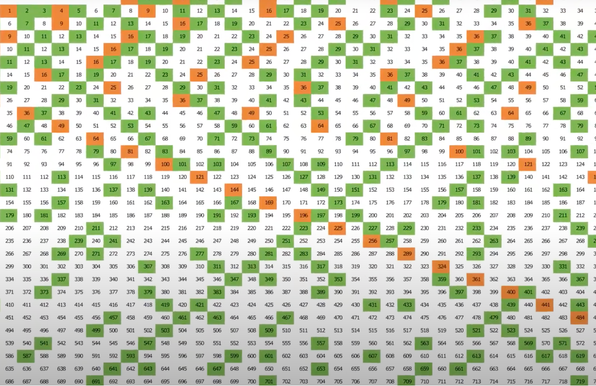
#Primes in quadratic progression 1/3

I’ve been looking at primes in what I’m calling quadratic progression but I don’t really know if that name is accurate or if there’s already a name for them. I’ve found some patterns that relate to #twinprimes and I’ve also made a video of this idea if that’s more your jam. http://www.youtube.com/watch?v=DiTRYaja4pY

I’ve created a sieve where the width of the table changes on each row. It’s right-justified so consecutive square numbers line up down the right hand side. Effectively each row has all the positive whole numbers smaller than the square number to the left. It’s triangular. I’ve created a triangle.

When you highlight all the prime numbers there are some obvious patterns for composites. All the even numbers form a grid. If you count the right column with the squares as column zero and count from the right, all the columns corresponding to square number are entirely composite except for the top number in some cases (like the right column in the sieve of Eratosthenes).

There’s no clear pattern to the primes. All the primes are on diagonals because every other diagonal is odd but there’s nothing un-interrupted where you’d confidently predict where the primes were.

Linear progressions
I see other amateur mathematicians trying to find primes by starting at say 7 and adding 6 repeatedly which results in a bunch of prime numbers - 13, 19, 25 is not a prime but 31, 37, 43 are. And while that linear approach is interesting, it’s not much more complicated than saying that primes don’t have 2 or 3 as factors. I think the prime progressions in this sort of visualisation are far more interesting. They follow the same sort of pattern but the number you add increases by 2 each step.

Primes in quadratic progression and twin primes

YouTube

2/3
Each number is an odd number less than the number below it. The size of the odd number is determined by its row. The difference between the 1st and 2nd row is 3, between the 2nd and 3rd is 5 and so on. That also means that a number on the second row like 3 is 5 fewer than the number 8 below it, 4 fewer than the number 7 down and to the left and 6 fewer than the number 9 that’s down to the right. To progress down a diagonal, you take the last increase and add 2 to it: 6 then 8, 10 etc.

These progressions create some clear diagonals in both directions and there are long runs of #primes on some. Not uninterrupted and you can see some obvious places where the square columns break up the runs of primes. But when they happen, the diagonals continue fairly obviously.

Longer runs of primes
In the really small numbers these runs aren’t as obvious and they overlap each other. If you skip along the number line and look at the gap between the original squared numbers in the right column minus 9^2 and minus 10^2.

Starting at 17 in the top of the 10th row and going to follow the diagonal lines that go down and to the left. I’m going to follow a simple rule. I’m going to add 20 the first time (because it’s in the 10th row) and then 22, 24, 26 and so on. The first 15 of these numbers are primes. It’s interrupted by the composite number 527 and then by the column of composites created by subtracting 10^2 but the series continues after that and enough that, even at a distance, you can pick out a clear line of mostly primes.

In the same gap between 9^2 and 10^2 There’s another diagonal down to the right starting at 1, adding 22, 24, 26 and so on. That diagonal has 17 consecutive primes.

3/3
Quadratic primes as they relate to #twinprimes and pairs of twin primes
The prime number 233 at the intersection of these two diagonal runs of prime numbers isn’t a twin prime but as an inevitable consequence of the way diagonals work, it’s immediately below the twin primes 197 and 199 and above the twin primes 269 and 271. Above and below that are cousin primes and above and below that are sexy primes.

In isolation I think that would be great but an intersection number like 233 isn’t particularly rare. At a slightly wider view, you can see really clearly where these diagonal runs intersect and in almost every case you’ll find either twin primes or, in a lot of cases, a pair of twin primes above and below the intersection.

One avenue for further research (that’s far above my skill level) is to prove if these runs of quadratic primes are infinite. If they always exist, then the diagonal runs of primes will intersect and wherever they do, you’ll definitely find twin primes, cousin primes, sexy primes. In lots of cases each will come in pairs.

Sidebar about Euler’s prime generating function
If you look to the right of the column of consecutive square numbers there are some amazing examples of quadratic progressions of primes. Notably there’s a diagonal run of primes matching Euler’s prime generating function k2 − k + 41 which has 40 or so consecutive primes.

I'd love to hear anyone's feedback on this. Particularly without a proper name for the quadratic progressions, it makes it impossible for me to google and see what else has been written about them. Happy to discuss or explain things better. Thanks for getting this far.

@benpetersjones
Huge subject. I do want to chat with you now and then about these topics, but sometimes I feel a little overwhelmed by it all.

"I'd love to hear anyone's feedback on this. Particularly without a proper name for the quadratic progressions, it makes it impossible for me to google and see what else has been written about them. "

One thing you certainly should be aware of is the OEIS (The On-Line Encyclopedia of Integer Sequences), which tries to record "all" interesting integer sequences -- so it started out huge and continues to grow.

In particular it has a lot of progressions of primes; check out this one, for instance:

https://oeis.org/A005115

A005115 - OEIS

@benpetersjones Actually I should have started by pointing out that you can search it for "41, 43, 47, 53, 61, 71" and it gives a list of things that generate that sequence, including Euler's formula

https://oeis.org/search?q=41%2C+43%2C+47%2C+53%2C+61%2C+71&go=Search

Which I think is awesome.

Far less useful, but kind of fascinating, is wikipedia's "Formula for Primes":

https://en.wikipedia.org/wiki/Formula_for_primes

But be warned, this page is largely *trivia*, mostly not actually useful, so don't go down any rabbit holes there!

41, 43, 47, 53, 61, 71 - OEIS

@dougmerritt Thanks. I'm familiar with the OEIS and a bunch of effort to find that type of run of primes but haven't seen anything about why they happen or anything that links them all or links them to twin primes.

@benpetersjones Oh good.

*why* they happen is a good question. There's some good material on that if I can remember it.

Part of it is that there's a certain kind of argument that it *has* to happen *somewhere* because simple formulas can't contain enough randomness to avoid it.

Making that rigorous rather than hand-wavey is the hard part, clearly.

Related to that is that you can't have a list of all of them; it's an infinite list

The connection to twin primes is doubtless interesting but I suspect it's over my head.

Sorry that I don't have a meaty comment at the moment.

@benpetersjones Since you have long had an interest in these topics, it's probably going to be hard for me to come up with something you've never heard of before, but that is also accessible to us both.

Like prime spirals, starting with the Ulam spiral.

@dougmerritt Ulam is great and particularly when you highlight the square numbers. I also like primes plotted on an Archimedes spiral. There are big long curves of primes that point in each direction. More #mathsart than maths. Beautiful stuff.

@benpetersjones #mathart is great, but there is actual math in there as well

It may always be true that wherever art is to be found in math, that there is also math to be found in math.

LOL that sounds pretty silly when I put it like that!

@dougmerritt I kind of know why they happen at a really basic level. Part of it I think is that the square numbers that create composites are increasing by +2 and there's a sweet spot just on the high side of the smaller squares. While the increase is also +2 then you don't run into the square number on the low side or where the difference of two numbers to squares is 3. It's like a million little tightropes. That explanation in hindsight sounds like numerology but I don't know it better to explain it better - Sorry.

@benpetersjones I get the gist of what you mean.

The cool thing about this is that you're starting with data-based intuitions about such things, which is a great foundation for learning any relevant mainstream math out there -- I think that is far easier than starting by learning abstract math and then somehow intuiting all of the data (how would that work??)