 darookee
 Ólafur Waage
What in the Daft Punk is going on with the Rust XML parsers?
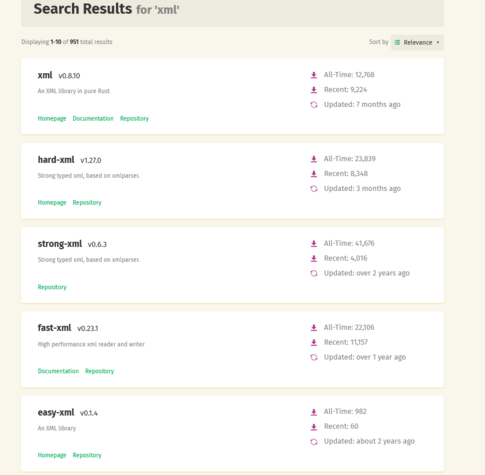
@olafurw Somebody heard a Daft Punk song and tried to make it into XML parsers?
Harder, better, faster, stronger. Just missing better-xml here.
@olafurw the thing is that those language wide repositories need some kind of moderation. Otherwise their namespaces get clogged real fast.
Unless the language is not that popular.
@freundTech @olafurw didn't pypy have closed its web search feature due to too many bots?
I feel that python already had a good set of basic additional libraries when the explosion of usage happened. That means that this might be happening within the less known packages.
@olafurw they probably be thinking "work is never over".
Poor folks.
@olafurw This is a late reply, but I think I can give a bit more context to this… since I started writing "yolo-xml" a while back 
The gist is that writing a spec-compliant XML parser that you can use safely on untrusted data is ANNOYING. Note that I didn't write 'hard', but you basically need a recursive coroutine with safety limits to do this. Ideally it should also opt-in-support includes, and accurate streaming, because indefinite streamed XML documents are a thing.
…
@olafurw …
What this leads to is that (when I last checked) *not one* of those XML implementations is remotely general or even to spec.
Most will accept invalid XML documents without observable notice (which is somewhat okay, the spec does say you can skip validation iirc and you would need heap allocations to do it when parsing a `Read`), none support XML streaming iirc, support for includes and XML entities is spotty, and many don't actually implement XML but a specific serialisation scheme.
Overall this creates a major headache if you want to implement something like XMPP in Rust (outside of Websocket mode) since that:
- is untrusted data,
- streaming XML,
- does use namespaces (kinda¹),
- *negotiates encryption by aborting an open streaming document and reusing the underlying byte stream*².
¹ I'm pretty sure most implementations take a shortcut there.
² which means the streaming parser mustn't over-consume (valid XML) while yielding XML events
@olafurw I wouldn't say it's a bad format for all applications, e.g. *in theory* it would allow creating data processing adapters and workflows through a graphical interface, and makes formal validation of partial systems easier.
A binary (and less annoying) form of streaming XML is now in use in car chargers, which is very sensible.
However, I feel like it is a format that lends itself mainly to formally specified work expected to be partially in flux for decades as e.g. an industry evolves.
@[email protected] Life is not fair sometimes 🧐 Is there also a trie-harder and trie-harder-with-a-vengence 🤔

 MenhirMike
 Sean Murthy
 Peter Bindels
 Roc
Roc 
 Victor Bogado
 freund
 petes_bread_eqn_xls
 0xC0DEC0DE07EA
 Bill0004
 Tim
Tim llogiq
 Alex Rock
 SakuraSubnet 🥙
 LR
LR Dirkjan Ochtman
 subway duck
 Jonas Köritz
 Francis 🏴☠️ Gulotta
 Tamschi
 Shafik Yaghmour
 Amethyst Basilisk
 Kevin
Kevin