Reading a book on BTS by a Seoul National University professor of cultural studies, and it’s really interesting. She had published a book back in 2013 about the so-called Hallyu/Korean Wave, before BTS had debuted, but right after Psy’s Gangnam Style had broken all sorts of records on YouTube. She’s been studying the topic since the early 2000s which is the very start of the Hallyu Wave so she has a ton of insights on the unique global rise of BTS.

This is already a fascinating read!
One of the best classes I took in college (late 90s) was called Race & Gender in Asian America. We examined our identity & representation through the lens of media: books, movies, tv shows, and music.

I loved this class—and the other classes I took w/ the same Asian American history professor—because it taught me so much about how I view myself, how society views me, and how history shaped both.

I wonder what it would be like to take a similar class right now, with the meteoric rise of K-pop.

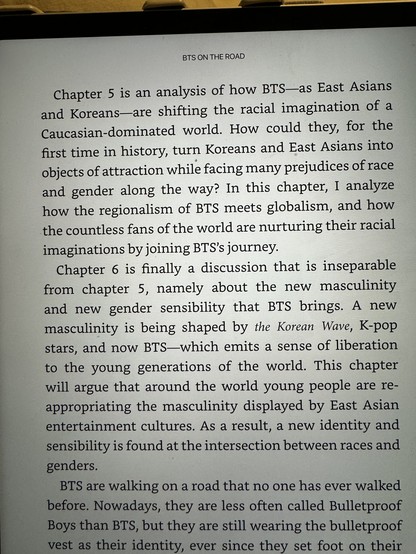
“Chapter 5 is an analysis of how BTS as East Asians and Koreans-are shifting the racial imagination of a Caucasian-dominated world. How could they, for the first time in history, turn Koreans and East Asians into objects of attraction while facing many prejudices of race and gender along the way? In this chapter, I analyze how the regionalism of BTS meets globalism, and how the countless fans of the world are nurturing their racial imaginations by joining BTS's journey.”

“Chapter 6 is […] about the new masculinity and new gender sensibility that BTS brings. A new masculinity is being shaped by the Korean Wave, K-pop stars, and now BTS-which emits a sense of liberation to the young generations of the world. This chapter will argue that around the world young people are reappropriating the masculinity displayed by East Asian entertainment cultures. As a result, a new identity and sensibility is found at the intersection between races and genders.”

Fucking yes! 👏🏼

Such a huge part of the western narrative about East Asians is that the women are demure & obedient sex kittens and the men are emasculated, unattractive, undesirable, backwards caricatures to rescue/white knight the women from.

That’s been going on for generations. Fuck that narrative.

It is still SUPER weird to me to hear / read about so many non-Asian women being so thirsty over Korean singers & actors though, but I’m glad of the change! 😂😅

This book is just the right level of wonky & pop culture-friendly. It is now talking about early Japanese manga & anime fan translations and early Japanese idol systems and how they informed what happened with early K-pop and what is happening now with fandoms.

This is like the easiest to munch popcorn for someone who loves pop culture, sociology, entertainment, history, and ethnic identity. Chomp chomp chomp 🍿

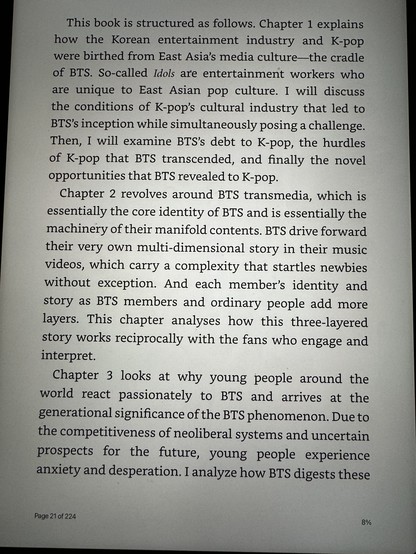
Omg, now she’s diving into how the Marvel Cinematic Universe works as something she calls a “transmedia” experience, as compared to how narratives in Korea, China, and Japan have traditionally been more “One Source Multi Use” (OSMU).

Utterly fascinating! This is her context for deconstructing BTS’s transmedia approach and why/how this finally succeeded in a k-pop group breaking through to western audiences when many prior attempts by much more established bands w far more resources failed.

FYI, this book is called BTS on the Road, by Seok-Kyeong Hong, and is a translation of the original which was written in Korean. There are some editing issues in the translated edition, but this is a really great read for fans of pop culture & media studies, especially as examined through a global lens. And of course for BTS fans 😂

She’s covering the Spice Girls, One Direction, reality competitions, and Beyoncé’s incredible Lemonade visual album (which I loved!).

lol my main mastodon account almost became a BTS stan account, but instead it’s now a Seok-Kyeong Hong stan account. 😂

@eingy you might be unsurprised to learn that in gay circles, East Asian men get to be treated as both emasculated AND demure sex kittens

there was a really interesting essay about this in the NYT a month or two ago, focusing on how the author's experience with this dovetailed with a latex fetish -- a chance to put on a different skin, almost literally.

(and anecdotally I've seen it in otherwise progressive community spaces too.)

@relsqui Exactly! 😭 I’ve also heard from gay friends that even in the Bay Area, there is a lot of “no Asians” as stated preferences on grindr and if not that, looking for East Asian men exclusively to be subs 😢

And I know this type of fetishized racialization happens to all global majority folks. 😢

I’ll have to look up that essay! Thank you!

My Fetish for a Second Skin

As a gay Korean American, I yearned for the privilege of being heterosexual or white. So I began wearing latex, a new skin.

The New York Times

@relsqui that was beautiful, painful, lovely, vulnerable, and so anguish-filled. I loved this:

“With help, I healed the lesions on my sense of self. I sought out art and media I could see myself in and began to create my own. I forged community with other queer and kinky people of color. I practiced seeing my skin as worthy, visible and perfect. I reclaimed my sexuality and my sexiness.”

❤️❤️‍🩹❤️‍🩹❤️‍🩹

Thank you for sharing this. It was so worth the read. ❤️

@eingy I'm glad you liked it too! it stuck with me after I read it originally (clearly)