
sitting in a room with #IPFS hackers new and old #ipfsconnect
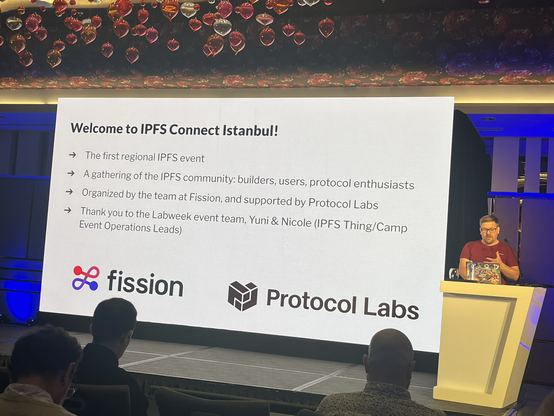
If you don't know #ipfs , it's a peer-to-peer system for finding and then distributing data to and from you, wherever you are, whereever the data is, without unnecessary intermediaries. https://github.com/ipfs/awesome-ipfs
GitHub - ipfs/awesome-ipfs: Community list of awesome projects, apps, tools, pinning services and more related to IPFS.

Community list of awesome projects, apps, tools, pinning services and more related to IPFS. - ipfs/awesome-ipfs

GitHub
I'm going to nip over to hear the talk on #iroh, which is a new sibling implementation of some parts of the IPFS stack, but if you want to see how IPFS is doing in the browser, follow along with
https://kyledenhartog.com here: https://bit.ly/ipfs-browser-talk
Home

Hacker. Golfer. Futurist. Skier. Developer.

Kyle Den Hartog
So, Iroh is a mobile-centric IPFS-ish system, that emphasizes smooth sync'ing between mobile and local machines (especially when the nodes connectivity goes up and down) https://iroh.computer/
iroh

A distributed systems toolkit

the syncing means that it uses (I think) a different distribution protocol than classic IPFS, but it's still content-addressable. (For instance it uses #blake3 hashing so you can incrementally check the integrity of big files) https://github.com/n0-computer/iroh
This is a theme I see in modern #IPFS usage -- #iroh is optimized for small private networks of a few known devices, rather than one big public network of unknown peers. You see the same setup in https://tryquiet.org/ a Discord-on-IPFS-on-Tor for private groups.
Quiet - Private messaging. No servers.

Okay, next up, @willscott talking about Car files, which are kind of like tar files for content-addressed trees of data. Carv1 was a serial dump, Carv2 has an index at the end, and versioning (Versioning! Always a thing for v2!) https://ipld.io/specs/transport/car/carv2/
IPLD ♦ CARv2 Specification

@willscott's talk is how Cars have become more tied with moving data around, rather than a local serial dump (so for instance, #ipfs gateways now have options to pull down a whole CAR, which includes not just the data of a file, but also the hashes so you can check the integrity without trusting the gateway: https://specs.ipfs.tech/http-gateways/trustless-gateway/ )
Trustless Gateway Specification

The minimal subset of HTTP Gateway response types facilitates data retrieval via CID and ensures integrity verification, all while eliminating the need to trust the gateway itself.

@willscott there's actually a pretty complex set of variants of how car files can be sent from a web gateway, including ordering and whether you repeat blocks. (Intrigued by who uses these optimizations -- often this stuff gets implemented because #filecoin storage providers are stress-testing bits of IPFS in their work, but not sure that's the case here)
@willscott some upcoming Car-on-gateways additions, https://github.com/ipfs/specs/pull/431 -- one for extra metadata delivered together with CARs, including signatures etc. This was asked for by the Spark folks I think https://github.com/marsfoundation/spark-interface
IPIP-431: Opt-in Extensible CAR Metadata on Trustless Gateway by bajtos · Pull Request #431 · ipfs/specs

Define an optional enhancement of the CARv1 stream that allows a Gateway server to provide additional metadata about the CARv1 response. Introduce a new content type that allows the client and the ...

GitHub

Okay, next up https://www.linkedin.com/in/vrudomanov/ is talking about IPFS and Storj. https://cfp.ipfsconnect.org/ipfsconnect-istanbul/talk/HGV8FH/

(Little aside here, I know many of my masto pals are web3llergic, but it's sort of interesting how after the crash, that ecosystem is sort of shaking out and continuig to do obscure-but-fascinating things)
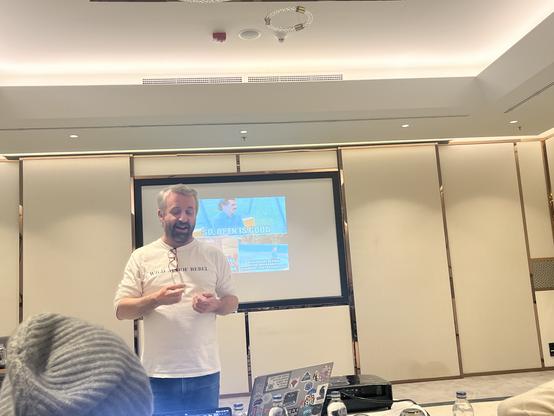
Chainstack is a good example -- in another era, Storj and the Filecoin ecosystem would be hyper competitors (Storj is another tokenized p2p storage group) in a bubble. When I met the Storj folks at #dwebcamp, they were super friendly and wanted to work together. This talk is about an obvious way the two cross over -- you use IPFS to get content-addressable hashes for files, which are stored on say both Storj and Filecoin. But you can still find them because IPFS will just locate it either way.
Watching various bits of the crypto space implode wasn't too surprising (you weren't surprised either, were you?), because if you are trying to build a winner-takes-all protocol or network, decentralization either works against your world domination plots, or has to be abandoned early on in the game to give you a better edge. So many of the remaining players are at least aligned to co-operate. Welp, I hope! ANYWAAAY
Talking of such things, https://grunseid.com/ is talking about https://saturn.tech/ which is a peer-to-peer CDN that lets anyone join to share IPFS content, and be remunerated (in filecoin). It's up to 25Tbps capacity across all the world. Right now yo can join it if you have a 10GiBs connection (I highlight that because it's really the toughest constraint -- pretty much everything else is just kicking up a docker instance).
Ansgar Grunseid

If you serve #IPFS content on your website, this p2p CDN https://saturn.tech is launching a private beta in a couple of weeks, sign up here https://tally.so/r/mRo7xp
Filecoin Saturn | The Web3 CDN

Join the Saturn Network and start earning Filecoin!

I just asked a question about fraud, which is something that's really tricky when you're paying a stranger $$$ based on how much they claim they are distributing content. Reasonable answer about the parallels with clickfraud, and how non-zero levels of fraud are ok, but the long-term answer is just aligning people so that the distance between the person distributing the content, and a person paying to receive it, doesn't have room for fraud. It's still a hard problem though!
Back after lunch at #ipfsconnect, and a room full of people setting up a distributed computation network with @fission 's IPVM initial build -- https://github.com/fission-codes/ipfsconnect-istanbul-workshop-2023
GitHub - fission-codes/ipfsconnect-istanbul-workshop-2023: Instructions and settings for Istanbul, 2023

Instructions and settings for Istanbul, 2023. Contribute to fission-codes/ipfsconnect-istanbul-workshop-2023 development by creating an account on GitHub.

GitHub
So this is a demo of the idea of content-addressed *computation* -- you take a hash of a WASM function, a hash of your inputs, and you get a hash of the output. You only need to run a function with the inputs once, because results are cached across the whole network. Inputs and outputs are grabbable using content-addressing, because if you have the hash, you can find the file! #everywherecomputer
Now I'm sitting with Juan Benet @dietrich , @boris , Megan Klimen and others listening to @robin setting the scene for a discussion of #ipfs governance and nurturing the ecosystem
this was a great discussion, we talked about tooling (and ended up exploring some convos about IPFS chat https://tinyurl.com/ipfschat on https://pol.is/ a tool that we're building on in the #filecoin universe too), gardening and documentation, oral cultures in a zoom era, Coasean floors and teasing out the elemental parts of a governance organization)
Polis

Finally, a fishbowl session where we all agonize about how to make #IPFS mainstream. https://en.wikipedia.org/wiki/Fishbowl_(conversation) -- I've never done this before! I took one for the team and relayed what users tell me about #IPFS first impressions-- that it takes a lot of CPU and network connections. I think it's actually just an issue of Kubo's defaults, but it's the number one papercut I hear about.
Fishbowl (conversation) - Wikipedia

But the really memorable comments were from a developer in China talking about seeing images and messages vanishing in real time from their social timeline, and the impact that has on how they think about IPFS, and a teenage IPFS hacker from here in Istanbul talking about how to convey the software's values to new generations. #ipfsconnect
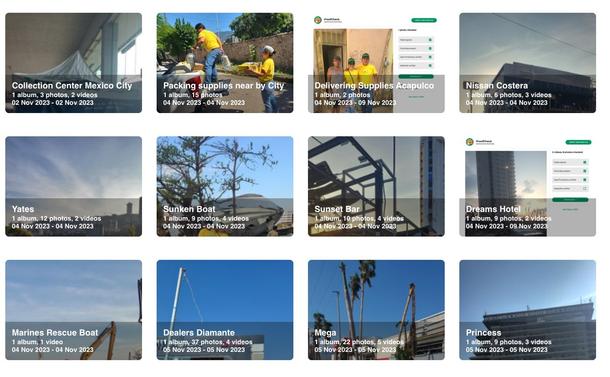
@danny Just posted our semi-mainstream use of IPFS to store visual documentation of hurricane relief efforts in Mexico: https://proofmode.org/blog/hurricane-otis-proofmode - we've been really happy using filebase.com as node+gateway, but also run our own IPFS nodes, and publish CARs to web3.storage, so livin' the dream
BASELINE: Hurricane Otis Relief Efforts in Acapulco, Mexico – ProofMode

A ProofMode Baseline report from our direct work in support of relief and recovery efforts

@danny It includes our call-to-action for community preservation: "If you would like to help preserve this proofpack, you can do so using the following ipfs pin command..." with links to how-to information.
@danny The "SETI@home" nature of this is really appealing I think - if you care about a cause, or event, or audio-visual archive, participate in its preservation using spare storage and cycles you have on your own computing device.
@danny Otherwise, we made this really sweet static site photo+video gallery using thumbsup that is published on ipfs at https://baseline.proofmode.org/ipfs/QmYJMjG3uBDKVZ11GAJSCahiJ2N6uBseFePiHEwoqQw4GP/ aka ipfs://QmYJMjG3uBDKVZ11GAJSCahiJ2N6uBseFePiHEwoqQw4GP
Hurricane Otis - Acapulco - MX - Nov 2023 - ProofPack - Home

@danny this looks great!

I’m also looking forward to a day when you can easily pin an #ipfs DNSLink (or IPNS link) *and have your IPFS server follow changes*. I’d love to see “follow” become “pin” on social graph applications (even blogs), so enjoying something is synonymous with supporting the cost of running it 😊

@danny IPFS seemed like the most useful and straightforward piece of their whole shitstack, I must say. I remember when some folks dug into the NFT mess early on and discovered "Oh, at its root it's just an IPFS URI? Well, that's *boring*! That's just The Internet, isn't it?"
@danny ahah, interesting! I was having some trouble with small private IPFS clusters that I partially pinned down to kubo being tuned for global public usage...
@kitten_tech yeah, Kubo ends up being a bit of a super-generalised codebase (one of the reasons why folks tryed to de-emphasise it as the canonical IPFS implementation -- better to have multiple variants speciialising. I think you'd like #iroh! )