Imagine a future electricity system mainly based on 🌬 #wind and ☀ #solar energy. I guess many of you ask: what happens when the wind doesn’t blow and the sun doesn’t shine?

#Electricity #storage and #interconnection to the rescue! But how do these two interact?

In a recent study (@iScience, @cellpress), co-authored with my colleague @wpschill we looked into exactly that.

Link to the study: https://www.sciencedirect.com/science/article/pii/S2589004223011513?via%3Dihub

🧵 Buckle up and get ready for some energy modelling content!

1/
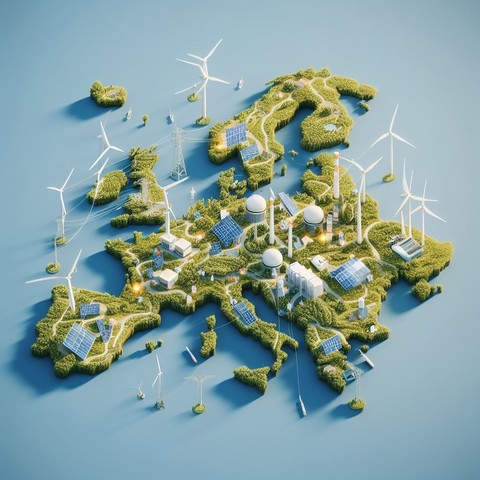
(the pic above was ai generated)

In Europe, most countries will likely rely on a mix of #solar and #wind power to generate most of their #electricity in the future. These are the most important sources of #renewable energy.

However, their #variability is challenging for the #electricity system.

2/

#Temporal and #geographic #flexibility could help here: we could store excess energy and use it in times of need or exchange it with neighboring countries. As all European countries exhibit different weather and demand patterns, and also have different power plants portfolios, these differences could be of help balancing a future 100% renewable electricity system.

3/

One feature established by literature is that in a geographically more extensive electricity system, less storage is needed. This is intuitively plausible, as exchanging energy with neighbouring countries could save us from building and using additional storage for "bad times".

4/

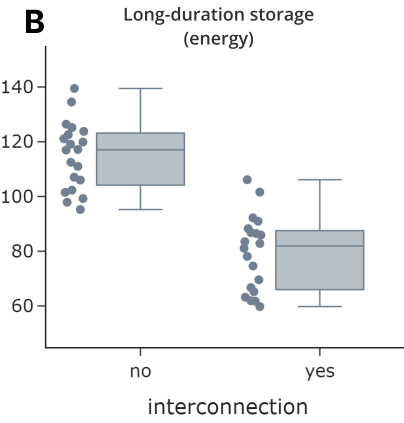
We also find this effect in our analysis. In our setting, with 12 #European countries in a 100%-#renewable energy #scenario, allowing for exchange between countries leads to a drop of 30% for long-duration #storage.

5/

However, what is now the reason for this result? Which of the factors (weather, demand, power plant portfolio) that vary between the countries is exactly driving this result?

To find this out, we employ a "factor separation". We run many counterfactual scenarios to identify the effect of each factor.

This factor separation method has already been used in other fields, such as climate science, and we are - to the best of your knowledge - the first ones to use it in #energysectormodelling.

6/

But what are now the results?

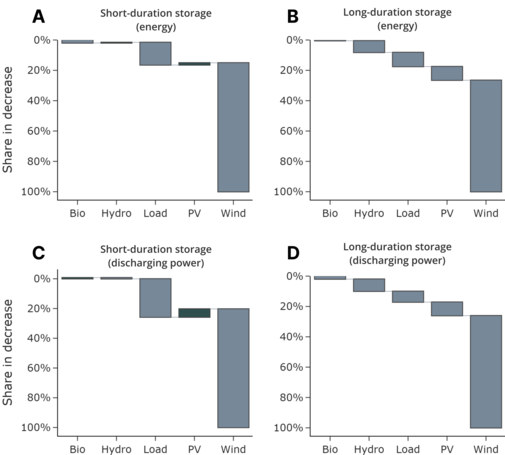
It's mainly wind power: differences in profiles explain around 80% of the drop in storage energy and power.

7/

The principal reason is that wind profiles are less correlated between countries than solar, and demand profiles, for instance.

Hence, in "times of need", there is a possibility that a neighbouring country could supply your own country with electricity generated from wind power. PV and demand profiles are just too correlated to make a sizable difference.

8/

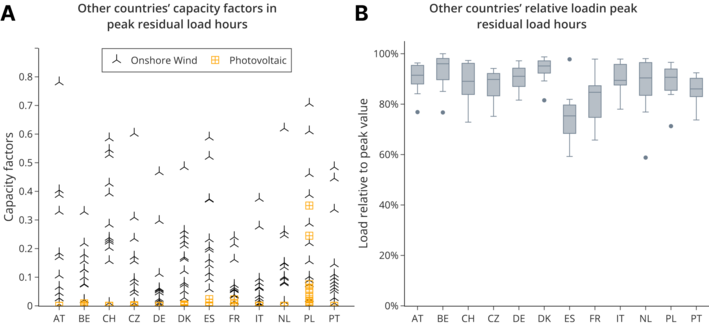
In hours of high electricity demand, neighbouring countries often also exhibit high demand (B). On the contrary, PV feed-in is often low in high-demand hours (A). Wind, on the other hand, is much more heterogeneous.

9/

We hope that this study and its results are interesting to researchers and practitioners equally and will help even better to understand the functioning of the European electricity system.

We're looking forward to your questions and comments!

Here again, is the link to the study: https://www.sciencedirect.com/science/article/pii/S2589004223011513?via%3Dihub