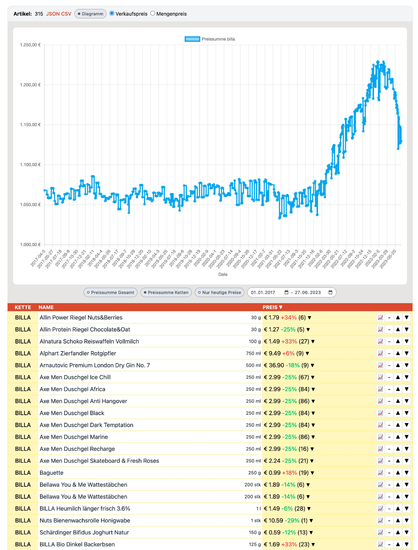
Today was ... interesting. If you followed me for the past months over on the shitbird site, you might have seen a bunch of angry German words, lots of graphs, and the occassional news paper, radio, or TV snippet with yours truely. Let me explain.

In Austria, inflation is way above the EU average. There's no end in sight. This is especially true for basic needs like energy and food.

Our government stated in May that they'd build a food price database together with the big grocery chains. But..
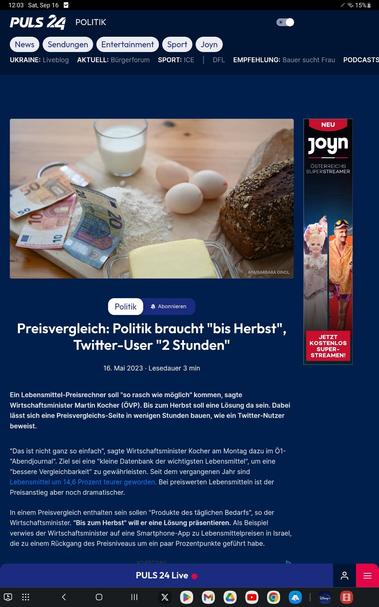
the responsible minister claimed it's an immense task and will take til autumn. It will only include 16 product categories (think flour, milk,etc.). And it will only be updated once a week.

Given how Austria works, some corp close to the minister would have gotten the contract for a million on two to create a POS just enough so the minister can say "look, I did something!"

Well. I heard that and build a prototype for all products of the two biggest chains in 2 hours. The media picked it up...

Here's a selection of media coverage of the entire thing.

https://heisse-preise.io/media.html

It spread like wild fire and made the minister look like an idiot.

I took the thing down in fear of retaliation by the grocery chains. My plan: get a big NGO, news outlet or political party to host the thing and be a legal shield for the endevour.

Almost every NGO, media outlet and political party got in contzct with me (not the other way around). There were lots of promises and big words but zero action.

Heisse Preise

Nicht-kommerzielles Open-Source-Projekt um KonsumentInnen es zu ermöglichen, die günstigste Variante eines Produktes im Handel ausfindig zu machen.

All these orgs only had their self-interest in mind. After two weeks of this bullshit, I figured I might as well gamble and put this thing up in my own name.

Surely the grocery chains won't sue me. The bad PR would easily outweigh whatever little inckme loss they'd suffer from a few hundred people using the site to find the cheapest product.

You see, I'm basically just crawling the stores online stores. Most of them have an API. I then normalize the data across the stores, and expose it.

The whole thing runs client-site. The server fetches the latest data from the stores once a day. All data fits into 5mb of gzipped JSON. Small enough for the client to do anything. The server just serves 8 static files. It can handle serve all of Austria easily and could be scaled trivially. It's just static files.

Being the idiot I am, I also made it open-source:
https://github.com/badlogic/heissepreise

And as usual, people flocked to it and contributed. In no time we had all stores in Austria in there.

GitHub - badlogic/heissepreise: Jo eh.

Jo eh. Contribute to badlogic/heissepreise development by creating an account on GitHub.

GitHub

Then we also got German and Slovenian stores. Then we normalized product categories across stores and added some light data science techniques to match the same or similar products across stores to make prices more easily comparable. You know, iterative improvements.

And then some anomymous guy in Twitter send me the data he crawled for the two biggest chains. Starting in 2017. And that's when thinga really got interesting...

I scrambled to integrate his data into my platform. I added analytics tools. And then I ran my first few analyses. And my jaw dropped.

"Well, that's a bit to much of a price increase even given higher energy prices."

So I started to dig. And boy did I find a lot of things...

My first analysis actually happened before I build the platform. I was manually comparing prices of products the stores themselves offer in the lowest price segment. Things like grocer store brand milk or flour.

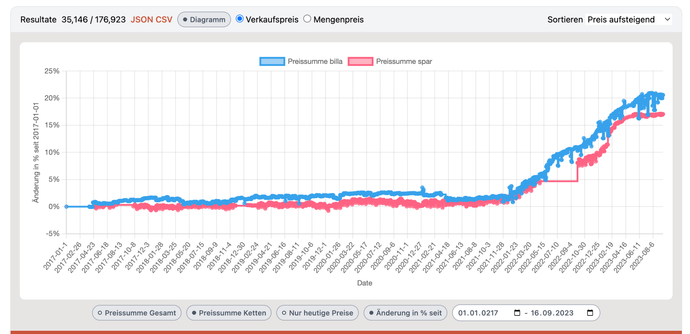
I compared 40 product pairs across the two biggest chains. And lo and behold: their prices matched exactly to the cent!

An NGO picked this up on Twitter and did the analysis for 600 product pairs. Same picture.

With my platform in place, I could do more advanced stuff.

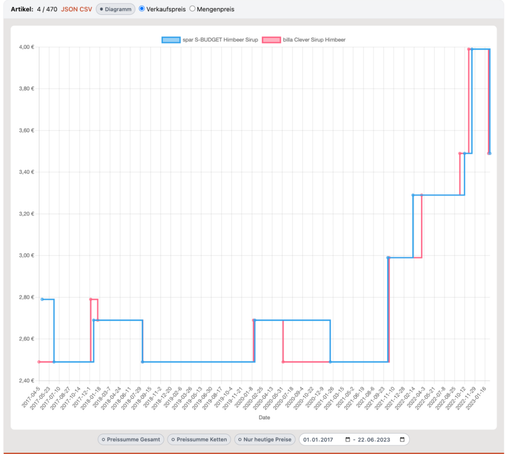
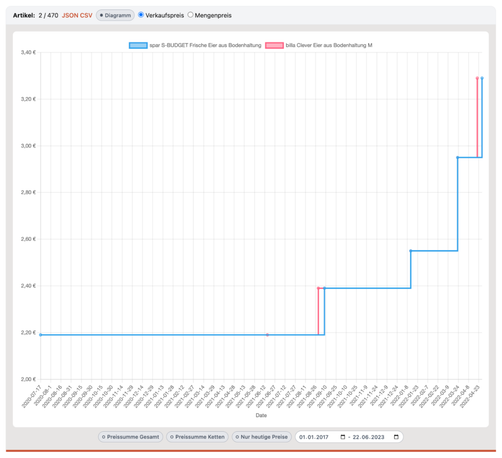
E.g. given the historical data, I could see price movements for a product across the two chains. And you won't believe what I found (well, you know what's coming...)

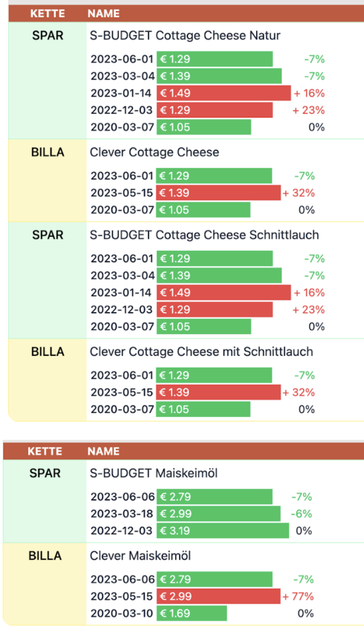
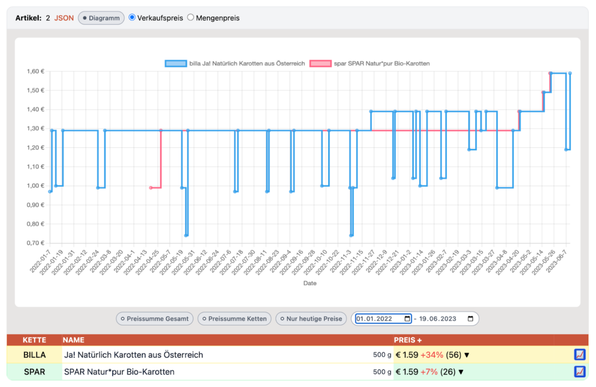
Them fine grocery chains changed the prices of the self-branded low cost products with one to two days, or even on the same day. And they both came up with the exact same price.

This wasn't only happening in the low-price chain-brand segment. It also happened in the mid-range segment of self-branded goods.

And it all started happening when inflation went through the roof.

Clearly, something was up. My guess was: tacit collusion, meaning, oligopolic price coordination without explicit coordination.

Meanwhile, others have build platforms like I did as well. And they too saw these patterns.

There were more.

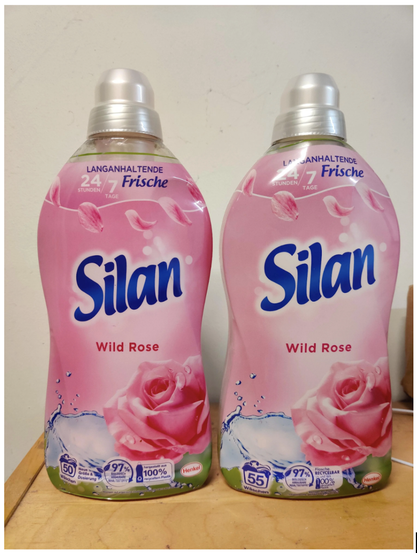
We could show shrinkflation, meaning products with less content are sold for the same or even higher price.

Examplified by e.g. laundry detergent.

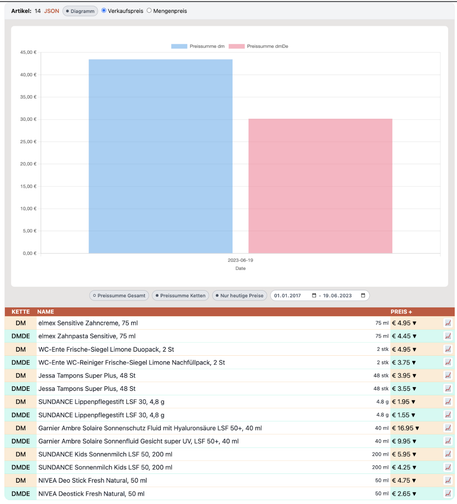
We could also show that the exact same product cost up to 40% less in Germany, a country with higher mean income and higher cost of living.

Even more interestingly, products exclusively produced in Austria cost less outside of Austria.

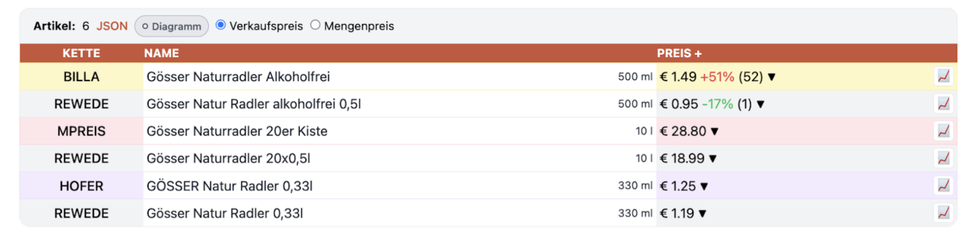
Billa is the Austrian version of REWEDE.

Even fucking Red Bull, an Austrian brand, costs more in Austria when it is discounted here, than it costs normally without discount in Germany.

WTF.

Then I looked at an aspect pretty unique to Austria: discounts.

You see, in a normal country, with a competitive grocery market, you usually have about 10%-20% of products that get discounted on average.

In Austria, that rate is 40%. It's a fantastic way to obfuscate the actual price of a product. As a customer, you'll never know what you'll pay on that day until you see the current discounts directly in the store.

The chains are very generous and will send you discount leaflets via mail.

If I were trying to describe it in more flowerly terms: It's asymmetric information war fare.

The stores tell you they are good and benevolent and only have your interest at heart, so here are discounts. Discounts for everyone. They even gamified the whole thing with stickers. I shit you not. People collect stickers they put on the products in the convery belt at the register. There's also apps, which will give them all info on you

In reality it makes it impossible to know how much things cost

Given the historical data I had, I was able to also check for patterns in the discounts they give. How often, how high.

The grocery chains got a little iffy about all that somewhat negative media coverage, some of which was spurred by my continued analyses.

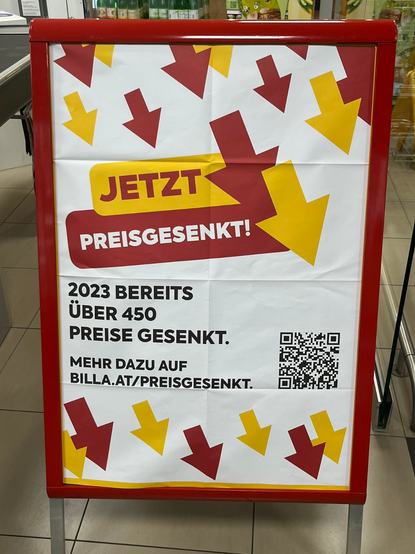
They started to put out these things in the store. It basically says "We've already lowered the prices of 450 products for you this year". With a sortiment of 22000.

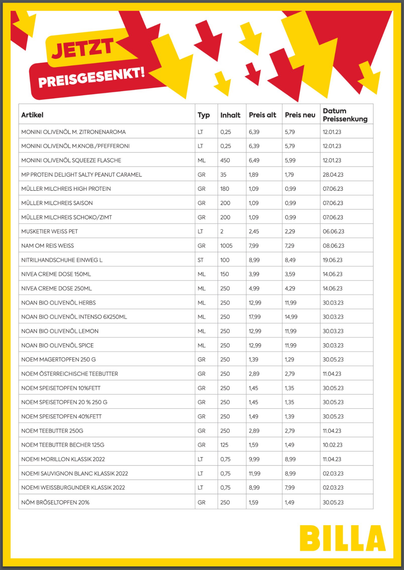
They were also dumb enough to put out a machine readable PDF with all the products they lowered the price for.

With a little data science magic, I was able to match those with my database...

The spot check showed that their claims were true on the surface.

But I'm a stickler for data, so I looked a bit closer.

And lo and behold. There was fun to be had.

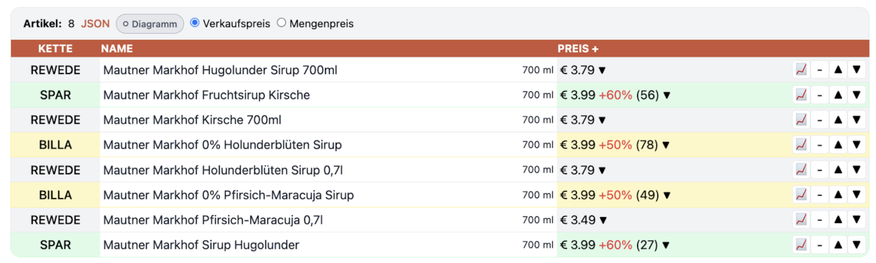
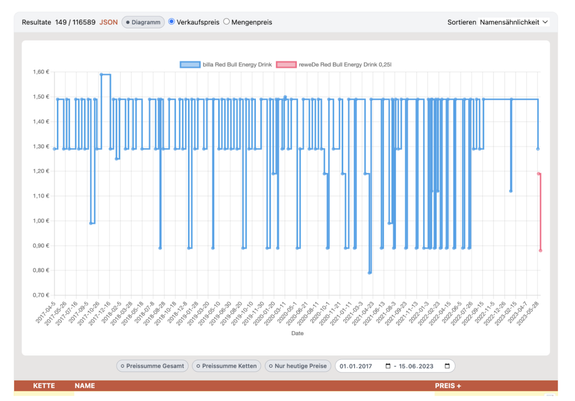
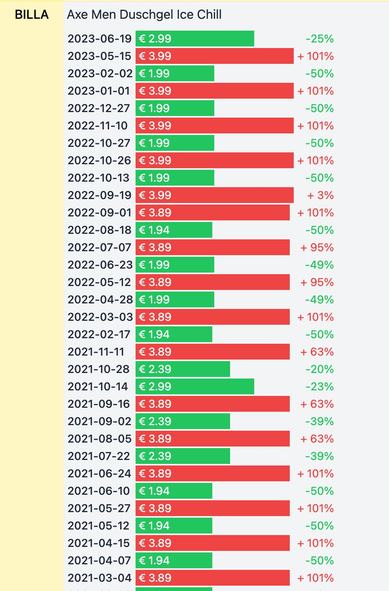
There are products that are cyclic in their price changes. E.g. this axe shower gel, which they listed as having a lower price now.

Yeah, you lowered the price from 3.99 to 2.99. But that follows the exact pattern this product's price had over the last couple of years.

Technically correct. But not a permanent price decrease.

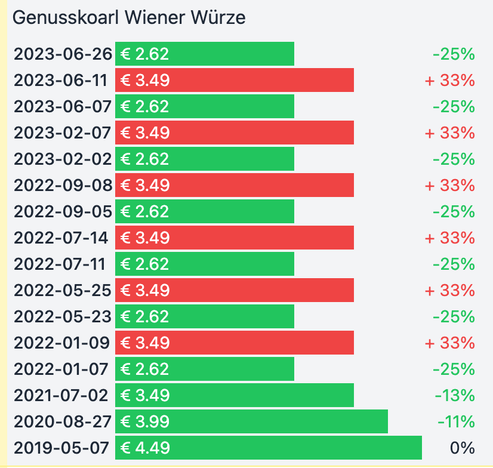
Second picture is another example of that.

But there's a more "nefarious" kind of price decrease.

As I said, Austria is a country of insane amounts of cyclic discounts. Many products will be sold for their "regular" price for one week and a discount price the other.

The real price for the consumer is the average of the regular and discounted price.

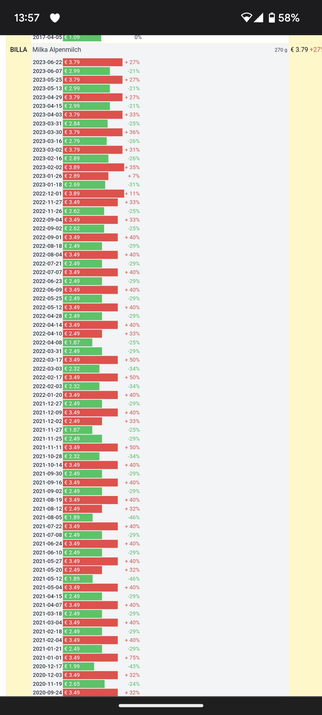
Given this knowledge, do you notice something with the prices for this product the grocery chain claims to have decreased the regular price on?

Of course you do, cause you are a smart cookie.

While their claim that they decreased the regular price is correct, they also increased the discounted price that comes into play every other X weeks/days.

So they are again technically correct: the regular price was decreased.

But on average, a consumer pays more if they buy the product every week, as the discounted price has been increased. The average is higher than before.

Sneaky.

All that media coverage of my platform and the platforms of other people, with whom I've started to converse and who've became friends of sorts, triggered the competition authority of Austria.

You know, the guys and gals who's job it is to sniff out anti-competitive behaviour, cartels, price gauging and coordination and so on.

They contacted all of us to ask what we'd need to continue doing our work. They actually saw value in that.

We provided them with a shit ton of feedback.

The basic gist of that feedback:
- Legal: it must be legal for us to crawl and publish the price data the stores put out on the web in their online stores
- Technical: ideally, stores would be forced to put that data out in a normalized form, so matching and comparisons become easier. We already did that ourselves though, with some data science and heuristics, so no biggie if that doesn't happen.

Besides that feedback, I also send them a shitton of data and patterns I found.

I'm but a lowly computer nerd and lay person, and not someone with an economics degree. I simply handed the data over in the hopes their experts would figure this shit out.

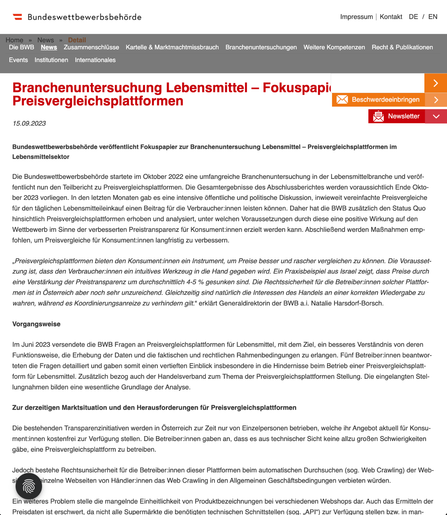
Well. Today they presented their first preliminary report.

In it, they basically copied my long ass email with answers to their questions from earlier more or less verbatim. They agreed with my conclusions regarding what needs to be done on the legal and technical site.

And they also officially said it's very likely the grocery chains use automated systems to follow each other in prices.

No word on the other data. We'll find out what they think end of October when the full report is scheduled to be released.

Now, here's how the chain of command works in this sector.

The competition authority is apolitical but under the reign of the politically appointed minister of economics. They can only report and suggest to him.

He then decides what gets done.

The suggestion by the competition authority to the minister was great:

1. Using the data should be made legal by the legislature for certain parties, including price comparison platforms and academic institutions.
2. Grocery chains of a certain size must publish all their data in real-time according to a predefined scheme with all necessary meta data to make things comparable and allow matching of products across stores.

Fantastic! Or so I thought.

Remember the chain of command. The minister decides what actually gets done.

And that minister is a member of the conservative party. You can already guess what gets done, right?

His plan:
1. The grocery chains must publish data. But only for a hand-picked list of basic products. Not the entire sortiment, like we do now.
2. Platform owners can be sanctioned/sued if they display the data the wrong way.

There's are only two up-sides in all of this.

First of all, the minister initially planned to create a price comparison platform "himself". This would have meant that some company he's buddy buddy with would have gotten a million Euro contract and delivered an abmysal failure of a system.

He's now given up on that.

The second upside: as soon as media coverage of our efforts picked up, the price hikes stopped for the most part. I'm obviously not entirely attributing this to our work. But I like to think we played a part in it.

@badlogic
This reminds me of the price comparison system in UK, which I suspect has the effect of misleading the small versions of the big supermarkets from putting their own brand versions on the shelves. -you can't put them in price comparison advertising: only major brands count. I may be wrong. I can't decide if it started out as a bug or a feature, if it's right.
@badlogic yeah, they are so predictable, it's almost funny.
@badlogic Just a few days earlier I was thinking that this is exactly what we need. I had no idea this was happening just across the border. Thank you for your work. I didn't know that the stores had the APIs, I'll have to look into it.
Mario Zechner (@[email protected])

Oh, and if you want to do this for your own country, you can re-use what we build so far! https://github.com/badlogic/heissepreise Happy to help if you need guidance! Adding a store is usually less than 200 LOC if they have a search API in their web store. https://github.com/badlogic/heissepreise/blob/main/stores/billa.js

Gamedev Mastodon
@badlogic ohhh no I could see what was coming 😰

Great job and amazing thread from @badlogic with a lot of interesting details.

I wish these two points would get more traction and be approved by every country. We definitively need a law granting this in the EU. Omnibus Directive was a small step in this direction.

Citizens need public data with historical trends accessible for everyone, and comparison tools, to break the asymmetric information power of big corps. Not just for supermarkets.

@badlogic Now we know why the grocery stores have an API. They want each other to know when they’re changing prices. What the Minister decides is irrelevant.
@badlogic I hope this becomes an EU-law
@badlogic not sure if they are automated - but, I worked for billa in Marketing until 2022, and if we had a discounted price and the sales person found out it was cheaper than Hofer, spar, etc. we automatically matched it to be their prices because they didn't want to be cheaper but wanted the exact same price???
@badlogic After living here for 7 years and counting I’ve observed that even the ostensibly apolitical is political. Way too much of that small town “favours for your friends” stuff going on even in central government and the very Blues Brothers idea that “balance” equals “We have board members from both parties, the ÖVP *and* the FPÖ!”.
@badlogic and on the other side there’s Vienna being run as the personal fiefdom of the SPÖ thanks to the extra power that comes from
the dual-role mayor/Landeshauptmann thing which the other parties hate but only because they want it to be *their* personal fiefdom instead.
@m jupp that's fucked up too. See Energie Wien and rent prices.

@badlogic did you see the report by the IMF (yes, the Internationale Währungsfond) that half the inflation was caused by company profits? https://www.draketo.de/politik/kommentare#inflation-unternehmensgewinne-iwf
https://www.imf.org/en/Blogs/Articles/2023/06/26/europes-inflation-outlook-depends-on-how-corporate-profits-absorb-wage-gains

It’s crazy that that story didn’t already get people riled up, but it seems they have to see *how* it happens and get a news anchor (2 hours vs. 2 months) to find it, and you showed that beautifully!

Kommentare

Verstreute Werke von ((λ()'Dr.ArneBab))

@badlogic I’m blown away by this. Outstanding work!
@console @badlogic watching prices at lidl i had a similar impression. now we know it's fact :-)

@badlogic Why and how should it be illegal to crawl that data?

Before I read this toot, I wouldn't have worried about this in the slightest.

@morre terms of services of online stores.
@badlogic very good to hear! Glad you were able to help your country and neighboring countries with this, hope they take real action based on this
@badlogic LOL our Commission is fast asleep at the wheel despite plenty of evidence to the contrary. Feel blessed that your Commerce Commission is actually doing something.
@badlogic Wär jetzt interessant dass auch in anderen Länder zu machen. Hier in Japan vergeht kein Monat wo nicht irgendwelche Produkte teuerer werden. :(
@badlogic I'm surprised they aren't diing PWM a.k.a. shortening the discount time compared to non-discount time. Or maybe they do, it's hard to tell from the graph.

@badlogic the cyclic product discounting happens here in Vancouver, BC too. It may well be BC or Canada wide.

Deodorants, Chocolate, Fruit, Vegetables, Chips (Crisps in UK English), Toilet and Kitchen Papers, Cooking Sauces, Breakfast Cereals all come to mind of things I wait to buy multiples of, when they’re on discount.

Canadian Grocers have seen tremendous profit increases in the last 2-3 years.

I wonder if Canadian data is available?

@badlogic Grandios gute Arbeit!
Ich kaufe in verschiedenen Läden und kann einige deiner Schlüsse bestätigen: gleichtzeitige centgenaue Preiserhöhungen, und zyklische billig/teuer-Produkte. Hier in Berlin auch noch unterschiedliche Preisniveaus derselben Kette in unterschiedlichen Lagen.
@badlogic It's probably even worse, because people have obviously picked up on the practice of only buying at discounted prices, so the real average price will be biased towards the discounted price. Also, this whole practice seems like a play against price-sensitive customers where the price sensitivity does not lead to more pressure for competition but the impression of cheap prices (via frequent discounts) is enough to get people into your shop.
@badlogic
Is it really the average? As a customer I always buy in discounted weeks.
@badlogic Could you please share the complete dataset?

@wk sure. All linos to .json and .csv data are in here. You can also get subsets directly from the site. Sorry it's in German. Google translate or DeepL will translate it OKish tho.

https://docs.google.com/document/d/1Q5OWJOICXjSzTEIHBZgJl1p3FsiWFO0lzXIuwGbXBck/edit?usp=drivesdk

Heisse-Preise

HEISSE-PREISE.IO HEISSE-PREISE.IO 1 Ziele & Open-Source 1 Datengrundlage 2 Bedienungsanleitung 3 Produktsuche 3 Suche 3 Ergebnisliste 5 Diagramme 9 Suchen teilen 10 Preisänderungen 10 Warenkörbe 11 Suche für Fortgeschrittene 14 Ziele & Open-Source Heisse-Preise ist als nicht-kommerzielles Ope...

Google Docs
@badlogic this is observably what happens here in Switzerland too.

@badlogic
In Poland we recently got a regulation saying that when advertising a discount, the shop has to provide the lowest price from last 30 days as comparison.

So if 2 weeks ago it was 2.99, yesterday it was 3.99, and today they're lowering the price again to 2.99, they d have to say they lowered from 2.99 to 2.99

@wolf480pl @badlogic I’m sure you’ll be shocked to learn it’s an eu regulation (and even steam now obliges by it but example)
@pony @wolf480pl doubt it's an EU regulation, as it's not happening here in Austria.
Directive 98/6/EC of the European Parliament and of the Coun... - EUR-Lex

@pony @wolf480pl The regulation only requires displaying the selling and unit price. That is in effect here. It doesn't concern discount prices at all. Read the text.
@badlogic @wolf480pl Would you mind taking the same screenshot again, just including one more paragraph following the header on the bottom of it please.
@pony @wolf480pl mea culpa, this wasn't intentional only. Watching our 2 year old and only quickly scanned it. You're right! Interesting.
@badlogic @wolf480pl now of course i don't know how this was transposed into austrian law, however i don't see any exemptions for particular member states, so i assume it somehow was
@pony @wolf480pl I'll check it out, thanks for the hint.