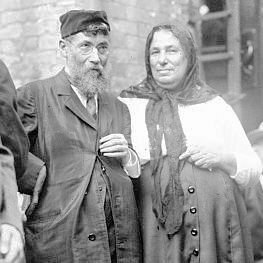
Journalists seem to love writing about the revival of the Yiddish language among younger people.

They've been writing articles about this sudden and new Yiddish Revival since around 1968... which seems a long time to treat something as surprising and new (and, for that matter, as a revival). Also, does the word "revival" really apply if the language never fell out of daily use in some communities?

I'm glad to see #Yiddish getting media coverage, but there's often something a bit "off" about the reporting.

@bwjewishhistory

There's a lot wrong with the coverage. As someone who feels Yiddish is his lost mother tongue, I find the coverage disturbing as well.

When it's non-Jews covering it, it's often Ashkenormative, they don't even want to address Hebrew as the language of Jews for thousands of years.

When it's Jews, the anti-Israel sentiment that becomes anti-Hebrew is palpable. It's this idea that Yiddish was crushed by Zionists, but the fact is that Yiddish theatre has always been a thing in Israel for the elite. Maybe Yiddish was not elevated by Israel, but it's the other languages of Jews that are dead, not Yiddish.

And I've seen enough anti-Sephardi language around Yiddish revival to put me on edge when it's discussed, which is doubly ironic when you realize that most of the power in Israel is held by us Ashkenazi, not the Mizrahi who have been the biggest victims of cultural erasure.

@bwjewishhistory

This is a prime example of the type of coverage I'm talking about, from the NY Times:

https://www.nytimes.com/2023/09/02/opinion/yiddish-language-diaspora.html

This is absolutely gross on multiple levels, including spreading the idea that Israelis were antisemitic!

It's possible to love Yiddish and not hate Hebrew, but this type of article is exactly what's wrong with this discussion.

#antisemitism #Hebrew #Yiddish

Opinion | Yiddish Is Having a Moment

The language has been experiencing something of a revival.

The New York Times
@serge This is true. I know quite a few American Jews who study Yiddish or Ladino and not Hebrew for precisely this reason. Whether they should think this or not is a different question. But the report is accurate on this count.

@bwjewishhistory

Yes, internalized antisemitism is a big problem.

@serge We're talking about people who are proud to be Jews and feel no connection to a foreign country that they're told is theirs, whether they want it or not. Completely different matter.

@bwjewishhistory

"I don't want to learn Hebrew because it's the language of Israel" is internalized antisemitism on so many levels.

We're Jews. Our core language is Hebrew. One may wish to not to speak it, but denying that is essentially denying a core part of our identity.

And not learning Hebrew because of Israel is antisemitic for the same reason that if someone said they didn't want to learn Arabic because of the actions of Arab governments.

And to deny our connection with 50% of our population is also problematic. We can disagree with a government, deeply, without cutting ourselves off from our fellow Jews.

As for Israel being ours whether we want it or not, we're Jews: No one is forcing us to move to Israel, but we can't deny our connection to our homeland either.

This is why it all seems like internalized antisemitism to me, because it's cutting off one's history and heritage for politics.

We Jews have been here before, and it doesn't generally work out well for us to do that.