 Jonathan
Denial in a crisis. 🧵
It's a maladaptive response trying to reimpose order on a world that to the person has lost sense.
I keep saying we need psychologists to weigh in.
[originally posted Aug 2021 on moron's site]
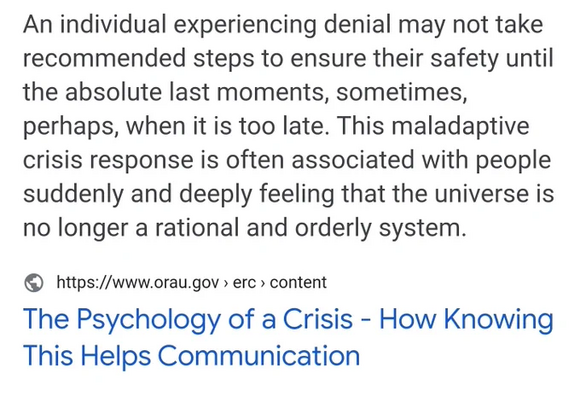
Denial in a crisis. 🧵
It's a maladaptive response trying to reimpose order on a world that to the person has lost sense.
I keep saying we need psychologists to weigh in.
[originally posted Aug 2021 on moron's site]
This is why you see it out of people who are ... odd.
And their followers as well. You will see the followers ssying thank you for the good news.
They are not looking for accurate facts.
They are looking to be soothed.
For any raft they can find in this storm.
I rather suspect the GIVER of "good" (fake) news feels good about giving it and reassuring the RECIPIENT.
And lo and behold we see that happen.
The two adults have self-soothed.
This is why my opposition to idiots in public health "soothing" the public. It is a myth that the public panics. These are just weak people in charge.
Took me 10 s to find a Foreign Policy piece referring to this _disaster sci expert_ saying it's a myth.
And here is the Foreign Policy piece itself.
https://foreignpolicy.com/2020/09/16/trump-woodward-elite-panic-coronavirus-pandemic/
But just to close out, I cannot see that infectious disease doctors (for ex) take a single disaster management course in their training.
Further, public health requires (in Ontario) one year of ID, and to be a doctor.
As I said from the start, these people are not trained for this.
Which is why, and this is just my opinion, we might see so much "be kind" messaging out of them.
It might be as much about being kind to THEM (i.e. not criticizing) as to each other. (Or it's straight career PR. Some are very good at that.)
To be frank, considering what people are going through, most people have continued to be pretty kind to each other
Why did countries in Asia do better than we did? No, IMO, it was not simply they threw on a surgical mask.
They have effective DISASTER RESPONSE systems.
Again, one minute of searching found this Korean article. Korea dealt with MERS.
https://www.ncbi.nlm.nih.gov/pmc/articles/PMC7123823/
"The recent major disasters in Korea ... taught Korea important lessons that cooperation among all relevant organizations, ...is essential for effective disaster response ...and [government] should execute a joint field training program"
And in 15 more seconds, I found this Japanese article discussing mental health consults in times of crisis.
https://www.ncbi.nlm.nih.gov/pmc/articles/PMC7084937/
Within WEEKS the consults are down to a low level.
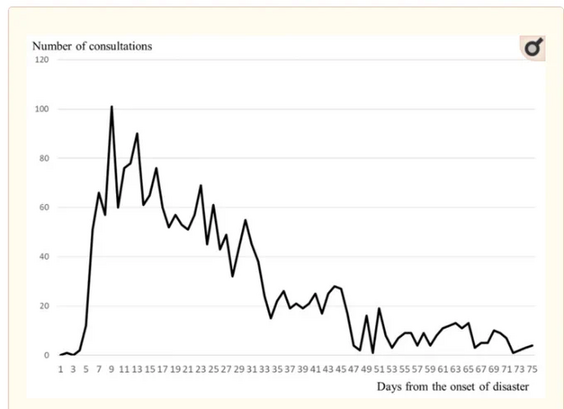

Background: How long acute mental health needs continue after the disaster are problems which must be addressed in the treatment of victims. The aim of this study is to determine victims’ needs by examining activity data from Disaster Psychiatric ...
Not zero. We shouldn't expect them to be zero.
But the myth that people panic and the world goes to pieces is exactly that:
a myth.
Reminder to follow the disaster science expert, above!
(Sure, I may read up before I open my mouth, but I am no expert.)
P.S. This is why people stating risks get called "fear mongerers"
It's a tactic to try to stop messaging that contradicts the worldview of the person trying to self-soothe.
Same with anti-mask sentiment.
Mask is necessarily a signal of risk. Incompatible with "no big deal", the fantasy they desperately want to believe in.

I don't know why I didn't think to search Wikipedia until now but there we go.
Article about how CDC had a messaging plan and it went out the window during this pandemic.
Link to PDF about disaster myth. Hosted at CDC, ha.
https://www.atsdr.cdc.gov/emergency_response/common_misconceptions.pdf
Department of Homeland Security has a link to 2002 guidelines for communication in a crisis.
CDC emergency manuals etc.
Short article about panic myth
https://journals.sagepub.com/doi/pdf/10.1525/ctx.2002.1.3.21

Group panic and irrational behavior did not occur at the World Trade Center on September 11, 2001. Instead the event created a sense of "we-ness" among those threatened, says Rutgers University sociology professor Lee Clarke. In his article, "Panic: Myth or Reality?", in the fall 2002 edition of Contexts magazine, he explains that 50 years of evidence on disasters and extreme situations shows that panic is rare, even when people feel "excessive fear."
Here are the two streams of response:
1. Denial, which avoids the cognitive dissonance and worry about death by simply suggesting to ones' self the danger does not exist. We see this in animal accounts on the bird site.
2. Actually changing behaviour to reduce risk.
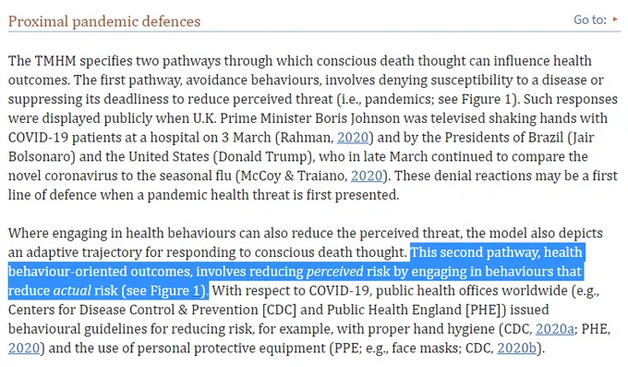
The novel coronavirus, COVID‐19, proliferates as a contagious psychological threat just like the physical disease itself. Due to the growing death toll and constant coverage this pandemic gets, it is likely to activate mortality awareness, to ...
Also, denial does not flow from ignorance.
It is a desire to reject beliefs that do not accord with our existing knowledge or beliefs.
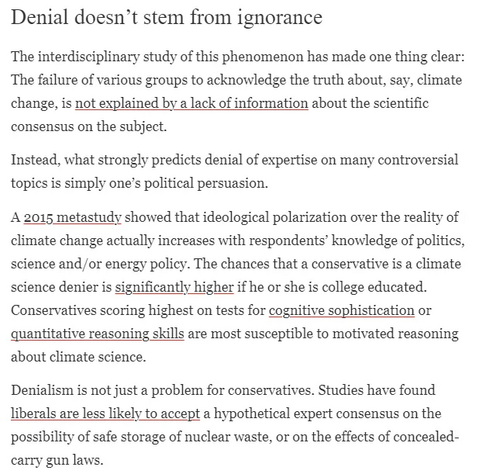

"It is Fauci’s profession of amazement that amazes me. As well-versed as he is in the science of the coronavirus, he’s overlooking the well-established science of 'anti-science bias,' or science denial."
Origins? We used to hang out and caveman & chill in small groups.
Things that didn't fit, got thrown out.
Including Bob, if he suggested we sleep by the lake and not in the cave everyone else wanted to sleep in.
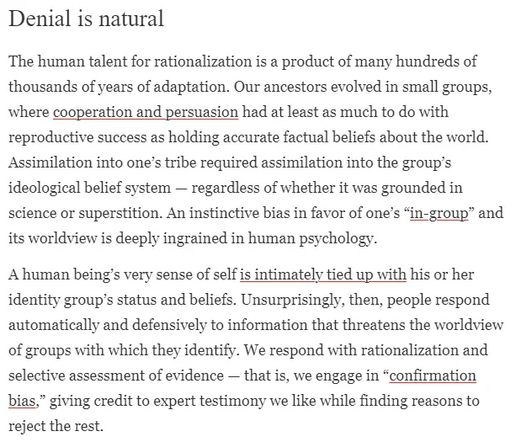
And another about panic myth

When disaster strikes, some people lose their heads, some people become cool and effective, but by far most people act as if they've suddenly forgotten the disaster. They behave in surprisingly mundane ways, right up until it's too late. Around the world, researchers are wondering how to combat normalcy bias.
You may revisit all the lies as institutional failure, in not being trained to respond to a crisis, and attempting to sooth a supposedly panicked public.
It's rather hilarious when you look back on it.
Except for the dead and disabled people.
Then it is not so hilarious.
---
Ah we do everything again, and again, and again.
This from 1948.
"It's not as bad as whooping cough, stop freaking out"
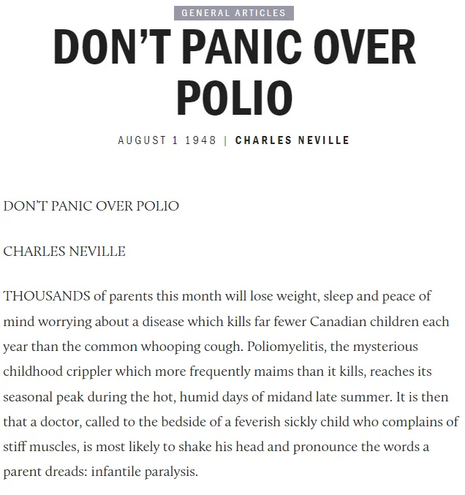
Worry about a risk is normal .
Panic myth is a myth.
Humans repeat the same things again and again.
No, we cannot stop without training.
(And there may be some things like optimism bias/denial we can never quite get over.)
This thread was about psychology.
However, I leave to you as homework to determine:
1. rate of polio, and outcomes;
2. compare/contrast with that of COVID-19.
Are they similar? Dissimilar?
Do we know enough about COVID-19?
Its long-term/developmental issues?
When will we see these things?
As for "again and again" here is a search with the many refs to items that we keep "rediscovering"
https://nitter.net/search?q=again%20and%20again%20from%3A%40jmcrookston&src=typed_query
Repeating mistakes.
Like #COVIDisAirborne.
Well, #MeaslesisAirborne too.
But people forget, measles was droplet first.
The case studies proved it was airborne. Took about 1912->1980 or so.
Book about elite panic.
Video about the topic.

Black plague stories.
[Ed. Because that's what we all want during COVID!]
Elites fled in panic.
Commoners just calmly dug their own graves.
Interesting thought.
Apparently when asked to imagine a mundane situation we will embellish the heck out of it.
Just the same way we imagine the future.
Just the way we are wired.
That's probably why we imagine that people will panic even though if we studied them we'd know they don't.
Again, the people in charge do not study this stuff.
Crisis and risk communication expert. His website has good articles.
_Crisis communication: A behavioural approach_
https://gcs.civilservice.gov.uk/publications/crisis-communication-a-behavioural-approach/
Here's a modern "don't panic over polio".
https://inews.co.uk/opinion/why-we-dont-need-to-panic-about-the-return-of-polio-1703701
_The history of pandemics is a history of denial_
From smallpox to COVID-19, when societies are struck by a plague, the urge to reject reality quickly follows.
https://www.bostonglobe.com/2021/07/17/opinion/history-pandemics-is-history-denial/
Cognitive beliefs found in both children and adults include that things were created with intentional design and are here for our use.
A world that randomly destroys does not "make sense" to these beliefs and to reconcile we must impose order (virus grows milder) or deny.
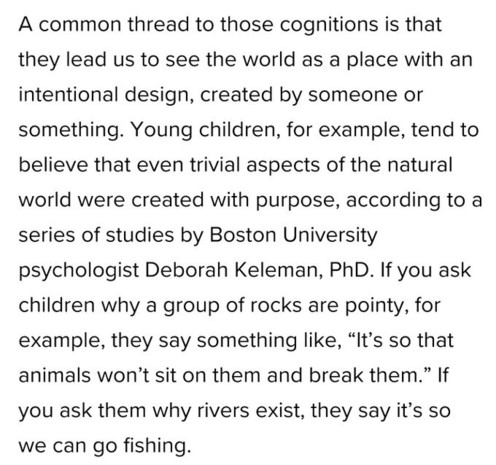
One may introduce an external diety and a reason for the event (punishment).
Or, perhaps, go the other way and impose "order" by way a fatalistic universe
Either way it is interesting to note we've been through this before and will go through it again.
And even the economics effects are the same. (Although no 401k retirement plans to be government propped up back then)
Reactions to Plague:
https://www.worldhistory.org/article/1534/reactions-to-plague-in-the-ancient--medieval-world/
Another:
https://www.worldhistory.org/article/1528/plague-in-the-ancient--medieval-world/
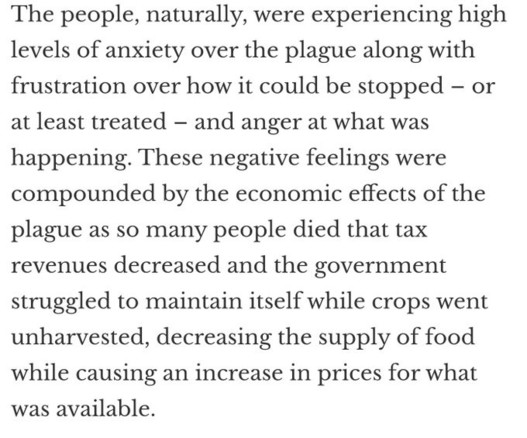
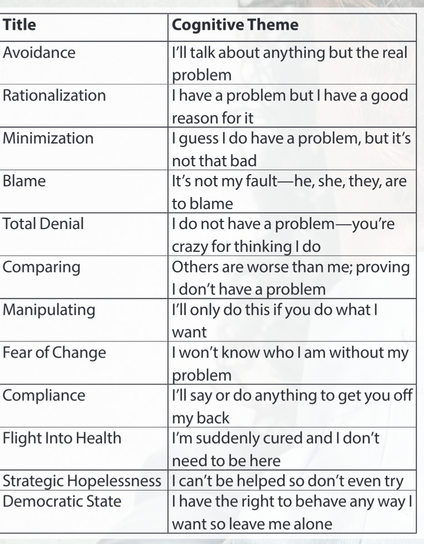
The only thing unique about the #COVID-19 pandemic is it was the first one to occur in the Information Age.


 Coach Pāṇini ®
 Carlos Guerreiro
 Syllus Green