34 B6?
THAT DOESN'T MAKE ANY SENSE
way too short to be a filename and it's also -12, 118 after decoding
HOW DO YOU HAVE NEGATIVE ASCII INDEXES
if we assume it loops around and thus this should be F4 76, it's not valid shift-jis, but in utf-16 it'd be 直, which... makes little sense.
I changed my code to ignore that sometimes the filenames make no sense, but then it errors after that: apparently the filenames not decoding ALSO breaks the variable-length headers. Interesting.
interesting: logo.pac goes "40 3F 00 00 A7 AC AF A7 AF 9F 70 71 6E B4 A9 AD 60 D4"
so my code was stopping after 40 3F.
but A7 AC AF A7 ... looks more like a filename
and it encodes as "glogo_01.tim \x94"
so I must be missing something, like some out-of-band file length indicator
got it. the first 2-4? bytes of the PAC are a list of how many 4-byte words come before the filename.
the 40 3f 00 00 before the filename in LOGO.PAC isn't part of the filename, it's part of the header.
I can't figure out how it's determining when filenames end, though.
Maybe it's assuming they all have extensions and all extensions are 3 letters long?
that makes some of the files make sense and some of the others not make sense!
oh god there is compression
not all files are compressed. but some are
found the code where it parses the PAC headers.
It's terrible as expected.
The pre-pac header stuff gives you a pointer into each header, but then the fun part is that the pointer is not to the beginning, it's to the middle. So it looks things up by indexing forward AND backward
so the filename starts at the offset of, uh, negative 28
and here's how it determines the ending: it's until it hits a 0, OR the filename ends up being 12 characters long.
FUCK
someday I'm gonna reverse engineer a game and not want to timetravel back to its creation and ask them WHAT THE FUCK at gunpoint
sometimes I won't even ask, I'll just start shooting
so I'm just gonna take all my current PAC parsing code and throw it out and replace it with the nonsense of the actual code.
that was my fatal mistake: I was writing parsing code assuming this shit made any fucking sense
also I think there's a mistake in this code OR ghidra is decoding it incorrectly.
it seems to be trying to ensure all filenames are uppercase, but because it's wrong, it is corrupting all non-lowercase characters.
they might not have noticed if they apply the same "uppercase" transformation when trying to load filenames, because both would be corrupted in the same way
okay so now I've got working filenames, offsets, lengths, and compressed lengths. So I can find out what files are where and if they're compressed. I can't uncompress them yet.
I have located the decompression routine.
now to try to figure out what the fuck it does
this decompression routine is big-endian.
on a little-endian system.
it seems it's loading 16bit lengths, then using the top 15 bits? with the lowest bit as a flag?
I don't recognize this. I don't think it's DEFLATE
so looking at this code, it doesn't seem to involve huffman encoding. there's no tables, just some look-back with a sliding (I think?) window.
So this is just a slightly fancy RLE, I think?
I'm gonna try to bypass figuring out the compression right now by just stuffing the ghidra code into a C program and calling it from python
Bingo. it works!
Mostly. my output file is always 64mb but that's because I don't have a good way to tell how big it should be
even more bingo.
I have textures now.
there's some weird-ass shit going on here. like, the datafiles have some PAC chunks with type 36.
As far as I can tell, there's no code that handles chunk-36.
So the only way that makes sense is if part of the game dynamically loads code which then registers a chunk-36 parser
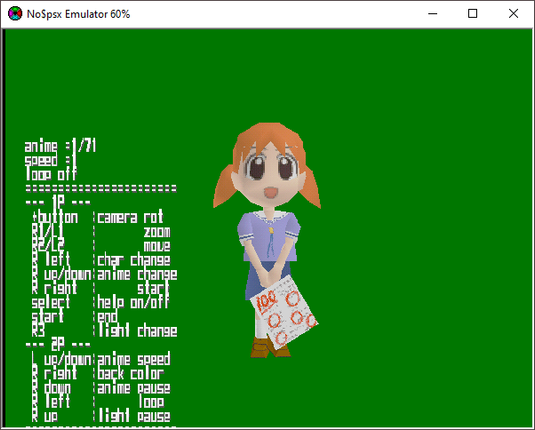
so each character is stored in a a PAC file under viewer\ (inside AZU.APF)
So like, the first Chiyo-chan is chi_v.pac
That PAC file contains 91 texture images and a 95 kilobyte GMD file, which seems to contain all the geometry AND animations.
so the next step is to figure out how GMD works.
Fortunately I know where the function that parses it starts
the code also seems to handle decoding two versions of the GMD format, but I can only find one in use in the datafiles.
Maybe they used the other in the One Piece games, and just never dropped support?
oh hello. I took a quick look at the second of the One Piece games, and it turns out they did the same thing as Azumanga and included the executable inside the APF file... but they did it twice, and the two don't match!
and it looks like that for the second One Piece game, it uses .TMD files, which have a completely different header than the two supported by azumanga
ahh. it looks like the GMD format gets loaded recursively, and I bet that's why there are a total of 3 (not 2, as I suspected) different versions of it.
I bet versions 1 and 0 appear inside version 2
interesting string:
"This is Technosoft\'s communication shell password"
Technosoft is the company that game before Ganbarion. Apparently they built some kind of communication shell utility for their PS1 games
ugh I'm not being paid enough for this.
so it seems there's a complex function-pointer system used so that the main loop can stay the same, and it can be overwritten by overlays loaded from the APF files
but it's a ton of function pointers being thrown around and it just makes me go crosseyed
return (int)*(short *)(**(int **)(*(int *)(param_1 + 0xc) + 0x14) + 0x10);
C is such a simple and expressive language
@foone With that horrific piece of indirection, please give me a less expressive language so I'll be horrified about the code instead of being horrified about the design.
 Alice Averlong🏳️⚧️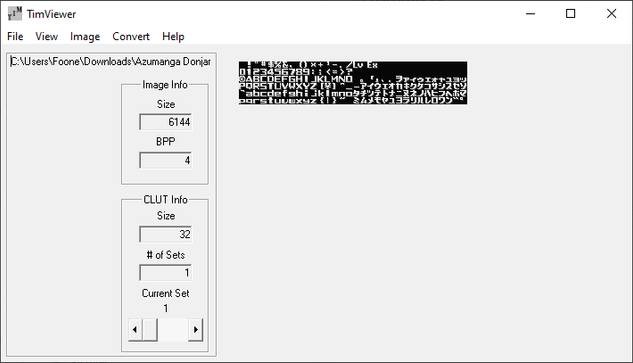

 Orc
Orc