
Moralizing Nostalgia Leads to Bad History – and Helps the Anti-Democratic Right
 
David Brooks’ “How America Got Mean” offers an ahistorical tale that obscures rather than illuminates – and provides fertile ground for a politics of reaction.
 
A thread, based on my new piece: https://thomaszimmer.substack.com/p/moralizing-nostalgia-leads-to-bad
Moralizing Nostalgia Leads to Bad History – and Helps the Anti-Democratic Right

David Brooks’ “How America Got Mean” offers an ahistorical tale that obscures rather than illuminates – and provides fertile ground for a politics of reaction

Democracy Americana
The story Brooks tells is one of moral decay – where once there was personal virtue and a whole network of institutions dedicated to “moral formation,” there is now a black hole of amoral emptiness that people try to fill by engaging in “moral war” and “tribalism.” 2/
Brooks’ story doesn’t hold up to scrutiny and is indicative of a much larger problem: A pervasive longing for a golden past that never really existed, providing dangerously fertile ground for a reactionary politics of weaponized nostalgia. 3/
There are at least three major problems with the diagnosis Brooks presents here. First, he operates entirely on the level of individual behavior, unwilling to grapple with the systemic injustices and inequalities against which individual morality must fail as an antidote. 4/
Secondly, Brooks completely obscures the specifics and the stakes of the political conflict that is shaping the country and has shaped much of U.S. history by dissolving everything into an ultimately apolitical morality tale. 5/
Look closely at the phenomena Brooks presents as evidence for his morality tale and they point to a concrete political conflict. For that, however, Brooks has nothing but contempt. Brooks is as disgusted as he is frustrated by what he perceives as silly “tribalism.” 6/
Brooks is either entirely oblivious or utterly dismissive of the actual stakes in the current political struggle; that people might engage in politics because their basic rights and civil liberties are under assault seems beyond him. 7/
Are trans people just reveling in “tribalism” because they feel spiritually empty? Are women mobilizing because they are looking to fill the moral void – or could it have something to do with the fact that millions have been degraded to the status of second-class citizens? 8/
Are Black Lives Matter activists merely flocking to “identity politics” because they are so “internally fragile” – or are they organizing because they are trying to somehow get the country to address racist police violence? 9/
The piece is over 11,000 words long. Yet there is nothing here about the political and ideological conflict over fundamentally incompatible ideas of what this country should be – a white Christian patriarchal society or an egalitarian multiracial, pluralistic democracy. 10/
The third major problem with David Brooks’ interpretation: It is based on an utterly ahistorical understanding of the past and a rather bizarrely distorted perspective on U.S. history. Brooks is simply not a trustworthy narrator of how we got to where we are today. 11/
How does he reconcile his argument with the fact that the era of supposedly intact moral education, when “America was awash in morally formative institutions,” coincided with the worst forms of slavery, genocidal violence, and white supremacist apartheid? 12/
What does Brooks make of the fact that significant progress towards multiracial, pluralistic democracy was made after “moral formation” was, according to the author, largely abandoned? The answer is: He doesn’t. 13/
The message seems to be (my words, not his): “This society was horrible when all this morality formation was ubiquitous, and it has gotten so much better since that was abandoned – and yet, all of today’s problems can be traced to the tragic abandonment of morality formation.” 14/
Brooks presents insufficient evidence to support an inconsistent and ahistorical diagnosis. But his view of America appeals to people across a relatively wide ideological spectrum not in spite of these flaws. They are precisely what makes the argument so attractive. 15/
To the center-Right, and “moderate” (former) Republicans, Brooks offers an apologist narrative for anyone who doesn’t want to engage in critical introspection over the question of how the party they used to support until very recently ended up uniting behind Donald Trump. 16/
No need to inquire about their own role in conservative politics, in fostering a cultural and ideological environment in which Trumpism could flourish. What could they have possibly done to avert a crisis that was brought about by secular amorality? Not their fault, certainly. 17/
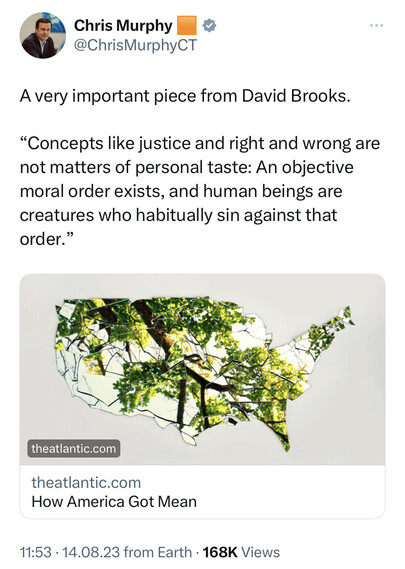
Brooks’ diagnosis also has appeal well beyond the conservative political spectrum. Democratic Connecticut senator Chris Murphy, for instance, recommended the “very important piece from David Brooks” to his audience on Twitter. 18/
What liberal elites, in particular, almost reflexively support is the unity gospel aspect of “How America Got Mean” and the nostalgic view of the past in which America was supposedly characterized not by polarization, but by a common enterprise to be good. 19/
This is what makes this piece interesting: the way it articulates, justifies, and ennobles a sense of nostalgia that is prevalent among moderate conservatives, at the center, as well as deep into the liberal camp. 20/
Much of the mainstream political discourse is shaped by nostalgia – and the Right understands that they can latch onto that, weaponize it, in order to make their political project of rolling back the social and political progress of the past century more attractive. 21/
@tzimmer_history Is there anything in the culture war that Chris Murphy won't be bamboozled by?

@tzimmer_history

Gah. No longer on Twitter to observe the irresponsible revisionism and "leadership" there.

@tzimmer_history

He's never even been a trustworthy narrator of what we are today.

@tzimmer_history it’s somewhat wild that the people rallying against tribalism are only rallying against non-white cis straight male tribalism.
@tzimmer_history Conservatives, including Brooks (whether he'd ever have the intellectual honesty to say so or not), are absolutely fine with large chunks of society being second-class citizens. This is, in fact, necessary and central to American conservative aspirations.

It’s so weird Brooks looks at a conflict between eliminationism on the one hand and multiculturalism on the other and considers that frustrating tribalism.

The ascension of one of those sides, even for people like Brooks, means exile or death.

@tzimmer_history

@tzimmer_history Does he include himself in that story of moral decay, having divorced his wife of 27 years to marry his assistant who is 23 years younger than him?
@tzimmer_history ugh and chris murphy signed onto it? depressing.
@tzimmer_history this doesn’t seem too different from Hillary’s recent Atlantic piece to me though—looking to old-fashioned institutions. Could there be something true about this? That we need *something* to bring people together in the flesh? And if we are oppressed we need each other, in person, all the more?
@jillrhudy Well, you can make anything sound reasonable if you put it in a very abstract way. But Brooks isn’t simply saying “Hey, maybe some old-fashioned institutions could be helpful.” You said that.
@tzimmer_history let me read the Brooks article in full and then comment further. I agree with you that false nostalgia can be poisonous. I just subscribed to the Atlantic, because with @TheAtlantic on here I see something I want to read every day.
@tzimmer_history I gotta agree with you that we can't just separate morality and politics the way he does. The New Gilded Age creates massive genuine misery. Poverty and misery go together. I had exemplary "moral training" and yet when I gave my children all the food and went to bed hungry I was miserable.
@tzimmer_history This is one of the things he's "good" at.
@tzimmer_history aw man--don't make me read David Brooks...

@tzimmer_history

How America got mean... Newt Gingrich, extremist evangelicals. movement conservatives... they demanded power to rule over America at any and every cost... and here we are....

"Newt Gingrich turned partisan battles into bloodsport, wrecked Congress, and paved the way for Trump's rise."

a basic everyday mans perspective... obviously it's more than that, but... the line form Gingrich to the hate we see today.. pretty direct.

@tdwllms1 @tzimmer_history The meanness was always there: See J. Edgar Hoover.

@c_merriweather

I was just coming back to say.. we've always been mean... always. @tzimmer_history

@tzimmer_history Brooks lives in a fantasy world. He still thinks there are "moderate Reagan conservatives" out there ... which is just wrong AND completely ignores the role Reagan had in the hateful rhetoric of the right, the tilting of the economy to massively benefit the wealthy and foreign policy that was at times completely illegal and unconstitutional. Further, THOSE policies are at the root of a lot of the instability today in central America and our "refugee crisis" at the border.
@tzimmer_history I love his "married people have decreased, sadness has increased" causation argument. That logic definitely checks out! Isn't he basically being tribal by suggesting that those who don't live by his idea of virtue are "mean"?

@tzimmer_history Thanks for doing this. I"ve been thinking on similar lines.

One striking thing about Brooks is his absolute inability to address politics. His desperate urge to transform every issue into a cultural framework is a reaction, I believe, to his unacknowledged awareness that all his political claims throughout his career have been wrong.

@tomlevenson @tzimmer_history Yes, well done. Brooks’ inability to address politics is matched only by his inability to report. The trends he cites on sadness and meanness vary wildly by geography and demographics. Does that mean Calif. & NY are doing better on moral development than Kentucky? He says, “We inhabit a society in which people are no longer trained in how to treat others with kindness and consideration.” Yet not a word about SEL, under attack by the right for doing precisely that.
@tzimmer_history It's amazingly astonishing reading the comments and seeing how a pseudo intellectual with illogical bad faith arguments can derail a perfectly sound and well written response to Brooks nonsense. 🙄

@tzimmer_history Brooks is utterly oblivious.

His previous essay on happiness had him confusing happy/sad normal days with actual MDD, and he misused medical statistics in irresponsible ways that were pretty transparently "hey, this stat matches my assumptions".

I'm not surprised to see that he's as bad at playing historian as he is at playing doctor. The Atlantic's editorial staff have pretty much vanished, as near as I can tell, leaving their authors free to make stuff up.

@UncivilServant I think the more concerning explanation is that, ideologically and politically, this is the kind of diagnosis the leadership at The Atlantic favors and therefore happily platforms.

@tzimmer_history Good point. It's a hard ideology to nail down, since it's almost a faux-centrism. I mean that where centrism supports evidence-based policy, they seem to prefer "White suburban college educated common sense" and genuinely believe the two to be identical.

It's not populism, and not quite populism's cousin in a business suit. But I do think that to name a thing makes it easier to distinguish, otherwise it's easy to dismiss, as I did, as a simple lapse of standards.

@tzimmer_history
#DavidBrooks is the archetype against which the phrase #OkayBoomer should be lobbed. So high on his own supply of "the good ol days", and utterly devoid of any measure of introspection or ability to learn.