 Vacuumfountain
 Ars Technica
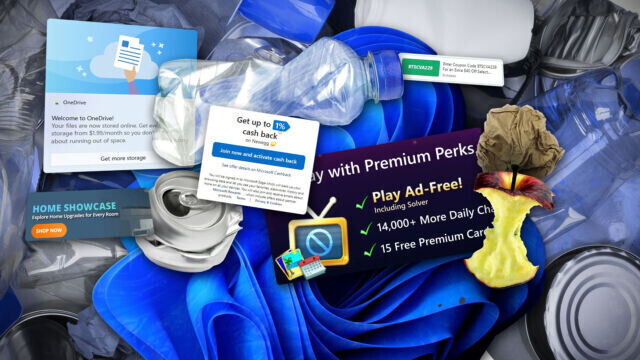
Windows 11 has made the “clean Windows install” an oxymoron
Op-ed: PC makers used to need to bring their own add-on bloatware—no longer.
Windows 11 has made the “clean Windows install” an oxymoron
Op-ed: PC makers used to need to bring their own add-on bloatware—no longer.
@arstechnica
There are good guides that help you install Windows 11 without all the crap it comes with, and without breaking the system. Here's one https://www.youtube.com/watch?v=6UQZ5oQg8XA&t=459s
But the real solution, and one that is being perfect for me... is to just install Linux, zero enshitification problems here.
I have windows 11 in dual boot only because of work-related things, but man there's no comparison to Linux at all. Much better experience overall, warts and all compared to Windows 11.

@arstechnica To be honest, enshittification of Windows goes back a lot further, although years ago it was more subtle.
Windows 1.x-3.x was bare-bones… it had to be, it was shipped on floppies. 3.11 required 7 1.44MB floppies. It gave you the basics. No OEM license key needed to install. Windows 3.0 introduced the Program Manager, with MS-DOS Executive morphing into the File Manager.
MS and IBM collaborated on OS/2, but when that fell apart, Windows NT began, around 1993. It included more, but was still pretty "basic". It used a "layered" kernel architecture (cross between monolithic and microkernel).
Windows 4.0 (Chicago) started soon after… and in late 1995 to the sound track of "The Rolling Stones - Start Me Up", it was released as Windows 95. It pushed the Microsoft Network (their BBS cum WebTV service) fairly prominently. It also required you enter a license key to install (I still remember two OEM license keys to this day). This OS introduced the concept of the task bar and start menu.
Windows NT 4.0 was released, sporting OpenGL and the same desktop as Windows 95. Some graphics routines were implemented in kernel drivers -- the "layered" architecture is now polluted with UI cruft.
IE 4.0 was released with ActiveDesktop. This was built-in to Windows 98, and also would self-install on Windows 95 rev D if you weren't quick enough to eject the CD after install. ActiveDirectory normalised the idea of using a web browser engine to render the file management windows (Windows Explorer), as well as desktop widgets.
Windows 98 wound up being a QA disaster, and soon was followed up with Windows 98 SE which fixed many flaws.
Microsoft spent so much time refining Windows NT 4.0 into Windows 2000 they forgot about the consumers, so they pushed a hack job called Windows ME. It was a bigger mistake than Windows 98. It was also the last DOS-based Windows release.
Windows XP came out two years later, and aside from the "Luna" UI, was the first to require online activation. It came with IE6 which became the bane of web developers worldwide. The start menu was tweaked to a two-column format (but the old single-column "classic" format was still available).
Windows Vista re-vamped the UI with the Aero interface. The OS was a resource hog and utter flop. This was the last version of Windows to support the "classic" (Win95-esque single-column) start menu.
Windows 7 fixed a lot of issues with Windows Vista but kept its UI. It did drop the classic start menu though -- you now had only the two-column version that XP introduced (unless you installed ClassicShell or similar).
Windows 8 was the touchscreen-oriented disaster that cost Steve Ballmer his job. It very aggressively pushed the concept of the Microsoft Store and Metro^WModern applications. Start menu was replaced with a full-screen launcher. It also did away with the start button.
Windows 8.1 walked back some changes from Windows 8, notably the start button returned.
Windows 10 introduced telemetry monitoring and "Windows as a Service". The telemetry was later backported to 7, 8 and 8.1. It further walked back 8.1's UI, but still heavily pushes Microsoft's store and online services.
Windows 11 is basically a billboard for MS online services now.
@tk @arstechnica Gaming will be a challenge in that situation.
In fact, using a computer at all will be a challenge if you've got a marginal Internet connection.

 k cavaliere
 Glitchy Pixel
 Stuart Longland (VK4MSL)
 Neil E. Hodges
 Kaito
Kaito luddite 🇵🇸 computer
 Matt
Matt Professor Dickson