

#Papertime! ๐ŸŒŒ ๐Ÿ’ซ ๐Ÿ“ก (From Monday, but I totally did not have the time to post this before ...)

"The first mm detection of a neutron star high-mass X-ray binary" led by the amazing J. van den Eijnden, including @fuerst, @pkretsch, yours truly et al.
MNRAS submitted (not yet refereed).

โ–ถ๏ธ https://ui.adsabs.harvard.edu/abs/2023arXiv230806021V/abstract

What is this about and why is this important? Follow along for a science ๐Ÿงต

#Astrodon #astronomy #XraysAreTheBestRays #astrophysics
1/7

The first mm detection of a neutron star high-mass X-ray binary

Neutron stars accreting from massive binary companions come in a wide range of types. Systems with an OB supergiant donor are often divided between persistently and transiently accreting systems, respectively called Supergiant X-ray Binaries (SgXBs) and Supergiant Fast X-ray Transients (SFXTs). The origin of this dichotomy in accretion behaviour is typically attributed to systematic differences in the massive stellar wind, the binary orbit, or magnetic field configuration, but direct observational evidence for these hypotheses remains sparse. Here, we present the results of a pilot exploration of a novel approach to this long-standing question, turning to the mm band to probe the outer regions of the stellar wind beyond the binary orbit. Specifically, we present 100-GHz NOEMA observations of a SgXB, X1908+075, and a SFXT, IGR J18410-0535. We detect the SFXT as a point source at $63.4 \pm 9.6$ $\mu$Jy, while the SgXB is not detected. The spectrum of IGR J18410-0535 is constrained to be flat or inverted by comparing with quasi-simultaneous $5.5$+$9$ GHz radio observations, ruling out non-thermal flaring and consistent with thermal wind emission. Additional X-ray measurements further constrain the wind mass loss rate and velocity of the SgXB. We compare our targets with each other and earlier wind estimates, and reflect on future opportunities using this novel observational approach to characterize stellar winds in X-ray binaries.
NASA/ADS

In a high-mass X-ray binary (HMXBs), a compact object (usually a neutron star) orbits closely around a massive star and persistently or transiently accreting mass from its companion. If the donor is an OB (blue supergiant) star, the accretion happens through the stellar wind of the companion.

OB stars are key object in astrophysics & their mass loss has major impact on their evolution. HMXBs give a unique view of these winds.
2/7

There are two types of HMXBs with OB companions:

1. persistent, averagely-bright systems, supergiant X-ray binaries (SgXBs)

2. Supergiant fast X-ray transients (SFXTs) which are mostly in weakly accreting very faint states, interspersed by brief very bright X-ray flares

Something about the interaction between the gravitationally captured wind in these systems with the neutron star magnetic fields is different. But we don't know what yet!
3/7

Folks have previously tried to find differences in the properties of these to types of systems using different approaches, but with mixed results. Given the low numbers of systems that can be investigated and the challenges inherent to IR,optical and UV analysis, we present steps towards a new, complementary approach using mm data.

To do so, we observed a SgXB (called X1908+075 or 4U 1909+07) and a SFXT (IGR J18410-0535) in a pilot study with the Northern Extended Millimetre Array (NOEMA).
4/7

This resulted in first mm detection of a SFXT! ๐Ÿฅณ
(Side note: I always wanted to be on a paper with "a first detection" in the title :D)

We do not detect the SgXB, on the other hand.

The SFXT mm emission can arise from thermal stellar wind emission, non-thermal jets, a combination thereof or the jet-wind interaction. We detect the SFXT in the quiescent state, where the jet contribution is unlikely.
5/7

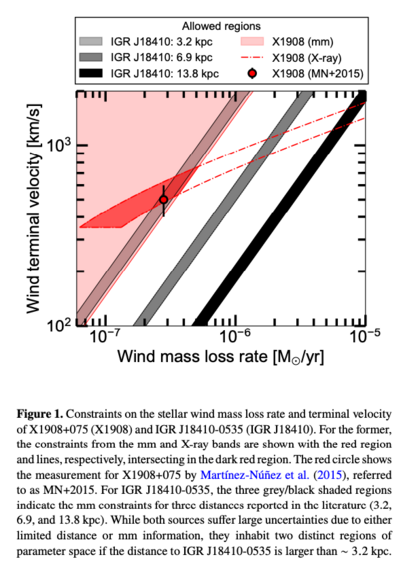
We can then show, using some additional archival observations, that if the distance to the SFXT is larger than 3.2 kpc, the two sources live in different areas in the wind terminal velocity vs. wind mass loss rate space.

This is super intriguing. But of course this is just two sources so far!

So we discuss some caveats of the assumptions we made in our estaimates & how to proceed next in order to obtain a good constraint with more sources.
6/7

This was a fun paper, totally out of my normal wavelength area (there is a reason why my name is so far back on the author list!), but also, to me, highlighting the importance of

a) our X-Wind collaboration, bringing folks from different areas together and trying to emphasize the importance of HMXB wind studies

b) working together across different wavelength and methods. Challenging, but super rewarding scientifically!

#Astrodon #astronomy #XraysAreTheBestRays #astrophysics
7/7

Btw., thread written with https://rstockm.github.io/mastothread/ - which is a bit buggy but still HIGHLY recommended!
Mastothread

Wooot! The paper ๐Ÿ‘† is accepted! See also: https://arxiv.org/abs/2308.06021

#astrodon #XraysAreTheBestRays

The first mm detection of a neutron star high-mass X-ray binary

Neutron stars accreting from OB supergiants are often divided between persistently and transiently accreting systems, called Supergiant X-ray Binaries (SgXBs) and Supergiant Fast X-ray Transients (SFXTs). This dichotomy in accretion behaviour is typically attributed to systematic differences in the massive stellar wind, binary orbit, or magnetic field configuration, but direct observational evidence for these hypotheses remains sparse. To investigate their stellar winds, we present the results of pilot 100-GHz observations of one SFXT and one SgXB with the Northern Extended Millimetre Array. The SFXT, IGR J18410-0535, is detected as a point source at $63.4 \pm 9.6$ $ฮผ$Jy, while the SgXB, IGR J18410-0535 remains undetected. Radio observations of IGR J18410-0535 imply a flat or inverted low-frequency spectrum, arguing for wind emission and against non-thermal flaring. Due to the uncertain SFXT distance, however, the observations do not necessarily imply a difference between the wind properties of the SFXT and SgXB. We compare the mm constraints with other HMXBs and isolated OB supergiants, before considering how future mm campaigns can constrain HMXB wind properties by including X-ray measurements. Specifically, we discuss caveats and future steps to successfully measure wind mass loss rates and velocities in HMXBs with coordinated mm, radio, and X-ray campaigns.

arXiv.org