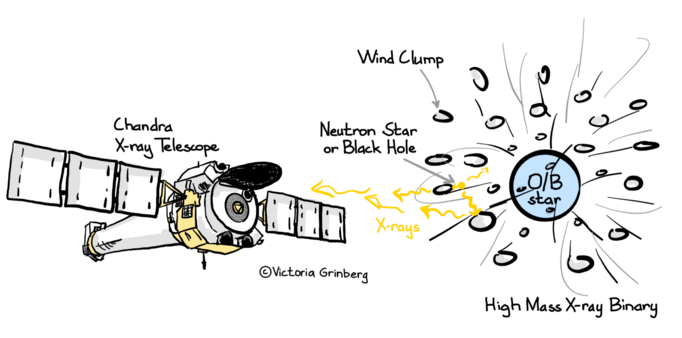
#Papertime! "Characterisation of the stellar wind in Cyg X-1 via modelling of colour-colour diagrams" by E. V. Lai et al., including yours truly

▶️ https://arxiv.org/abs/2408.05852

I especially love this paper because a PhD student read a paper of mine, took the method I developed there (https://ui.adsabs.harvard.edu/abs/2020A%26A...643A.109G/abstract), cleverly applied it to her data and developed a statistical approach to evaluate the models vs. the data, a step my original proposal did not make.
#astrodon #XraysAreTheBestRays

Characterisation of the stellar wind in Cyg X-1 via modelling of colour-colour diagrams

Cygnus X-1 is a high mass X-ray binary where accretion onto the black hole is mediated by the stellar wind from the blue supergiant companion star HDE 226868. Depending on the position of the black hole along the orbit, X-ray observations can probe different layers of the stellar wind. Deeper wind layers can be investigated at superior conjunction (i.e. null orbital phases). We aim at characterising the stellar wind in the Cyg X-1/HDE 226868 system analysing one passage at superior conjunction covered by XMM-Newton during the CHOCBOX campaign via modelling of colour-colour diagrams. Since X-ray absorption is energy-dependent, colour indices provide information on the parameters of the stellar wind, such as the column density $N_{H,w}$ and the covering factor $f_c$. We fitted colour-colour diagrams with models that include both a continuum and a stellar wind component. We used the KDE method to infer the unknown probability distribution of the data points in the colour-colour diagram, and selected the model corresponding to the highest likelihood. In order to study the temporal evolution of the wind around superior conjunction, we extracted and fitted time-resolved colour-colour diagrams. We found that the model that best describes the shape of the colour-colour diagram of Cyg X-1 at superior conjunction requires the wind to be partially ionised. The shape of the colour-colour diagram strongly varies during the analysed observation, as due to concurrent changes of the mean $N_{H,w}$ and the $f_c$ of the wind. Our results suggest the existence of a linear scaling between the rapid variability amplitude of $N_{H,w}$ (on time scales between 10 s and 11 ks) and its long term variations (on time scales 11>ks). Using the inferred best-fit values, we estimated the stellar mass loss rate to be $\sim 7\times10^{-6} {\rm M_{\odot}yr^{-1}}$ and the clumps to have a mass of $\sim10^{17}$ g.
arXiv.org

#PaperTime! (From Monday, but I was too sick to post then.)

Bouchet et al., A&A accepted:
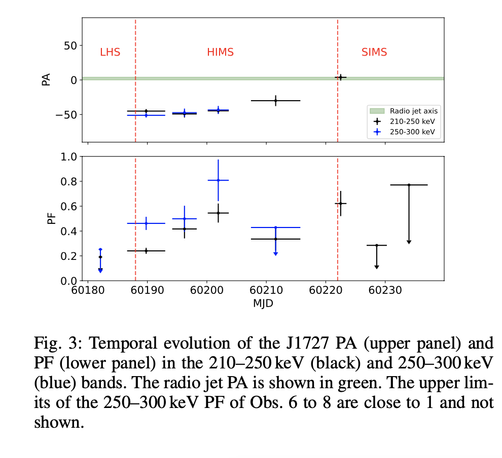
"INTEGRAL/IBIS polarization detection in the hard and soft intermediate states of Swift J1727.8-1613"
https://arxiv.org/abs/2407.05871

(Soft) gamma-ray #polarization has been detected in black hole X-ray binaries in the hard state (i.e. when strong jets are present) and interpreted as due to synchrotron from the jets. For the first time, we detect such polarization in other states!

#astrodon #XraysAreTheBestRays

INTEGRAL/IBIS polarization detection in the hard and soft intermediate states of Swift J1727.8-1613

Soft gamma-ray emission (100 keV -- 10 MeV) has previously been detected in the hard state of several microquasars. In some sources, this emission was found to be highly polarized and was suggested to be emitted at the base of the jet. Until now, no $γ$-ray polarization had been found in any other state. Using INTEGRAL/IBIS, we studied the soft gamma-ray spectral and polarization properties of Swift J1727.8-1613 throughout its outburst. We detect a highly polarized spectral component in both the hard intermediate state and the early stages of the soft intermediate state above 210 keV. In the hard intermediate state, the polarization angle significantly deviates from the compact jet angle projected onto the sky, whereas in the soft intermediate they are closely aligned. This constitutes the first detection of jet-aligned polarization in the soft gamma-ray for a microquasar. We attribute this polarized spectral component to synchrotron emission from the jet, which indicates that some of the jet might persist into the softer states.

arXiv.org

#PaperTime from yesterday's #ArXiv

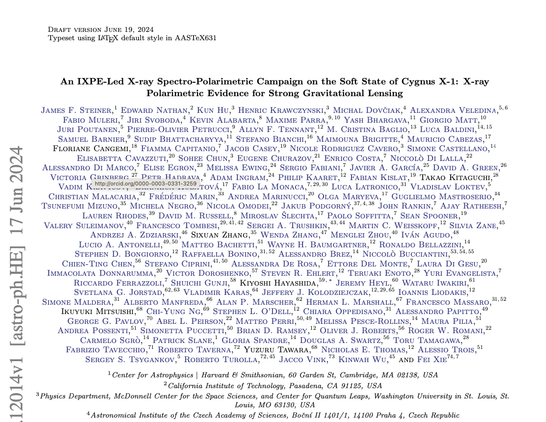
Steiner et al., incl. me + @astrobianchi
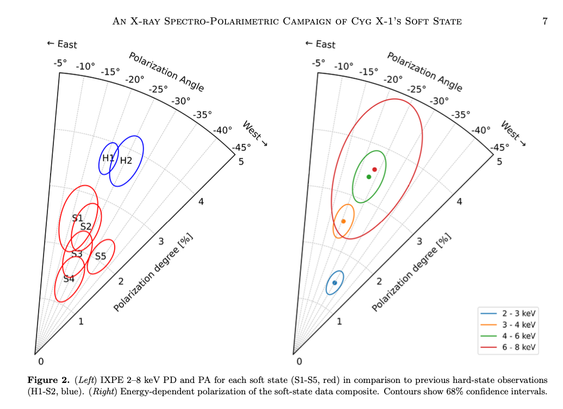
"An #IXPE-Led X-ray Spectro-Polarimetric Campaign on the Soft State of Cygnus X-1: X-ray Polarimetric Evidence for Strong Gravitational Lensing"

➡️ https://ui.adsabs.harvard.edu/abs/2024arXiv240612014S/abstract , ApJ accepted

🤯 Soft X-ray polarization in the black hole X-ray binary Cygnus X-1 can be explained by returning radiation, i.e. radiation from the disk returning back due to GR effects & reflected off the disk!

1/3

#astrodon #XraysAreTheBestRays

An IXPE-Led X-ray Spectro-Polarimetric Campaign on the Soft State of Cygnus X-1: X-ray Polarimetric Evidence for Strong Gravitational Lensing

We present the first X-ray spectropolarimetric results for Cygnus X-1 in its soft state from a campaign of five IXPE observations conducted during 2023 May-June. Companion multiwavelength data during the campaign are likewise shown. The 2-8 keV X-rays exhibit a net polarization degree PD=1.99%+/-0.13% (68% confidence). The polarization signal is found to increase with energy across IXPE's 2-8 keV bandpass. The polarized X-rays exhibit an energy-independent polarization angle of PA=-25.7+/-1.8 deg. East of North (68% confidence). This is consistent with being aligned to Cyg X-1's AU-scale compact radio jet and its pc-scale radio lobes. In comparison to earlier hard-state observations, the soft state exhibits a factor of 2 lower polarization degree, but a similar trend with energy and a similar (also energy-independent) position angle. When scaling by the natural unit of the disk temperature, we find the appearance of a consistent trendline in the polarization degree between soft and hard states. Our favored polarimetric model indicates Cyg X-1's spin is likely high (a* above ~0.96). The substantial X-ray polarization in Cyg X-1's soft state is most readily explained as resulting from a large portion of X-rays emitted from the disk returning and reflecting off the disk surface, generating a high polarization degree and a polarization direction parallel to the black hole spin axis and radio jet. In IXPE's bandpass, the polarization signal is dominated by the returning reflection emission. This constitutes polarimetric evidence for strong gravitational lensing of X-rays close to the black hole.

NASA/ADS

#Papertime! 🌌 💫 📡 (From Monday, but I totally did not have the time to post this before ...)

"The first mm detection of a neutron star high-mass X-ray binary" led by the amazing J. van den Eijnden, including @fuerst, @pkretsch, yours truly et al.
MNRAS submitted (not yet refereed).

▶️ https://ui.adsabs.harvard.edu/abs/2023arXiv230806021V/abstract

What is this about and why is this important? Follow along for a science 🧵

#Astrodon #astronomy #XraysAreTheBestRays #astrophysics
1/7

The first mm detection of a neutron star high-mass X-ray binary

Neutron stars accreting from massive binary companions come in a wide range of types. Systems with an OB supergiant donor are often divided between persistently and transiently accreting systems, respectively called Supergiant X-ray Binaries (SgXBs) and Supergiant Fast X-ray Transients (SFXTs). The origin of this dichotomy in accretion behaviour is typically attributed to systematic differences in the massive stellar wind, the binary orbit, or magnetic field configuration, but direct observational evidence for these hypotheses remains sparse. Here, we present the results of a pilot exploration of a novel approach to this long-standing question, turning to the mm band to probe the outer regions of the stellar wind beyond the binary orbit. Specifically, we present 100-GHz NOEMA observations of a SgXB, X1908+075, and a SFXT, IGR J18410-0535. We detect the SFXT as a point source at $63.4 \pm 9.6$ $\mu$Jy, while the SgXB is not detected. The spectrum of IGR J18410-0535 is constrained to be flat or inverted by comparing with quasi-simultaneous $5.5$+$9$ GHz radio observations, ruling out non-thermal flaring and consistent with thermal wind emission. Additional X-ray measurements further constrain the wind mass loss rate and velocity of the SgXB. We compare our targets with each other and earlier wind estimates, and reflect on future opportunities using this novel observational approach to characterize stellar winds in X-ray binaries.

NASA/ADS

#papertime 🥳

Where we use a method originally used for AGN to answer the question whether
we can use variability in individual X-ray lines to probe the variable stellar wind.

And the answer is: yes, we can!

The paper (submitted not yet refereed) is:

"Stellar wind variability in Cygnus X-1 from high-resolution excess
variance spectroscopy with Chandra" by Härer et al.
https://arxiv.org/abs/2304.14201

Let me disentangle what the title means: 1/6

#astrodon #BlackHole #VicisAstro #astronomy #SciArt

Stellar wind variability in Cygnus X-1 from high-resolution excess variance spectroscopy with Chandra

Stellar winds of massive stars are known to be driven by line absorption of UV photons, a mechanism which is prone to instabilities, causing the wind to be clumpy. The clumpy structure hampers wind mass-loss estimates, limiting our understanding of massive star evolution. The wind structure also impacts accretion in high-mass X-ray binary (HMXB) systems. We analyse the wavelength-dependent variability of X-ray absorption in the wind to study its structure. Such an approach is possible in HMXBs, where the compact object serves as an X-ray backlight. We probe different parts of the wind by analysing data taken at superior and inferior conjunction. We apply excess variance spectroscopy to study the wavelength-dependent soft X-ray variability of the HMXB Cygnus X-1 in the low/hard spectral state. Excess variance spectroscopy quantifies the variability of an object above the statistical noise as a function of wavelength, which allows us to study the variability of individual spectral lines. As one of the first studies, we apply this technique to high-resolution gratings spectra provided by Chandra, accounting for various systematic effects. The frequency dependence is investigated by changing the time binning. The strong orbital phase dependence we observe in the excess variance is consistent with column density variations predicted by a simple model for a clumpy wind. We identify spikes of increased variability with spectral features found by previous spectroscopic analyses of the same data set, most notably from silicon in over-dense clumps in the wind. In the silicon line region, the variability power is redistributed towards lower frequencies, hinting at increased line variability in large clumps. In prospect of the microcalorimetry missions that are scheduled to launch within the next decade, excess variance spectra present a promising approach to constrain the wind structure.

arXiv.org