 Dr. Victoria Grinberg
#Papertime! 🌌 💫 📡 (From Monday, but I totally did not have the time to post this before ...)
"The first mm detection of a neutron star high-mass X-ray binary" led by the amazing J. van den Eijnden, including @fuerst, @pkretsch, yours truly et al.
MNRAS submitted (not yet refereed).
▶️ https://ui.adsabs.harvard.edu/abs/2023arXiv230806021V/abstract
What is this about and why is this important? Follow along for a science 🧵
The first mm detection of a neutron star high-mass X-ray binary
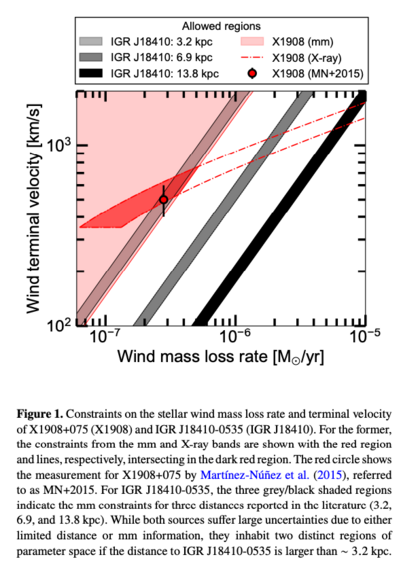
Neutron stars accreting from massive binary companions come in a wide range of types. Systems with an OB supergiant donor are often divided between persistently and transiently accreting systems, respectively called Supergiant X-ray Binaries (SgXBs) and Supergiant Fast X-ray Transients (SFXTs). The origin of this dichotomy in accretion behaviour is typically attributed to systematic differences in the massive stellar wind, the binary orbit, or magnetic field configuration, but direct observational evidence for these hypotheses remains sparse. Here, we present the results of a pilot exploration of a novel approach to this long-standing question, turning to the mm band to probe the outer regions of the stellar wind beyond the binary orbit. Specifically, we present 100-GHz NOEMA observations of a SgXB, X1908+075, and a SFXT, IGR J18410-0535. We detect the SFXT as a point source at $63.4 \pm 9.6$ $\mu$Jy, while the SgXB is not detected. The spectrum of IGR J18410-0535 is constrained to be flat or inverted by comparing with quasi-simultaneous $5.5$+$9$ GHz radio observations, ruling out non-thermal flaring and consistent with thermal wind emission. Additional X-ray measurements further constrain the wind mass loss rate and velocity of the SgXB. We compare our targets with each other and earlier wind estimates, and reflect on future opportunities using this novel observational approach to characterize stellar winds in X-ray binaries.