 Oliver Reichenstein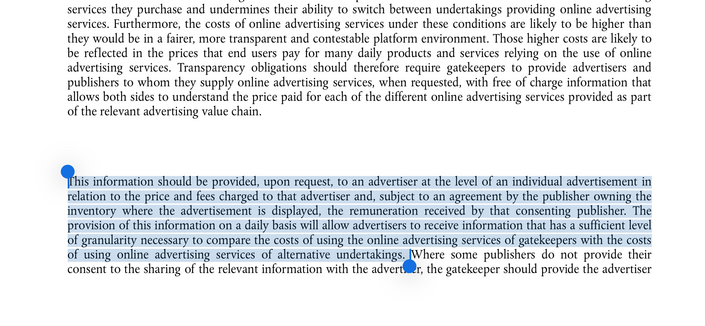
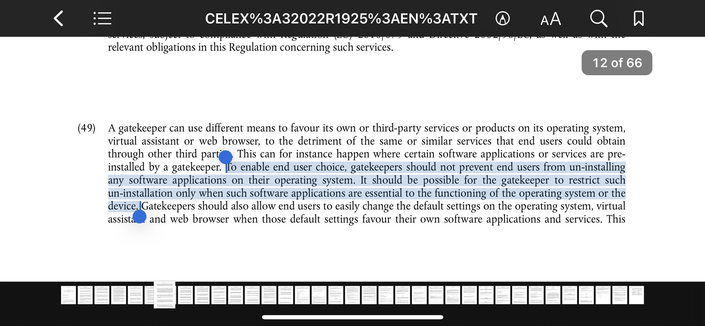
I won't comment on every paragraph. But I'll mention good or bad things when I find them. No really bad things so far (12/66 pages). 49) Again completely reasonable:
"To enable end user choice, gatekeepers should not prevent end users from un-installing any software applications on their operating system. It should be possible for the gatekeeper to restrict such un-installation only when such software applications are essential to the functioning of the operating system or the device."
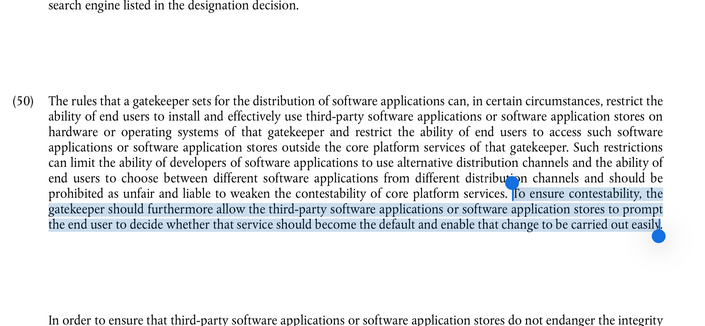
Whoa, great news for camera, calendar or mail apps:
"To ensure contestability, the gatekeeper should furthermore allow the third-party software applications or software application stores to prompt the end user to decide whether that service should become the default and enable that change to be carried out easily"
Critiques of DMA suggested focus and modesty like "They should have focused on 'allow apps to communicate directly with their customers'" or some other minor details. LOfuckingL.
If you oppose the DMA as an indie dev you probably haven't read it. Look: No more private APIs:
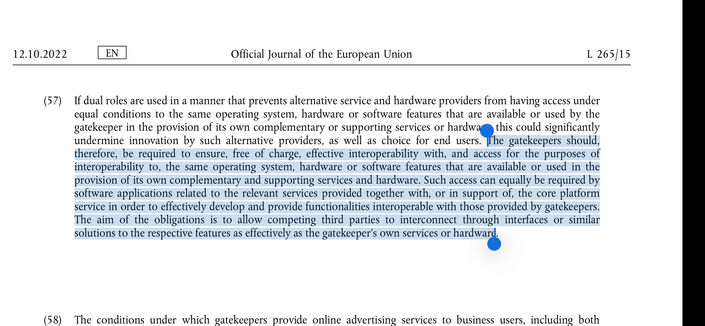
"The gatekeepers should, therefore, be required to ensure, free of charge, effective interoperability with, and access for the purposes of interoperability to, the same operating system, hardware or software features that are available or used in the provision of its own complementary and supporting services and hardware." 🎉
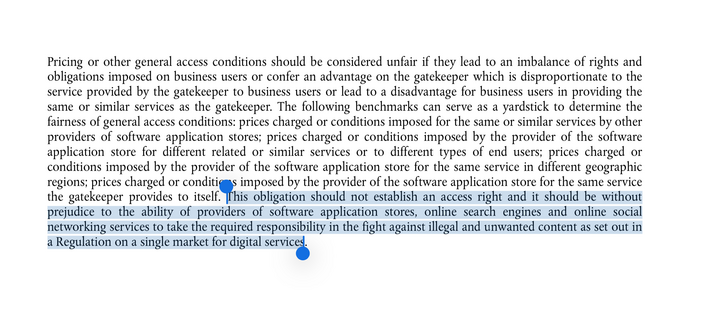
What is short sighted, unrealistic or unreasonable about 63?
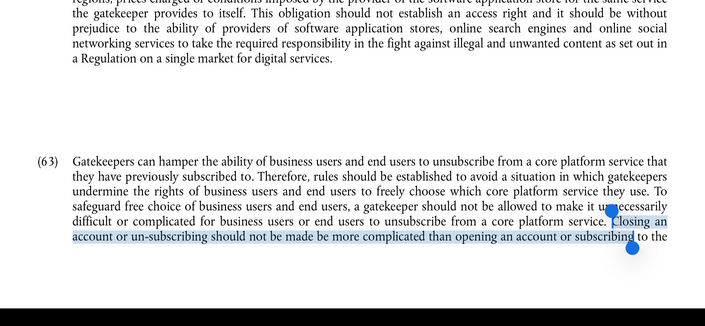
"Closing an account or un-subscribing should not be made be more complicated than opening an account or subscribing to the same service. Gatekeepers should not demand additional fees when terminating contracts with their end users or business users."
64 is one for Mastodon:
"gatekeepers should therefore ensure, free of charge and upon request, interoperability
with certain basic functionalities of their number-independent interpersonal communications services that they provide to their own end users, to third-party providers of such services"
Again, in a nitty gritty American interpretation you can spin flaws into it. If you read it as it was meant, you know it's the right thing to do.
Winner takes it all? Not in mama EU's house! Inform us of your planned acquisitions, give us all the relevant data and we'll use that data to understand market trends to prevent all your planned predominance tactics.
"gatekeepers should inform the Commission of all of their intended acquisitions, prior to their implementation, of other undertakings providing core platform services or any other services provided within the digital sector or other services that enable the collection of data."
72 dedicated to ensure privacy is one for the books:
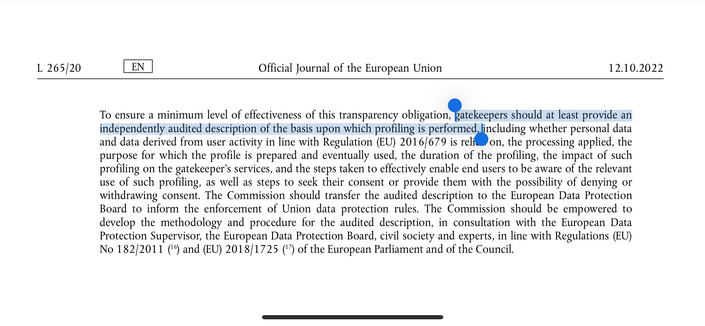
"gatekeepers should at least provide an independently audited description of the basis upon which profiling is performed"
'At least'!🤣 I can only imagine the shock on US business people's faces when listening to their lawyers explaining what is in there and what it means for their business in Europe. "We'll just shut everything down in the EU!" Turns to BA: "Right?" BA silently shakes head.
The following paragraphs mostly regulate how the commission can ensure compliance. Okay, so what happens if they still don't comply? 86 gets more concrete:
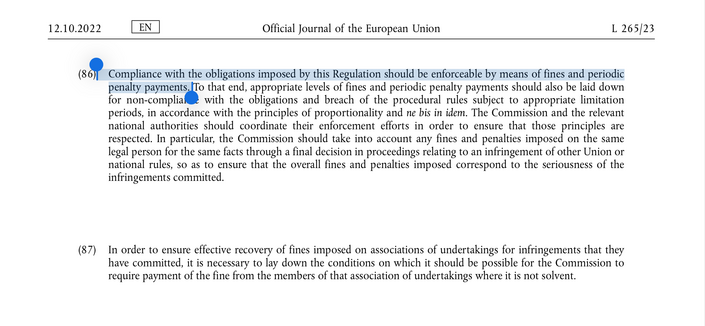
"Compliance with the obligations imposed by this Regulation should be enforceable by means of fines and periodic penalty payments."
As we know penalties now speak big tech language and use the Billions, not the Millions scale.
Nothing spectacular or unusual in the following paragraphs, still focusing on execution of the strong rules specified before. 101 is somewhat interesting maybe: Who are the experts?
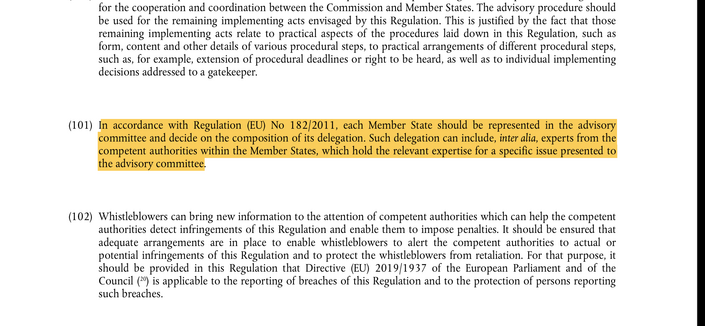
"…each Member State should be represented in the advisory committee and decide on the composition of its delegation. Such delegation can include, inter alia, experts from the competent authorities within the Member States, which hold the relevant expertise for a specific issue presented to the advisory committee."
Coming to a close for the regulations part. 104 explains that if you think that things go wrong you don't need to wait for the parliament to notice and act, but that as a consumer you can enforce your rights:
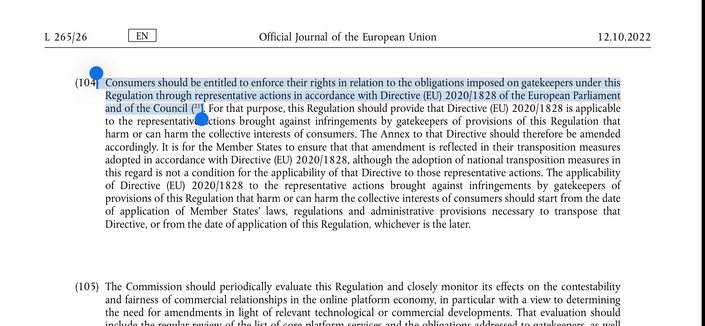
"Consumers should be entitled to enforce their rights in relation to the obligations imposed on gatekeepers under this Regulation through representative actions"
A good reminder in a time where the law seems to be different for the affluent and the common citizen. 😊
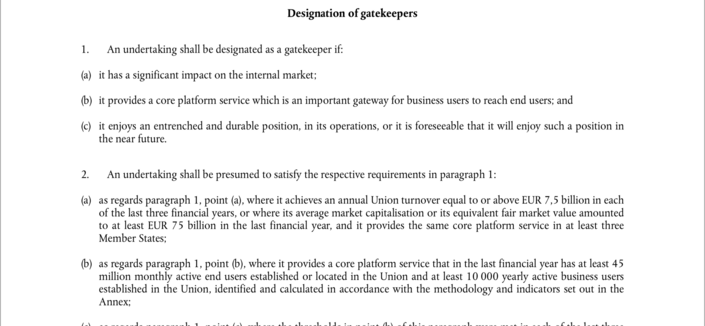
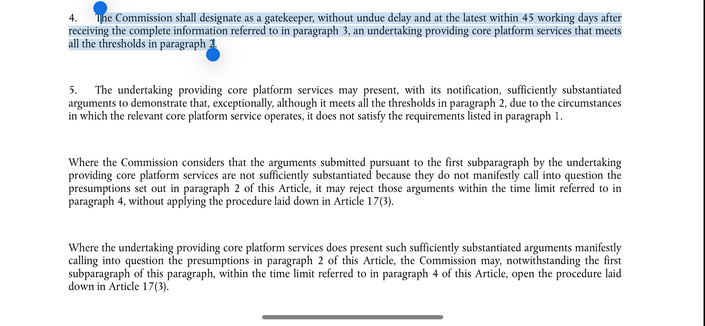
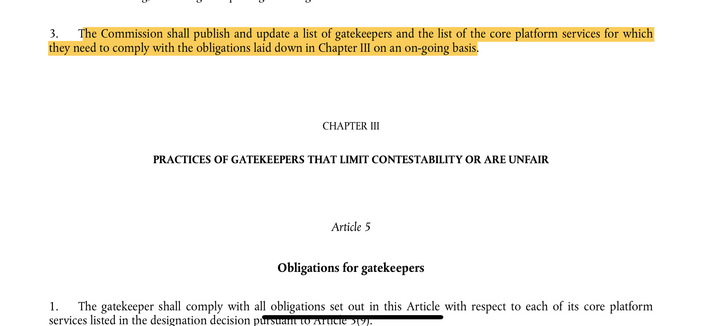
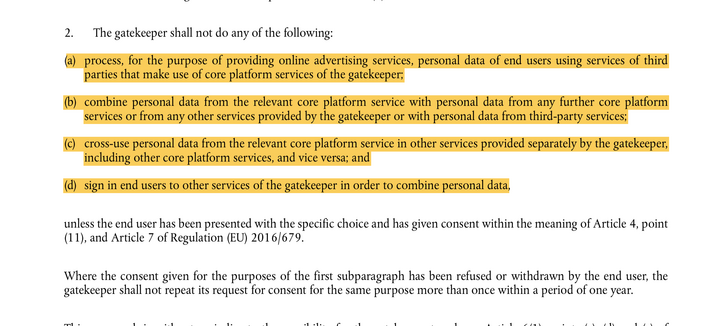
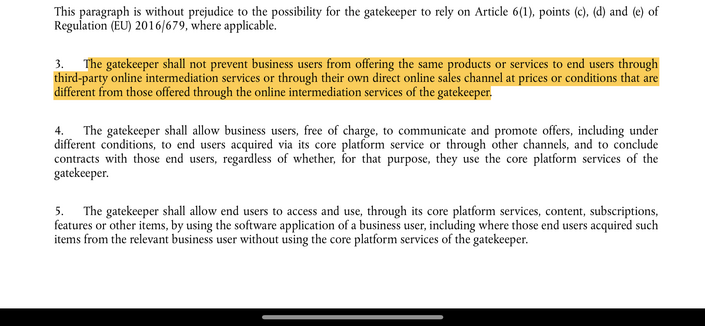
Okay, let's finish this up:
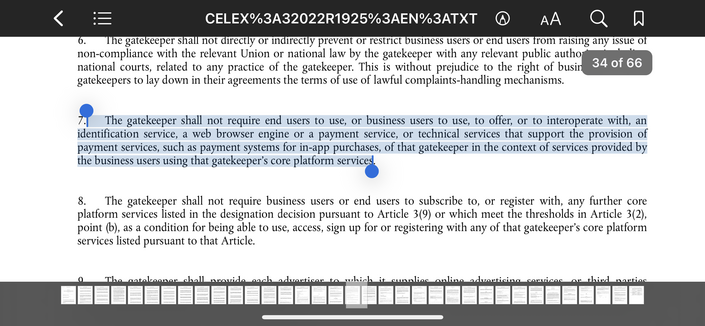
"III.5.7. The gatekeeper shall not require end users to use, or business users to use, to offer, or to interoperate with, an identification service, a web browser engine or a payment service, or technical services that support the provision of payment services, such as payment systems for in-app purchases, of that gatekeeper in the context of services provided by the business users using that gatekeeper’s core platform services"
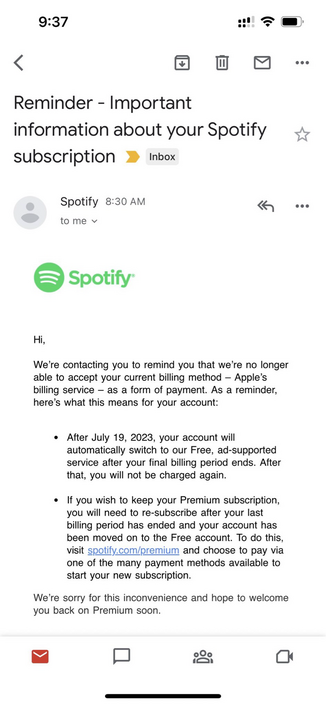
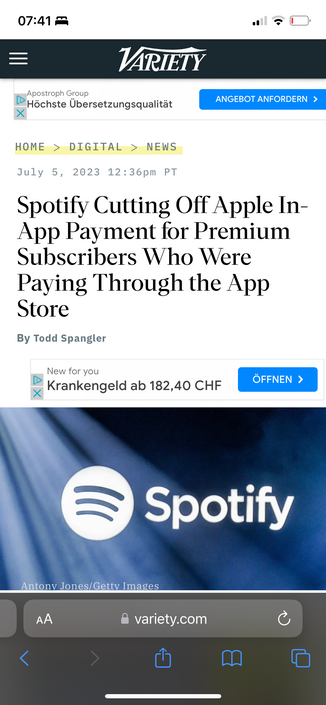
Just this month, Spotify took action and informed its users that it won't accept payment for its Premium Service through AppStore anymore. They're in an ongoing battle with Apple for years.
News about this didn't make the rounds because this change only affected a small group of Spotify users, as Spotify AppStore subscriptions were only possible in a 2 year window.
Reminder: The discussed regulations only apply in the EU. In other territories... Apple's own rules about payment still apply.
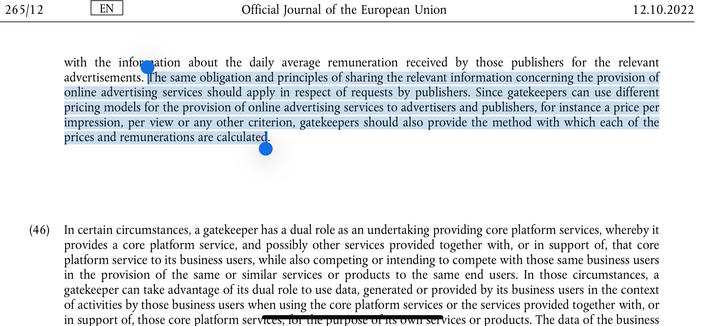
So unless I misunderstand: If you advertise in Der Spiegel via Google, Google has to tell both you and Der Spiegel how much they charge for ads on spiegel.de.
This finally brings light into the ad business black box. These people know exactly what they are doing.
I'd like to go through this faster, but it's just too good to skip. Every paragraph is a little treasure trove of things I always wanted and never dared to hope for. Next person that casually critizizes the DMA gets a smack down.
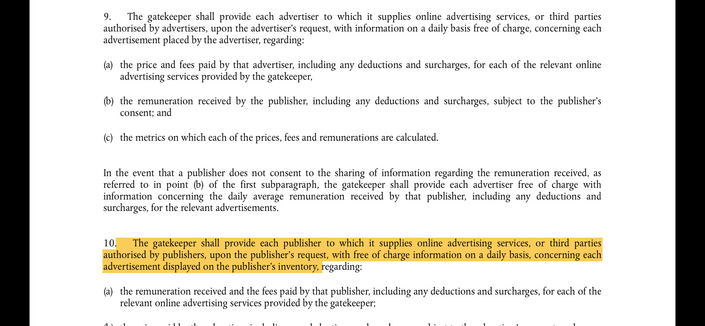
It keeps getting better: this paragraph, translated into practical reality, tells Apple that they can't cut the 20 Billion Dollar deal with Google to set Google Search as a default, but they have to provide a lot of Search engines the first time a user opens Safari.
Yeah, "let the user decide" for real.
If you know what it is talking about, this paper is so *not* boring. They're walking into a Saloon in a corrupt village in the far West like Clint Eastwood and clean the place up.
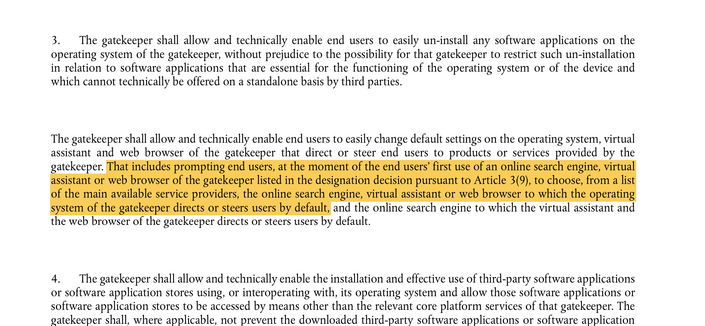
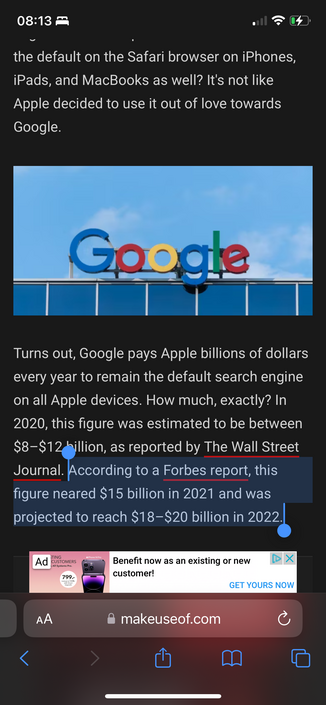
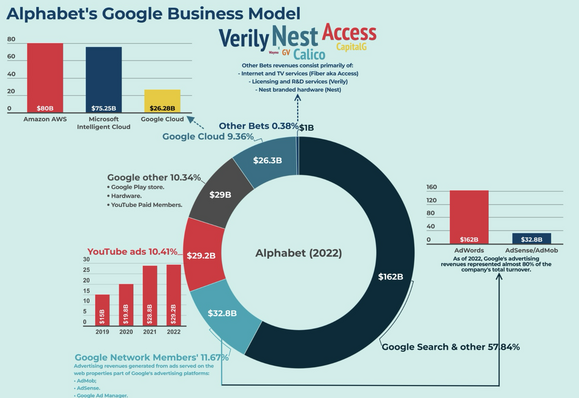
"Let the users decide." Users can't decide anything if you let Google and Apple have their go, uncontrolled. User don't know anything. Few know why Google Search is the default search on iPhone and how much this is worth to Google. They pay 1/8th of their *revenue* to Apple.
With all the work they do to protect our privacy, 20B is the price for making them turn a blind eye and let nosy Google be your default search.
https://www.makeuseof.com/why-google-pays-apple-billions-of-dollars/

Thank you for all the compliments. And, really, "Thank *you*!" It's great that you care. I was prepared to die of suffocation reading this and then get NO response.
I am not done yet, but you can already guess that I haven't even begun telling you what my conclusion of this adventure is, it is slowly building in my mind as I read this. I don't know what is coming, but I'm already preparing the encore. Gonna take a break now, and continue tonight.
Read on through a series of compliance articles, there is not much to report that would be of interest for consumers or third parties. It mostly about how investigations are conducted, what obligations gatekeepers have at what stage of the investigation and what happens if they fail.
So what happens if they do not comply? Companies risk a fine of up to 10% of their *global* annual revenue. Worst case, they risk to be shut down partially or completely in the EU.
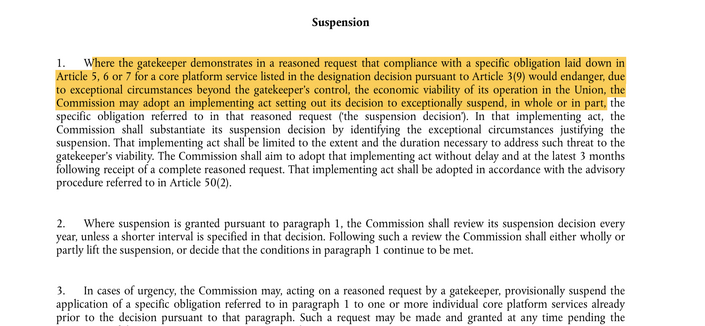
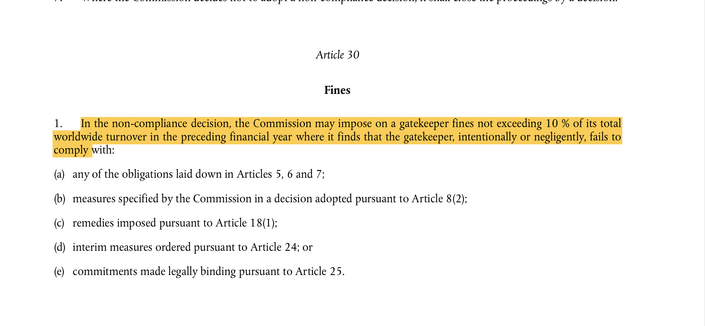
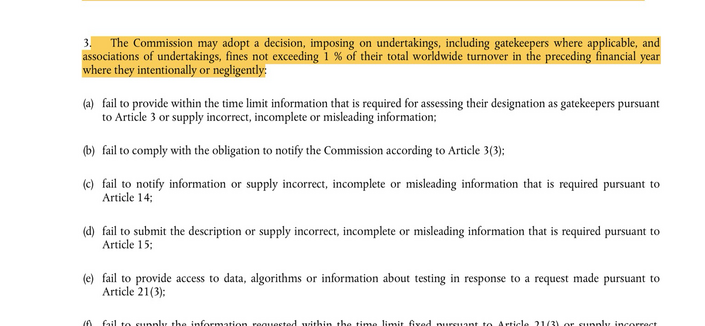
Okay, done, the rest is not *that* interesting for us. It mostly specifies process technicalities and then defines terms like 'active business users' or 'submission of information'... it gets very technical at the end.
Final note: Individual countries cannot oppose findings form the EU court. A fully logical and pragmatic rule but, politically, likely, not a popular declaration.
It's late, now. I'll sleep over it, then I'll try to draw some general conclusions from it.
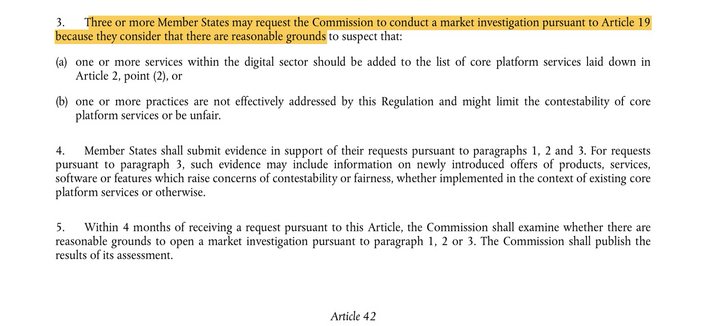
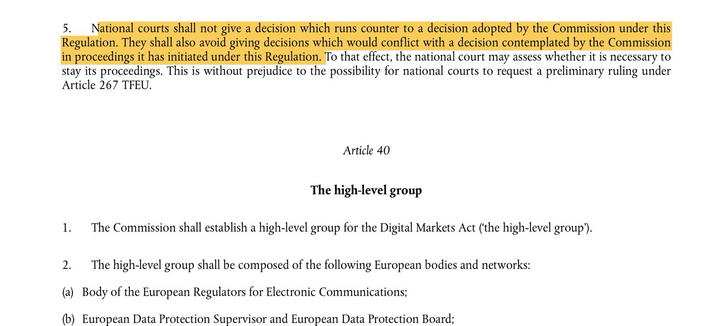
I'm cleaning it up, turn it into a blog post where I add the conclusion. It'll take some time...
Putting it in the right chronological order would already have been quite a job. Luckily there's Python. (Well, I could have extracted it a bit more cleverly, too 🤣).
I'll try to finish it as soon as possible and add a link to the end of this thread, when it's ready.
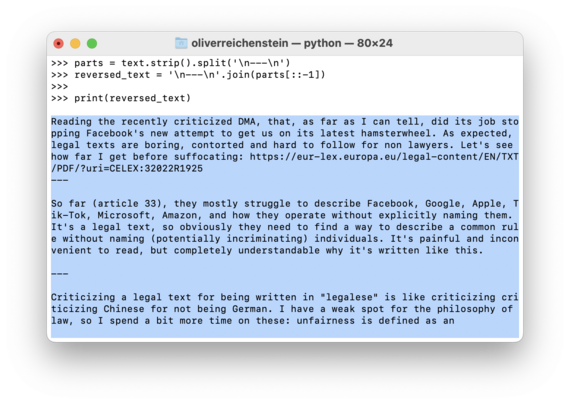

I need to find out how come that the repackaging Social Media threads for the blog turns out in days of work. I copied the thread, rearranged, rewrote and rewrote the post at least 30 times until it was halfway publishable. I could have gone for another 30 revisions.
I cannot fully explain it. Part of it is probably that I am completely neurotic when it comes to publishing. Part of it is that the size of information bits changes the overall idea presented in a very essential way.
I never fully thought about what I presume when I consider the length of an online article. It seems too obvious to think about it. The longer the text, the more information was needed to fulfill its promise. Right?
Maybe, the longer the text the more dense it needs to be to not appear chatty. The longer the presumed scroll, the more likely I roll my eyes when getting to the article. I think "This content had better be exceptionally compelling otherwise I'll quit."
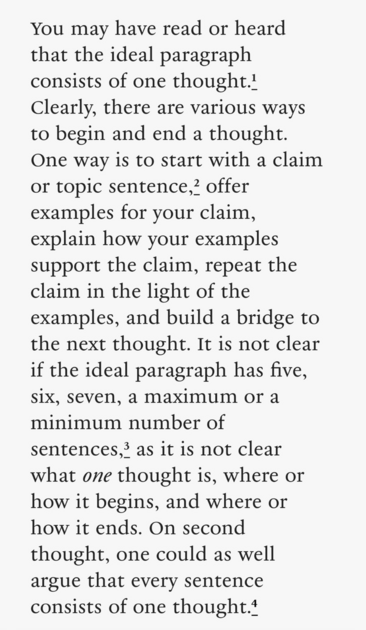

The Ideal Paragraph
You may have read or heard that the ideal paragraph consists of one thought. Clearly, there are various ways to begin and end a thought. One way is to start with a claim or topic sentence, offer examples for your claim, explain how your examples support the claim, repeat the claim in the light of the examples, and build a bridge to the next thought. It is not clear if the ideal paragraph has five, six, seven, a maximum or a minimum number of sentences, as it is not clear what one thought is, where or how it begins, and where or how it ends. On second thought, one could as well argue that every sentence consists of one thought.
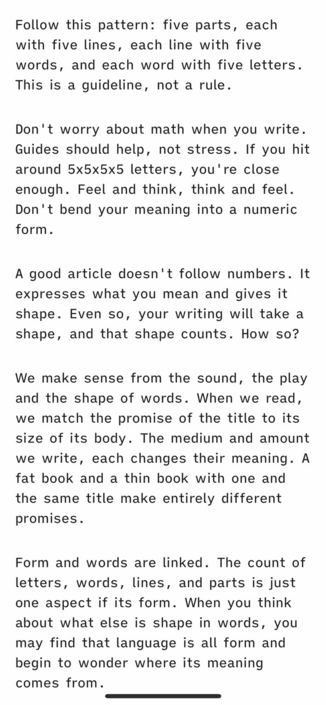


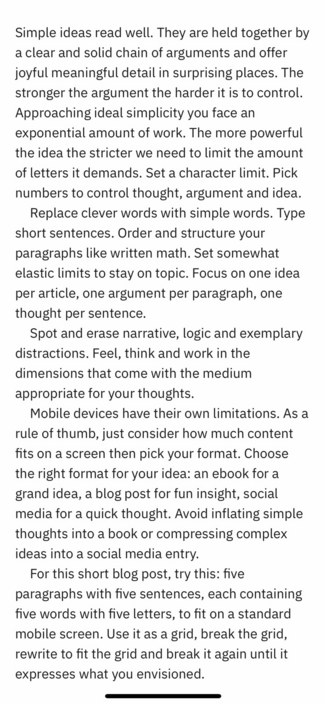
Version 6. Deleted version 5 because that was just a sleepy early morning whatever. You can se now that I've crossed the line where I need to change the story and structure all the time and I am starting to have fun adding color and spice to the core idea.
Unless this is a late evening sleepy whatever, it may be ready for publishing. Will sleep it over then decide. I really start liking it now. It makes me smile; it's fun to work on. The Radiohead reference is still a bit forced though.


 Cole Peters