A lot of people still think about Covid as a wash your hands and socially distance kind of thing.

Chances of getting Covid from touching something is near zero and we're far more likely to catch it from someone we can't see because it can stay in the air for a long time, drift long distances, and remain potent long after a contagious person is gone (as much as 2 hours).

This is why improving ventilation is one of the most important things you can do to reduce risks of infection for yourself and people around you. With good air flow, an infectious person is less dangerous. Infected air is diluted and can't linger to keep infecting.

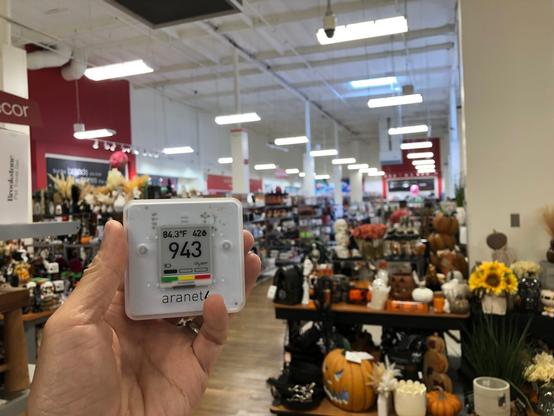
I took a variety of CO2 readings to estimate indoor air quality. Based on these readings, places I wouldn't want to be unmasked would be: house gatherings, offices, meeting rooms, conventions, public transit, a plane, funerals.

Places that may not be as risky as originally believed are: supermarkets, pharmacies, and restaurants.

#Covid #CO2 #Aranet4

One surprising finding I'm having from taking CO2 readings in various places is that I'm consistently getting readings between 700 and 800 ppm at supermarkets.

I mostly took readings at peak hours. I'll need to go back at off peak times to see how much the readings change. I was really amazed at how "not terrible" the reading at Trader Joe's was.

Picture 1: Trader Joes at noon on a Saturday. It is packed. It was a total surprise to see CO2 readings between 700 and 800ppm! (Fair)

Picture 2: Smart and Final, a mostly California-bases grocery outlet selling a mix of regular groceries and bulk package items with a reading of 714ppm. (Good)

Picture 3: Walgreens Pharmacy, at off peak hours. 529ppm. This is very good, but hard to believe. I'll have to go take this again.

Picture 4: Nob Hill Foods, a small grocery chain in Northern California. 726ppm. Good-Fair.

#aranet4 #co2 #covid #traderjoe

I'm making some blunt assumptions about what these readings mean. From what I've been gathering from scientists posting about air quality readings, 400ppm is a baseline and every +200ppm gets you from excellent to good to fair to unhealthy.

Most people seem to be suggesting 800 and below as the line to really start exercising more strict caution if you're trying to avoid infection.

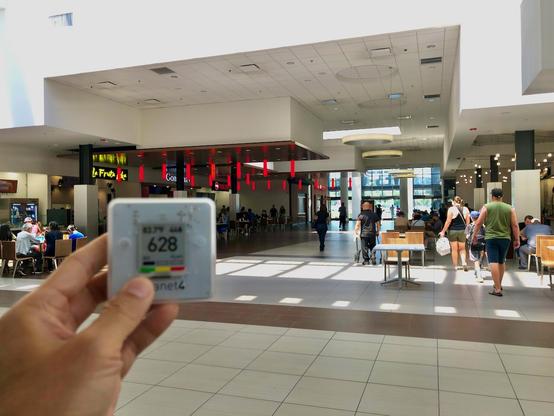
But keep in mind that's based on 400ppm as the baseline. My baseline for some of these readings is shown in the attached photo. It's 470ppm outdoors on that day.

My baseline is likely higher because I'm in an urban area at a mall near very busy roads. There's a lot of extra ambient CO2 so my cutoff lines would be 670 and below (excellent), 870 and below (good), 1070 and below (fair).

Every 400ppm above baseline roughly equates to 1% of the air you breathe being exhaled by someone else. That's like getting mouth to mouth once every 6-8 mins.

#aranet4 #co2 #covid

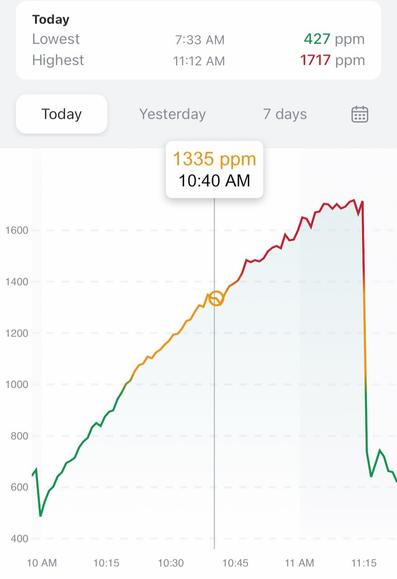
Want to see what a CO2 chart for an office meeting with about 12 people for one hour looks like? We start with excellent indoor air quality at 9am with 500ppm of CO2.

After one hour in a poorly ventilated space, the CO2 readings are 1720ppm! And this is a fairly spacious office that would have a bit of air reservoir to slow down the rise in CO2 levels.

Yikes! This means everyone is breathing quite a bit out of each other's lungs. If you're only going to wear a mask in the riskiest situations, this should be one of them.

Keep in mind that just having high CO2 concentrations doesn't mean much unless someone is contagious in the room, but if there was someone contagious that day, lots of people in that meeting would have gotten whatever was being passed into the air be it Covid, flu, RSV, or a cold.

#aranet4 #co2 #covid

I'm sharing all of this with you because we could still be in for another wave and lots of people have waned immunity and prior infection isn't good at keeping you from getting a next infection.

It's also because I'm realizing among my real world friends that some are still focusing on hand washing to avoid getting Covid.

They're also trading lower risk activities for higher risk ones because they don't understand how it works. My friends who do catering told me they were catering huge house parties every day during the height of the pandemic when restaurants were closed for dine-in.

Restaurants have modern HVAC systems and have to pass building inspections. I've been surprised that readings in most restaurants are quite good (off peak at least). Very few homes will have ventilation systems like those in even a run down restaurant.

Going to a house party instead of meeting at a restaurant is a bad trade-off!

#covid

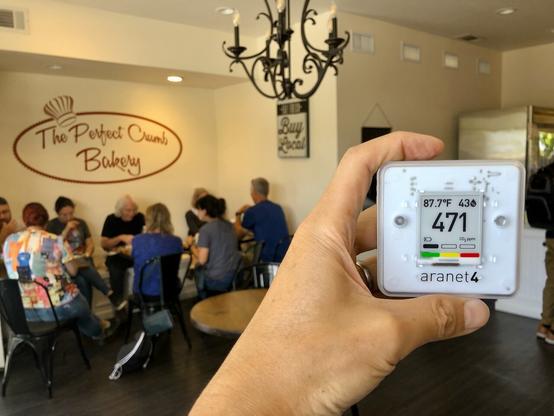
I spent some time inside a variety of food/retail businesses this week as a photographer. Here's an #Aranet4 #CO2 reading from a bakery where the owner is very Covid conscious. She keeps it very well ventilated. This small bakery cafe was at full capacity with 15+ people. The CO2 reading was 471ppm against an outside reading of 415ppm.

Front door open w/commercial kitchen in the back pumping air. That it was windy also helped.

Also took a reading deep in a packed small Thai restaurant w/Covid aware owner. 550ppm, door open + all windows 1/4 open. Very surprised it was that low.

I've yet to measure a restaurant exceeding 800ppm (which is roughly 1% of re-breathed air per breath).

I may eventually feel just fine dining indoors in some places once we have some more clarity with the direction that #Covid & therapies are heading. On the flip side, there are types of places that often have bad airflow that I'm never looking at the same again.

My last 2 eye clinics both hit 1000ppm. 🤔

#CovidisAirborne

@sysop408 On a day-to-day basis, I do not think about COVID. I'm in gatherings of 100 - 200 people every week, fairly busy restaurants, and crowded shopping areas (Costco), and never think twice about it.

As a cold/flu type of virus, it's not going to be stopped by social distancing, masks, etc. It still hit everyone despite the attempt, so is it worth doing it now?

@andrewhoyer if you see the first post, you'll see something that may support what you said.

Places like Costco and busy popular restaurants have modern HVAC systems and even if they're not trying to follow good ventilation practices, they probably still are because if you pack people in a restaurant, it'll get hot and smelly. Also, people don't tend to stay in a restaurant, Costco, or supermarket for 3 hours.

Social distancing isn't very effective b/c even in a peak infection period, the chance anyone near you is highly infectious is much less than 1 in 100.

The chance of you being at the same place with one of those people? Quite high, but if the ventilation is good, the chance of there being enough virus in the air to infect someone with a normal immune system is very small.

If you just avoid enclosed spaces w/poor ventilation & especially ones w/lots of people your chance of getting any respiratory virus goes way down. So far I'm finding most food/large retail buildings much safer than expected.

@andrewhoyer I know you just want to get on with life, but here's one reason why you shouldn't just treat it as a cold/flu.

Flus are pretty dangerous in their own right. The reason why they're not as much of a public health concern is because it's much harder to catch the flu and there's rarely more than 3 month winter window where healthy people are likely to get it.

It's summer. There are people on their 3rd bout this year. Nobody gets the flu 3x.

All viral illnesses come with a chance of long term disability each time you get infected. Covid's long term risk is higher (so far). My wife is disabled because of another virus. I live everyday with the consequences of an unlucky infection.

Really, it's in your best interest to favor clearer air and maybe avoid 5-10 flus or Covids in your lifetime. Could be as simple as sitting near the door at a cafe or asking to crack open a window a bit. You don't have to go thru the whole ordeal of excluding risk to do small things to bend the numbers in your favor.