Physicist Lise Meitner’s brilliance led to the discovery of nuclear fission. But her long time collaborator Otto Hahn, was awarded the Nobel Prize in Chemistry without her in 1944, even though she had given the first theoretical explanation.

Albert Einstein called Meitner “our Marie Curie." She also adamantly refused to work on the atomic bomb during WWII. https://whyy.org/articles/lise-meitner-the-forgotten-woman-of-nuclear-physics-who-deserved-a-nobel-prize/ #science #history
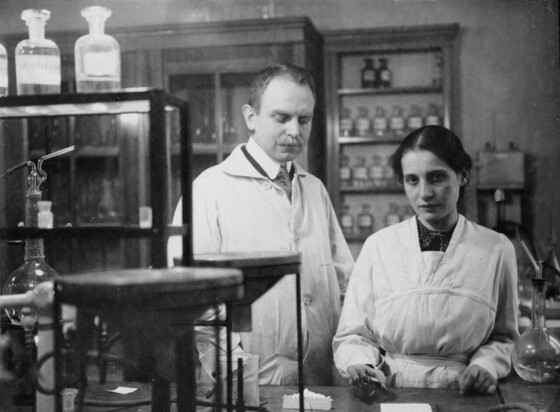
Lise Meitner – the forgotten woman of nuclear physics who deserved a Nobel Prize

Left off publications due to Nazi prejudice, this Jewish woman lost her rightful place in the scientific pantheon as the discoverer of nuclear fission.

WHYY

@Sheril

That last information "She also adamantly refused to work on the atomic bomb during WWII."

Is the most important. If a larger portion of scientists had acted half as responsibly as she did, we would not be in the situation of "mutually guaranteed annihilation" that we have been in for 65 years.

@WolfgangFeist @Sheril

Agreed. No scientist should have contributed to the technology of nuclear fission, in peace or in war.

But I didn't find mention of refusing to work on the bomb in the linked article, so I looked in Wikipedia and they also didn't mention it. Is there a source for this info Wolfgang?

@aka_quant_noir @Sheril

German Wikipedia-article on Lise Meitner:

"Meitner, inzwischen überzeugte Pazifistin, weigerte sich, Forschungsaufträge für den Bau einer Atombombe anzunehmen, obwohl sie von den USA immer wieder dazu aufgefordert wurde."

and another source:

https://etheritage.ethz.ch/2018/10/26/flucht-und-floetentoene-lise-meitner-zum-gedenken/

Flucht und Flötentöne – Lise Meitner zum Gedenken – ETHeritage

Fast wäre die Atomphysikerin und verhinderte Nobelpreisträgerin Lise Meitner (1878-1968) Professorin an der ETH geworden. Ein amerikanischer Spion überbrachte i

ETHeritage
@WolfgangFeist @Sheril Thank you! Weird that the English Wikipedia doesn't include that fact as far as I could find.

@aka_quant_noir @Sheril

But also something to "think" about:

At the time of the

https://en.wikipedia.org/wiki/Einstein%E2%80%93Szilard_letter

informed physicists really feared that Nazi Germany was working on the atomic bomb.

I can imagine why Einstein signed that letter and why Fermi, Oppenheimer and others worked on the "Manhattan" project.

I also know that Einstein later regretted signing that letter.

Well, it's complicated: as long as there was a real threat, the Nazis would have this weapon...

Einstein–Szilard letter - Wikipedia

@aka_quant_noir @Sheril

A very interesting personality in that field:

https://en.wikipedia.org/wiki/Leo_Szilard

There is also an impressive video:

https://www.youtube.com/watch?v=OgT-Gw6Pjz4

Leo Szilard - Wikipedia

@WolfgangFeist @Sheril A better use of resources would have been to sabotage the Nazi atomic bomb effort. But that would not have satisfied the desire of the War Dept to have a new weapon. I agree it's complicated.

My feeling today is that scientists should regret ever developing nuclear technology, ever mining uranium salts, ever causing hundreds of millions of tons of nuclear waste which we don't have a good plan to safely store, etc. etc. And the genie is out of the bottle. We should not have allowed scientists to rub that bottle.

@aka_quant_noir @Sheril

Its much more complicated:

-Szilard had the impression, that building such a bomb wasn't that much an effort
-during the Manhattan project it turned out, that it actually was: Not building the bomb, but producing the U235 and the Pu (costs: $24billion in 2021value)

After German defeat in Europe it was clear that there was no "Nazi bomb". That was the time, there responsibly thinking scientists spoke out against the use of the bomb against Japan (Szilard among them).

@aka_quant_noir @Sheril

It's a very interesting discussion: Finding that there was such a phenomenon as 'nuclear fission' - that was NOT possible to avoid (unless you see science as a dangerous thing in any case).

It wouldn't have been necessary to spend $24bio to construct a bomb out of this knowledge. That at the end was not a decision of the scientists; but they had an important role in it.

@WolfgangFeist @Sheril

Of course the question of ethically refusing to work on a technology so dangerous and waste-producing as this is a moot one as to those scientists in the past. They may or may not have had total freedom to act.

But as to scientists and technologists and companies and government agencies developing or re-developing nuclear technologies and weapons today, the question isn't moot. We should demand better reasoning and ethics and spending than what have heretofore applied, and everyone possible should refuse to participate, and where necessary sabotage others' participation in this technology, until and unless all nuclear waste and danger is ethically and technically solved.

@aka_quant_noir @Sheril

The "thinking" behind that is, that the scientists just decide very much on their own what they are going to research.

Partially that was true: Galilei or a Volta could pretty much decide. Later on, that became rare. It became more and more a question of money - and those, who decided about the money. Often governments, nowadays big money companies.

Potential solutions: We would need something like the "oath of hippocrates" for all scientists. And: democratic control

@aka_quant_noir @Sheril

... democratic control over this money!

The strategy of the most powerful rich was to make everyone (including the scientists) dependent on THEIR money. This would give them ultimate power - and it was believed that this was best for civilization. Because "all these other losers just won't make it" to keep "the complex industrial world" running and thriving.