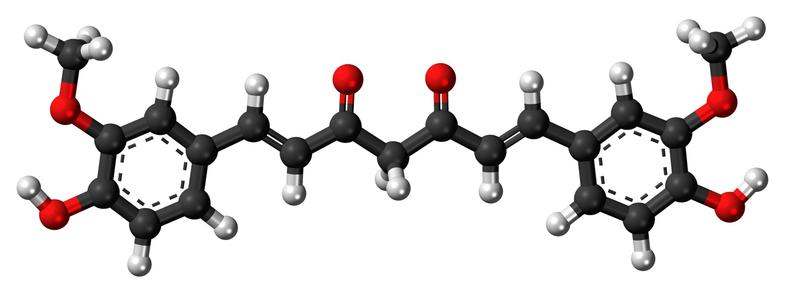
Suppose you were trying to invent a bright orange powder that could easily dye clothes and be hard to wash off. Using your knowledge of quantum mechanics you'd design this symmetrical molecule where an electron's wavefunction can vibrate back and forth along a chain of carbons at the frequency of green light. Absorbing green light makes it look orange! And this molecule doesn't dissolve in water.

Yes: you'd invent turmeric!

Or more precisely 'curcurmin', the molecule that gives turmeric its special properties.

The black atoms are carbons, the white are hydrogens and the red are oxygens.

Read on and check out what pure curcurmin looks like.

(1/n)
Ain't it pretty? People extract curcumin from turmeric to use as a food coloring in curry powders, mustards, butters, cheeses, and prepared foods. It's also used in dietary supplements due to its unproven and dubious health benefits.

It doesn't dissolve well in water, but it does in alcohol. If you dissolve some curcurmin in vodka and shine a black light on it, you'll see it's fluorescent! That is: it absorbs the high-energy ultraviolet photons and emits lower-energy green photons... the same kind of light it usually likes to *absorb.* Due to the principle of reciprocity, if a substance is good at absorbing some frequency of light, it's also good at emitting that frequency.

Let's see that fluorescence! Check out my next post.

(2/n)

Here's curcumin dissolved in a hydrocarbon called xylene with ultraviolet light shining on it! It's fluorescent. You can also dissolve it in ethanol, e.g. vodka.

Curcurmin also makes a good pH detector: if you mix it with a base it turns red. This video by @compoundchem illustrates it:

https://www.youtube.com/watch?v=PsVtME5o69I

(3/n, n = 3)

Turmeric Chemistry – Fluorescence and Indicators

Here are two fun chemistry tricks you can do with turmeric! Check out the accompanying graphic to learn more about turmeric chemistry here: http://www.compou...

YouTube
@johncarlosbaez @compoundchem this explains many culinary experiences I had, amazing
@mc - I've spent a lot of time trying to wash turmeric out of my clothes; I should have been using vodka.
@johncarlosbaez @mc i use sanitary alcohol for cleaning stubborn stuff, it’s really great for getting the rubber coating off of “rubberised” plastic.

@johncarlosbaez
I loved this entire post, thanks! Fun to read and informative 😊 As a teacher, I can appreciate that 😀

@compoundchem

@pascaline - thanks very much! That's what I aim for: informative yet fun.
@johncarlosbaez Aha, that explains why when I was washing a turmeric-covered spoon the other day, I saw a brief glimpse of red! I think the water sitting in our faucet can end up a bit basic at times, based on past observations. (Or possibly something else is going on with the chlorine in the water?)

@johncarlosbaez Huh! This booze I picked up recently has a VERY strong and persistent yellow color. It lists saffron as the top billing flavor/ingredient, but I always wondered how much of the color was really from the turmeric.

Did not think to try shining UV light on it before drinking it all!

@alopex - interesting! Saffron sounds a lot more high-class than turmeric. Next time you get one, break out the black lights for your party!
@johncarlosbaez @compoundchem And tonic water also fluoresces thanks to the quinine!
@johncarlosbaez In Dutch turmeric is called either “kurkuma” (after the Sanskrit name, I guess the source of both the name of the genus and of “curcumin”), “geelwortel” (= yellowroot), or kunyit/koenjit (from Indonesian)

@happydisciple - nice! I was wondering where that word 'curcumin' came from, and I was confused by 'cucurbits'.

https://en.wikipedia.org/wiki/Cucurbita

Cucurbita - Wikipedia

@happydisciple @johncarlosbaez Same for Finnish, we also call it kurkuma. :)
(we're also one of the languages that aknowledge Peru as the origin of potatoes in it's name, we call them "peruna")
@johncarlosbaez can it stop oil?
@bracken - I don't know what that means.
@johncarlosbaez When you say "Suppose you were trying to invent a bright orange powder that could easily dye clothes and be hard to wash off" it sounds like you're preparing a protest relevant to current events in the UK.
@johncarlosbaez
In Tamil (the oldest language that is still widely spoken), turmeric is called 'manjal' ( மஞ்சள் ) and the color yellow is also called 'manjal'!
@ThamizhKudimagan - cool! I guess turmeric was one of the most important yellow things for some culture.
@johncarlosbaez lol does this work with any color you want? just stick enough Cs between the aromatic groups?

@mc - basically yes! But the aromatic groups appear to be optional. The reason tomatoes are red is 'lycopene':

(1/3)

@mc - and the reason carrots are orange is beta-carotene.

(2/3)

@mc - I got into this when I saw a bunch of autumn leaves again in Washington DC, and realized it's all due to quantum delocalization of electrons! I wrote about it here:

(3/3)

https://johncarlosbaez.wordpress.com/2021/11/28/anthocyanins/

Anthocyanins

  As the chlorophyll wanes, now is the heyday of the xanthophylls, carotenoids and anthocyanins. These contain carbon rings and chains whose electrons become delocalized… their wavefunct…

Azimuth
@johncarlosbaez @mc anthocyanin. How is it that I had never heard this word before last week and now it’s everywhere?

@johncarlosbaez

Nope. I'd make an azo dye of the most hideous orange that would permanently stain my lab coat.

Organic chemistry at work. 😉

Turmeric can be removed with a washing additive. Azo dye can't.

@canusfeminacanis - okay, you're an actual chemist! So I should have added an extra requirement: you can cook with it.

@johncarlosbaez

Nope, but I was one of three students who didn't leave an explosion on the lab ceiling. 😆
Sometimes successes are the better teachers.

Still have the lab coat with the orange dye, though.

That said, if you'd specified 'must be able to cook with it, I would have understood turmeric to be THE answer. 😉

@canusfeminacanis
Azo is toxic, careful.

@simmagolda

Yeah, we learned that in chemistry class, too.

@johncarlosbaez Ha. I got as far as your first sentence and thought "turmeric". So much yellow. Clothes. Skin. Pots and pans. Worktops.
@ersatzmaus - it's an evil substance in my opinion. I don't think the flavor is worth it! But my wife disagrees, and she does most of the cooking. In general her use of spices is very nice. But turmeric is a nuisance.

@johncarlosbaez I really only use it for the colour, mostly for reasons of tradition.

Some dishes are Supposed To Be Yellow™.

And then only in small amounts.

Coriander/Cumin/Pepper/Chilli are the core spices for me.

@johncarlosbaez @ersatzmaus
Having been brought up on Indian food, the oh-so-familiar turmeric was taken for granted until neuroscientists started wondering why there was so little Alzheimers amongst India’s elderly.

@iChas -

"Can turmeric help treat dementia?

There is currently no real evidence that supports turmeric being used to prevent or treat Alzheimer’s disease. "

https://www.alzheimers.org.uk/about-dementia/risk-factors-and-prevention/turmeric-and-dementia

Turmeric and dementia

There is currently limited evidence from research studies in people to suggest that turmeric, which is a type of spice, can prevent or treat dementia.

Alzheimer's Society

@johncarlosbaez

I had a similar effect from white lilly pollen when this accidentally brushed against my white shirt when I was handling an arrangement of these flowers and the pollen coloured an area of the shirt strongly orange. Thankfully it came out completely in the wash as it was the first time I'd worn the shirt.

@johncarlosbaez So neat! Uses in India go way back. Refrigeration was not a thing, meat/poultry marinated in yogurt & turmeric b/c antimicrobial properties…. more here: https://www.ncbi.nlm.nih.gov/books/NBK92752/#_ch13_sec2_. Oxi-clean or oxygen bleach is your best friend to get stains out, or rubbing the stain with dishsoap like Dawn if you can’t wash it immediately.
Turmeric, the Golden Spice

Turmeric is a plant that has a very long history of medicinal use, dating back nearly 4000 years. In Southeast Asia, turmeric is used not only as a principal spice but also as a component in religious ceremonies. Because of its brilliant yellow color, turmeric is also known as “Indian saffron.” Modern medicine has begun to recognize its importance, as indicated by the over 3000 publications dealing with turmeric that came out within the last 25 years. This review first discusses in vitro studies with turmeric, followed by animal studies, and finally studies carried out on humans; the safety and efficacy of turmeric are further addressed.

NCBI Bookshelf
@johncarlosbaez Much of the middle income and higher Indian diaspora build “haldi kitchens” (haldi=turmeric) in their garages, or outdoors because of the staining properties. I refuse to do this. Stains can be avoided with care and frequent handwashing. And by taking care of any stains from cooking splashes immediately. OFC choice of countertop material, etc all impt. Don’t get me started on poor ventilation and cooking….
@johncarlosbaez It's VERY hard to wash OFF but "lore" says that it's quite sensitive to alcohol and UV light. They say the way to "wash it off" is soak it in alcohol and expose to sunlight. Makes GREAT curries anyway :)
@johncarlosbaez I'm curious about this idea of an electron's wavefunction vibrating along the chain at visible light frequency. If I look up the length of C-C and C=C bonds, in simple hydrocarbons they're roughly 150pm each. So if I look at tumeric, this adds up to ~2nm for the length of the molecule, which is quite far from the ~500nm wavelength of yellow light. Do you happen to know what I'm misunderstanding here?

@xavier - what matters is not the length of the chain of carbons but the difference in energy levels between two states of an electron that's delocalized and spread over the whole chain. We can convert this energy difference E into a frequency ν by

ν = ℏ/E

where ℏ is Planck's constant, and the molecule will easily emit and absorb light of that frequency.

Here's a bit more detail:

https://www.youtube.com/watch?v=zAQz5J3Tpgs

Conjugation and color | Spectroscopy | Organic chemistry | Khan Academy

YouTube
@johncarlosbaez Thanks for the explanation! This rings a bell, reminds me of some stuff I learnt in physics/chemistry at uni, though clearly I forgot most of it. The video's interesting, though most of it goes over my head 😅