
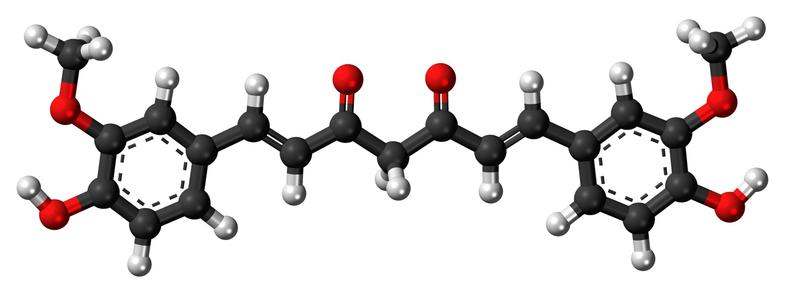
Suppose you were trying to invent a bright orange powder that could easily dye clothes and be hard to wash off. Using your knowledge of quantum mechanics you'd design this symmetrical molecule where an electron's wavefunction can vibrate back and forth along a chain of carbons at the frequency of green light. Absorbing green light makes it look orange! And this molecule doesn't dissolve in water.

Yes: you'd invent turmeric!

Or more precisely 'curcurmin', the molecule that gives turmeric its special properties.

The black atoms are carbons, the white are hydrogens and the red are oxygens.

Read on and check out what pure curcurmin looks like.

(1/n)
@johncarlosbaez Ha. I got as far as your first sentence and thought "turmeric". So much yellow. Clothes. Skin. Pots and pans. Worktops.
@ersatzmaus - it's an evil substance in my opinion. I don't think the flavor is worth it! But my wife disagrees, and she does most of the cooking. In general her use of spices is very nice. But turmeric is a nuisance.

@johncarlosbaez I really only use it for the colour, mostly for reasons of tradition.

Some dishes are Supposed To Be Yellow™.

And then only in small amounts.

Coriander/Cumin/Pepper/Chilli are the core spices for me.

@johncarlosbaez @ersatzmaus
Having been brought up on Indian food, the oh-so-familiar turmeric was taken for granted until neuroscientists started wondering why there was so little Alzheimers amongst India’s elderly.

@iChas -

"Can turmeric help treat dementia?

There is currently no real evidence that supports turmeric being used to prevent or treat Alzheimer’s disease. "

https://www.alzheimers.org.uk/about-dementia/risk-factors-and-prevention/turmeric-and-dementia

Turmeric and dementia

There is currently limited evidence from research studies in people to suggest that turmeric, which is a type of spice, can prevent or treat dementia.

Alzheimer's Society