ALL IN THE SAME BOAT

Stop me if you've heard this one before.

A few months ago some rich people paid a company called OceanGate a whole lot of money to get into a submersible to go to the bottom of the ocean in order to see the wreckage of the Titanic.

That's a lot of terms. Some definitions are likely in order.

https://armoxon.substack.com/p/all-in-the-same-boat

All In The Same Boat

A story about different kinds of innovation, and re-asking an ancient question.

The Reframe
“The Titanic” is a very large ship from early last century that was unsinkable, its builders and owners said, and they believed it, too—so much that in order to make its maiden trip a bit more convenient and impressively speedy, the captain set a course and a velocity that risked collision with North Atlantic icebergs, and then the Titanic collided with one of those icebergs.

The iceberg didn’t know that the Titanic was unsinkable, so it did what icebergs do to ships that collide with them, which is to sink them, and down the Titanic went to the ocean floor.

As for “the ocean,” it is a very large body of water, which we keep mostly on the surface part of our planet. This particular ocean was The Atlantic one, which we keep in between Florida and Norway, roughly.

How large is this ocean? It’s sort of hard to grasp the scale of it. Try this: imagine a pitcher of water. Got it?

Now imagine 187 quintillion pitchers of water. Hopefully that helps.

Down near its floor, “the ocean” has pressures that exert approximately 6000 PSI, or 600 lbs on every square inch, which is sort of like being in a machine designed to turn cars into cubes, except that to turn cars into cubes, Dr. Google tells me, compacting machines only need to exert 2000 PSI.

A “submersible” is a vessel designed to go down to those depths, supposing that you are somebody curious enough about the deep that you are willing to shell out a lot of money to get into a vehicle designed—you hope!—to survive a trip into a vehicle compactor.

This submersible was known as “The Titan,” and a “titan” is the type of ancient god after which the Titanic was named, with nomenclature suggesting that the Titanic was like the Titan, and maybe it was.

Now, “rich people” are people who have a lot of money, and “money” is an innovative human method of make-believe that allows people to exchange goods and services with relative ease, and which is something that in modern society people need to have in order to live.

“Society” is simply the way human beings choose to organize rules and power and social beliefs in order to shape our shared human life together.

In our society, we’ve arranged things so that if you don’t have sufficient money, enough pressure will be exerted upon you that you will eventually be submerged and crushed to death, and then you’ll be gone and those of us with money won’t have to worry about you anymore.
But rich people have no such pressures! It’s like they’re encased within a very well-designed societal submersible, which allows them to survive our inhospitable society in ways that regularly crush regular people to death.
They’ve got enough of this “money” that they can live without struggling for survival or even thinking about survival—they can not only survive but thrive with ease, and purchase comforts, or even luxuries, like seventh houses, and private jets, and legislatures to write laws and judges to enforce them, who will help them get even more money away from people who have less money, and then eventually they get so much money they don’t even know what sort of ease to spend it on anymore.
Once they reach this level of insulation, many rich people blow some of the excess money on trips to other places that are even more inhospitable to human life than a society that has been geared to accommodate only the wealthy, like space, or the ocean floor.
You might wonder why rich people, whose lives have been made so comfortable and easy, would take such risks, but money has observable insulating qualities, which can keep a rich person safe but eventually rather numb to the reality of human dangers.
If a person has enough money it can shield them from almost any societal problems that are out there, and this can lead rich people to often rather understandably believe that—because they are entirely immune to all the pressures that our society has decided to exert upon people without money—they are similarly immune to pretty much anything, and this seems to allow them to believe that even nature’s rules do not apply to them.

Again, it’s not too difficult to see why a rich person might believe that rules don’t apply to them, because as long as those rules are societal rules, they actually don’t apply.

They think that they are in a different boat, when it comes to rules, than everyone else.

Living in a society designed to accommodate the ease of wealth over the lives of humans has, it seems, led them to that belief.

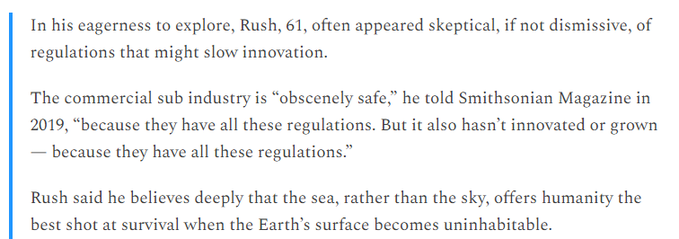
The captain of the submersible was the CEO and co-founder of OceanGate a man whose name was “Stockton Rush,” because hell yeah it was. Stockton Rush was a fairly rich person, and like many fairly rich people he was a strong believer in “innovation” but not a very big believer in “regulations.”

https://www.cnn.com/2023/06/23/europe/titan-submersible-victims-intl/index.html

“Innovation” is a word with many definitions.

Somebody using it can mean “the act of bringing to light something that wasn’t previously known” or it can mean “combining or reconfiguring already known things in novel and unique ways that create valuable new effects.”

But sometimes when people use the word, they mean “ignoring a rule that was there for what might be very good reasons, in order to gain an advantage by doing things that other people aren’t permitted to do.”

So it seems to me true “innovation” isn’t really about making new rules but noticing old ones either for the first time or in new ways.

But then there’s the other kind of innovation: the rule-ignoring kind—the kind that makes boats that can’t sink, or submersibles that ignore strict guidelines for managing the extreme pressures of the ocean depths, the kind that treats the right of other people to live as if it were something that could be owned like property.

Anyway, as you may have heard, the Titan submersible imploded down there. I don’t blame it. I would have imploded, too.

It hadn’t been made according to regulations that were apparently in place not only to stifle innovation, but also for very good reasons involving natural rules about ocean pressure, set by people who had decided to innovate not by ignoring nature's rules, but by deciding that safety was not obscene.

When the Titan imploded, everyone inside died pretty much immediately. Don’t get all superior on them; you would have died, too. You’re probably not even rich, so you might have died even quicker.

There are many lessons to all this, probably.

One lesson I take away is that physics doesn’t actually care how rich you are; if the systems that protect you from the rules of physics fail, physics will crush rich and poor all the same.

I also notice something about the limits of innovation. It turns out that there are a great many places in the universe where humans cannot live at all, and while innovation has recently proven very adept at taking humans to those places to look around, it can’t figure out how to help humans live in such places, in the rather inevitable eventuality that even a meticulously designed innovation fails—entropy being one of the rules for which physics is a bit of a stickler.

I also notice something else interesting embedded in the story, which is that Stockton Rush believed something that many people—especially rich people—didn’t used to admit they believed, not until recently.

He believed that the Earth’s surface will become uninhabitable.

This is, unfortunately, a very real possibility.

We now know that we’re going to have to innovate a lot, actually—the real sort of innovation, not the rule-ignoring sort—in order to see our way out of the coming climate catastrophe. This is going to have to be the sort of innovation that recognizes that we are all human beings that depend on a livable planet in order to live, that helping or harming the economy won’t mean anything if the planet isn’t livable.

Stockton Rush also seemed to believe that people with access to the innovations he was working on would be able to survive these changes—which would be really good for anyone who had enough money to afford access to that innovation, and even better for whoever controlled that innovation.

The only problem for Stockton Rush was this: the innovation he believed in was the most popular kind—the rule-ignoring kind—and eventually he came face to face with rules that care nothing for money.

It seems that when it comes to the planet, we’re all inside the same boat—or the same submersible, if you like. It seems that outside of our planet it’s awfully inhospitable to people, so our planet becoming inhospitable ought to be a concern to us all.

It isn’t, though.

Many of us, rich people in the world's richest economy, have apparently decided that we're in a different boat.

https://www.pbs.org/newshour/show/gop-presidential-candidates-avoid-discussing-climate-change-on-campaign-trail

GOP presidential candidates avoid discussing climate change on campaign trail

The 2024 Republican presidential campaign season is in full swing and candidates are stumping on a host of key issues. But one topic that’s missing from their agenda is climate change. Despite a summer of record-setting heat, new polling shows that Republican voters still don't see a warming planet as a concern. As William Brangham reports, neither do the GOP candidates who want to lead them.

PBS NewsHour

It makes me wonder who the last person was to die in the Titan. It all happened in a millisecond, it’s said.

But one of them must have died last.

Maybe it was the person closest to the front, or to the back. Was it the richest person? Maybe it was. Maybe if you had slowed time down by a factor of 1000 the last person in the Titan to die might have had time to observe the fate of the others, situated in the part that crumpled first, and to have the smug thought: “suckers.”

This seems to me no less bizarre or irrational a response than to think “If it doesn’t affect my neighborhood, it doesn’t affect me” in response to a cooking planet.

Still, it’s a popular belief. We’d be hard-pressed to call it an innovation, but it seems an innovation, nevertheless, to believe that living in relative wealth means that you don’t possess a human body the same as anybody else, or that the fate of other neighborhoods will somehow make your neighborhood immune to nature’s laws.

Here’s a question that seems relevant to that belief. It’s an ancient question.

Here it is:

Who is my neighbor?

I’ll answer it in the ancient fashion, which is to answer with another question:

Who isn’t?

https://armoxon.substack.com/p/all-in-the-same-boat

All In The Same Boat

A story about different kinds of innovation, and re-asking an ancient question.

The Reframe

@JuliusGoat

Can't we just move closer together, closer to where we work, and stop flying around for stupid reasons?

We only need to innovate if we refuse to change our behavior.

@JuliusGoat @iBlame You strike me as the kinda cat that would've already read Rushkoff's "Survival of the Richest," but if you haven't you'd love it. It hits all of these ethical and philosophical nails dead center on their respective heads, while poking the separatist billionaire class firmly in its eye.
@JuliusGoat One of the technologies the regulations were designed to hinder were imploding submersibles. Regulations.