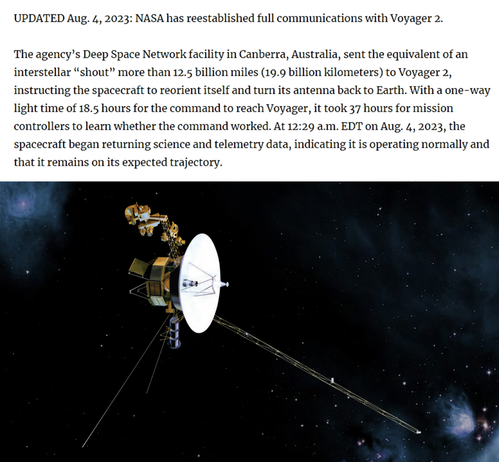
Update on Voyager 2, which lost contact with earth on July 21 due a mispointed antenna.

Voyager 2 is programmed to reset its orientation Oct 15; meanwhile, NASA is trying to make contact.

On Jul 31, the DSN station in Canberra picked up a faint signal, not strong enough to decode. It shows that V2 is healthy and calling home periodically as programmed.

On Aug 3, some commands were blasted out from Canberra (perhaps at higher power) in the hope that, V2 can decode it and repoint.

#Voyager
1/n

How can Voyager 2 decode a signal when its antenna is mispointed by 2°?

The graphic below shows the "antenna pattern" of the Voyager antenna. Most of the downlink energy is located in the narrow main lobe, but there is some energy in the side lobes too. The graphic shows 2 such sidelobes.

The uplink signal strength has similar but wider lobes, so it is possible for V2 to decode a high power signal from the DSN at a 2° offset. Here's hoping that it does 🤞

https://descanso.jpl.nasa.gov/DPSummary/Descanso4--Voyager_new.pdf
#Voyager
2/n

To make matters worse, only 1 of 2 receivers on Voyager 2 is healthy, but a fault prevents it from accurately tracking the receive signal. Signal frequency varies due to the rotation of the earth (doppler) and receiver temperature. V1 can track signals that are off by +-100,000 Hz, but V2 can only handle +-100 Hz. For V2, tx from earth is pre-compensated in freq, taking earth rotation and V2 temp. into account.

https://descanso.jpl.nasa.gov/DPSummary/Descanso4--Voyager_new.pdf
#Voyager
3/n

There is some more info on Voyager 2 in this earlier thread.
https://fosstodon.org/@AkaSci/110792770324764839
#Voyager #Voyager2
4/n
AkaSci 🛰️ (@[email protected])

Attached: 1 image Oops! Earth has temporarily lost contact with the Voyager 2 spacecraft. A series of planned commands sent to the spacecraft on July 21 inadvertently caused its antenna to get mispointed by 2°. NASA can no longer send commands or receive data from Voyager 2 via the DSN. Voyager 2 is programmed to reset its orientation multiple times each year to keep its antenna pointing at Earth; the next reset will occur on Oct 15, which should restore communications. https://blogs.nasa.gov/sunspot/2023/07/28/mission-update-voyager-2-communications-pause/ #Voyager 1/n

Fosstodon

Hallelujah. It worked! 😂
NASA has reestablished full communications with Voyager 2!!!

The commands sent from DSN Canberra on Aug 3 over S-band were successfully received by Voyager 2's mispointed antenna; the spacecraft is now correctly pointed towards earth.

At 12:29 a.m. EDT on Aug. 4, 2023, about 37 hours after the commands were sent (V2 is 18.5 light-hours away), science and telemetry data started getting received at DSN Canberra.

https://blogs.nasa.gov/sunspot/2023/07/28/mission-update-voyager-2-communications-pause/
#Voyager #Voyager2
5/n

Mission Update: Voyager 2 Communications Pause – The Sun Spot

And even as we toot , Voyager 2 is communicating with earth via the 70-m dish at the NASA DSN site in Canberra, Australia.

Downlink: 160 bps, X-band 8.4 GHz, 1E-18 watts!
Uplink transmission (S-band, 2.1 GHz) does not seem to be active at this time.

https://eyes.nasa.gov/dsn/dsn.html
#Voyager #Voyager2 #DSN
6/n

Deep Space Network Now

The real time status of communications with our deep space explorers

Deep Space Network Now

Looks like NASA DSN today uplinked some fresh new commands to Voyager 2 via its 70-m dish in Canberra, Australia.

Uplink transmission: 16 bps, S-band, 2.1 GHz
Transmit power: 20 kW.
Beamwidth: 0.12 degrees
Antenna gain: ~62 dB.

Go Voyager!

https://eyes.nasa.gov/dsn/dsn.html
#Voyager #Voyager2 #DSN
7/n

Deep Space Network Now

The real time status of communications with our deep space explorers

Deep Space Network Now
@AkaSci imagine being the programmer who hit send…. I wouldn’t be able to sleep without a copy of that send command to look over

@nikluz @AkaSci
I wonder what the Soviets did to that poor technician who had the misfortune of omitting a hyphen and ended the Phobos 1 mission

https://en.m.wikipedia.org/wiki/Phobos_1#Malfunction

Phobos 1 - Wikipedia

@AkaSci later we hear - the time lag between request & response is consistently a couple microseconds too long for the known position and speed of the probe, implying an unknown MITM intercepting and relaying the messages....

(Fodder for a story along the lines of Three Body Problem...)

@AkaSci I love that the solution was apparently YELL LOUDER from Canberra. 😆
@wcbdata @AkaSci
Centuries from now those star systems directly behind Voyager 2 are gonna be hopping mad at the Canberrans

@AkaSci
For me, one of the toughest parts of incident response is waiting for validation that the fix has worked.

I know in my head that it'll take 4h for the data pipeline to process the fix, yet I'm still sitting at my desk mashing F5 on the alerts board.

37h is... something else.

@AkaSci how tf is that thing still working? that's amazing. does it repoint with gyros or rocket fuel?
@barrygoldman1
Voyager uses Hydrazine and thrusters for attitude control, not gyros or momentum wheels.
There is enough Hydrazine to last until 2040 for V1 and 2048 for V2.
https://descanso.jpl.nasa.gov/DPSummary/Descanso4--Voyager_ed.pdf
#Voyager
@AkaSci amazing. >50yrs of hydrazine...
@AkaSci Not bad for 1970s technology eh?

@AkaSci @heafnerj

Hey, they put a man on the moon in the 60s…! 🖖
We could do with a bit more of that “Right Stuff” yeah?

@AkaSci

Vger!

Vger phone home…

👍👏👏👍

@AkaSci
That thing is 18.5 light-hours away. It still amazes me that we know where it is that far away and can find it 50 years later. I have trouble finding the screw driver that I just had in my hand 5 minutes ago.