 chianeko
 mcc
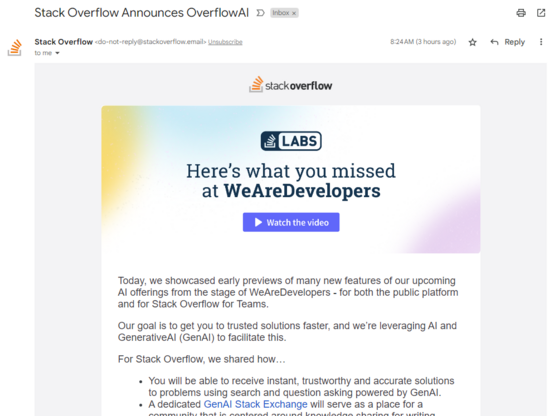
mccReceived an email this morning and I am now looking for an alternative to StackOverflow for tech support-y stuff
@mcc my favorite file sync software, syncthing, uses discourse for tech support forum. Which, apparently, just added an activitypub plugin.

:discourse2: Summary Discourse ActivityPub allows you to publish Discourse posts via ActivityPub so they can be read on services that support ActivityPub such as Mastodon. 🛠 Repository Link GitHub - discourse/discourse-activity-pub: Adds ActivityPub support to Discourse. 📖 Install Guide How to install plugins in Discourse If you’re unfamiliar with ActivityPub start by watching this short video: When you’re ready to get started setting up the plugi...
@mcc I especially love how SO is doing this when the entire community has been very loudly saying "no" to allowing AI answers of any sort.
This explains why the company was trying to roll back those policies
@mcc it is an embarrassment. They've also released multiple statements saying
* they still don't believe they're actually obliged to do the community data dump (they want to reserve a lot of rights beyond the CC-BY-SA licensing)
* only people who freely admit to using GPT/other AI should be suspended for making AI answers
it's all so dumb and self-destructive.
I still cannot comprehend how many people want to use LLMs for text search. What idiocy.
@mcc reminds me of what MDN tried to introduce their ExplainAI feature in their JS reference documentation — thus providing incorrect answers and docs to users 🤦 https://github.com/mdn/yari/issues/9208
(They reverted it recently following th backlash: https://developer.mozilla.org/en-US/blog/ai-explain-postmortem/#launch_and_feedback)

Summary MDN's new "ai explain" button on code blocks generates human-like text that may be correct by happenstance, or may contain convincing falsehoods. this is a strange decision for a technical ...
@mcc I'm a fan of Spiceworks. More focused on SysAdmin stuff but it is really helpful for me.

I’ve been day dreaming about a social media platform built entirely on a peer-to-peer (P2P) model, leveraging the existing BitTorrent protocol. The idea is to decentralize content creation, distribution, and moderation, eliminating the need for centralized servers and control. Here’s the high-level vision: - Posts as Torrents: Every original post creates and seeds a torrent file on behalf of the OP. - Upvotes as Seeds: Upvoting a post downloads and seeds the post, reinforcing its availability. - Comments as Torrents: Each comment generates and seeds a torrent file somehow linked to the original post. - Comment Upvotes as Seeds: Upvoting a comment downloads and seeds the comment, amplifying engagement. - Text Only: to avoid exposing users to potentially graphic content (due to lack of centralized moderation) this platform would initially be limited to text content only. This would also drastically reduce the compute and bandwidth requirements of the seeder. - Custom BitTorrent Clients: Open-source Social Media BitTorrent clients would display the most popular social media content by day, week, month, or year. These clients would allow users to seed only the content they find valuable thus organically moderating the network of ideas. Relevant content continues to be seeded and shared, while outdated or unpopular content fades due to a lack of seeds. This setup seems like it could address key issues in traditional social media—privacy, censorship, and centralized control—while naturally prioritizing high-value content. Why hasn’t a system like this been widely adopted? Is it a matter of technical limitations, lack of a viable economic model, or something else? I’d love to hear your thoughts.
 Cassandrich
 ch0ccyra1n is leaving fedi soon
 Aranjedeath
 [moved] stereo griever
 aeva
aeva Elias Mårtenson
 Bee O'Problem
 nev
nev Efi (nap pet) 🦊💤
 Stevoisiak
 clacke: exhausted pixie dream boy 🇸🇪🇭🇰💙💛
 Erin
Erin Mithical
 Viria
Viria mpoletiek
 Olivier Halligon
 ComplexedOne
 calvin 🛋️
  linus
linus