 Oliver Reichenstein
Reading the recently criticized DMA, that, as far as I can tell, did its job stopping Facebook's new attempt to get us on its latest hamsterwheel. As expected, legal texts are boring, contorted and hard to follow for non lawyers. Let's see how far I get before suffocating: https://eur-lex.europa.eu/legal-content/EN/TXT/PDF/?uri=CELEX:32022R1925
So far (article 33), they mostly struggle to describe Facebook, Google, Apple, Tik-Tok, Microsoft, Amazon, and how they operate without explicitly naming them. It's a legal text, so obviously they need to find a way to describe a common rule without naming (potentially incriminating) individuals. It's painful and inconvenient to read, but completely understandable why it's written like this.
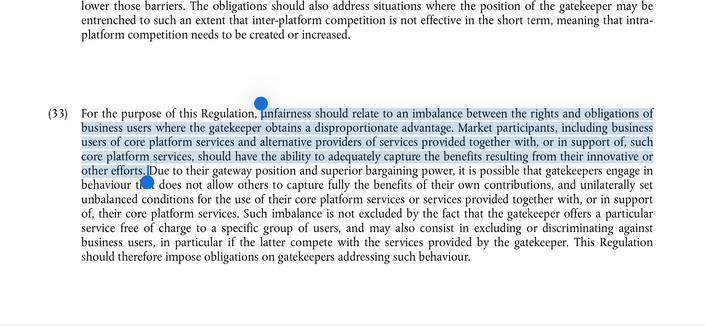
Criticizing a legal text for being written in "legalese" is like criticizing criticizing Chinese for not being German. I have a weak spot for the philosophy of law, so I spend a bit more time on these: unfairness is defined as an
"imbalance between the rights and obligations." 🤔
This is a standard definition. But it's not the most efficient when addressing a bad faith Wild West mindset ("I take what I can get, and the more powerful I get the more I define what's right and what's wrong").
Article 34:
"Contestability and fairness are intertwined."
Again a standard formulation. Mind you, I am just as far from a legal expert as most of you. For someone who has observed the market as a consumer and a seller, this argument in combination with unfairness as
"imbalance between rights and obligations"
...seems useful beyond my personal interest for the philosophy of law.
From what I can tell, most critique of the DMA is rather vague and builds on the preconception that the EU is useless to begin with, "doesn't understand" technology and creates inefficient stupid laws like the "acccept this cookie" banners. I read this document because DMA was efficient holding Facebook back in Europe, and I want to see for myself if this was the result of a reasonable law or just random luck.
DMA critique is predominantly cheap shots of people that don't care much about the law beyond claiming that "We should decide for ourselves."
I have sympathy for truly liberal minds. But If "decide for yourself" was generally the best or only regulation, then seat belts should not be mandatory, the use of drugs and medication would be open to anyone's own judgement, including small children, hormone steered kids, addicts and very old people other people that tend to be higher than is healthy.
More importantly, if "we can decide for ourselves" is the only law we follow regulating technology, the option building itself would also be subject to companies selling and promoting them at will. You can't regulate that either if "we can decide for ourselves."
We see what is happening right in front of our eyes when people drink the Kool-Aid of Apple, Facebook and Google. It's not just wrong, it's utterly depressing, sad and repulsive. Ok, next paragraph...
Often overseen by the end user that only thinks about their direct personal risks when offering private data:
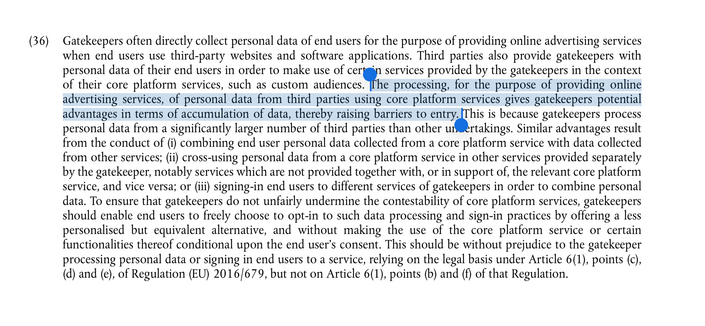
"The processing, for the purpose of providing online advertising services, of personal data from third parties using core platform services gives gatekeepers potential advantages in terms of accumulation of data, thereby raising barriers to entry."
Collecting personal data at big scale and using it competitively, will in itself result in an unfair (incontestable) advantage.
Paragraph 37:
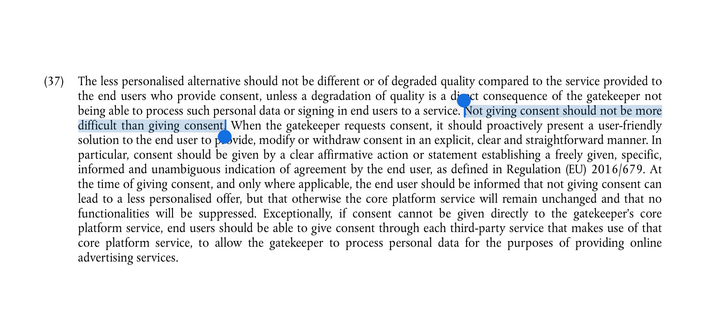
"Not giving consent should not be more
difficult than giving consent."
Another (not un)reasonable regulation and knowing how sneaky our big friends are a very accurate description of how our big tech friends operate.
38 makes sense, too:
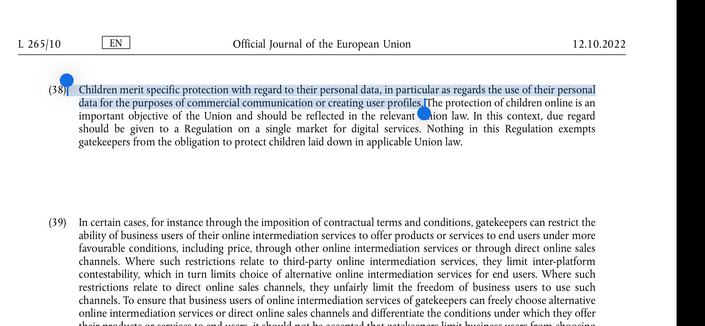
"Children merit specific protection with regard to their personal data, in particular as regards the use of their personal
data for the purposes of commercial communication or creating user profiles."
There is still a long way to go, but, so far, I haven't seen anything particularly uniformed or particularily stupid in this regulation.
39 addresses Apple:
"Where such restrictions relate to third-party online intermediation services, they limit inter-platform contestability, which in turn limits choice of alternative online intermediation services for end users. Where such restrictions relate to direct online sales channels, they unfairly limit the freedom of business users to use such channels."
Again, quite accurate. Critics of this paragraph like to repeat Apple's talking point about protecting customers from bad actors.
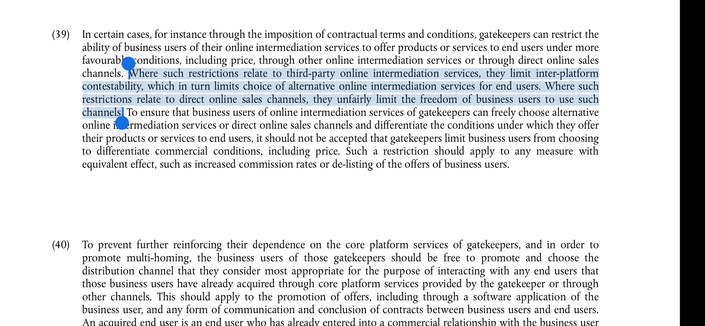
That Apple needs to control the App Store for the consumer's safety has a simple retort: Apple's own macOS shows that you don't need a dictatorship to protect consumers from bad 3rd party actors. The way the regulation frames the situation, again, shows insight. Not just the consumer needs protection, 3rd parties need protection, too. And, in consequence, the consumer profits as well if 3rd parties are not forced to follow the so called gatekeeper's self serving rules.
We get a lot of people asking when we'd add @ia Presenter to the AppStore. We currently avoid it, among others, to explore what the reality outside the AppStore is like. Does AS really give us that massive exposure? (No). Is it safer for us? (No). Is it easier/more practical for small developers? (Yes).
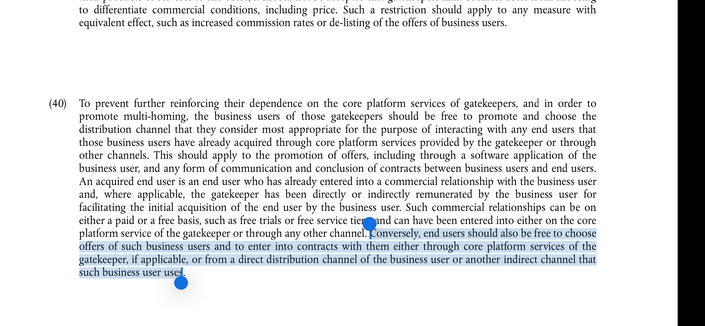
(42) DMA protects AppStore whistleblowers:
"Any practice that would in any way inhibit or hinder those users in raising their concerns or in seeking available redress for instance by means of confidentiality clauses in agreements or other written terms, should therefore be prohibited."
Meaning Apple (or Google) cannot prevent you or their employees from outing information that exposes malpractice via confidentiality agreements. Again, nothing wrong with that either.
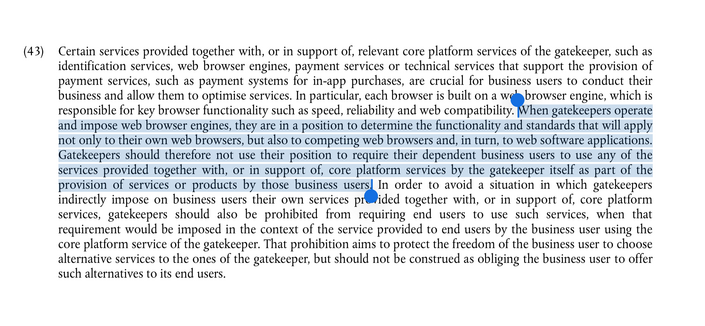
43) Gatekeepers can't impose Webbrowsers. Well argued but my mind rushes to see if there are some edge cases where that would create issues. Can't find any—but I'm sure a smarter person could.
Avoiding edge cases is one reason why the law sounds so weird. At the same time—to a Western European—the law is not by the letter or how it can be bent, what counts is its intention (its"spirit"). Could be irritating for Americans with their case law and its quite common by the letter interpretations.
If you have trouble understanding the difference between the letter and the meaning of the law, I can't think of a better explanation than this episode of Kung-Fu. https://youtu.be/Gm_yMBUNY08
This episode is so good, I can't believe it's a TV show. (I remembered it differently, I thought they both ate the plums when the master was away for some days, much longer than expected, and they both ate them because they had nothing else to eat).

Kung Fu: Master Kan on The Law
I've seen this series as a child and watched some of it again twenty years ago. I (inaedequately) quote this episode all the time when it comes to the difference between the letter and the spirit of the law. (Still prefer my, more realistic and dramatic version of the story where the boys got hungry after days of no food in their master's long absence).
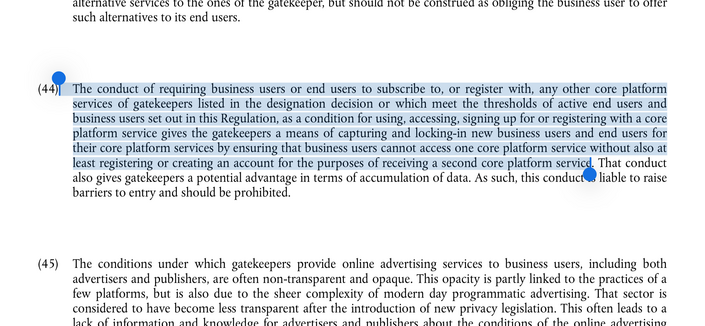
Paragraph 44 is a perfect example where you need to separate the letter and the intention of the law, because you can bend its interpretation to make an example of how "unrealistic" such a requirement is if you take it by the letter. Yes, technically we sometimes might have to subscribe to X to get Y. If you look at the spirit of the law you understand that what is meant is that you shouldn't abuse of such eventualities.
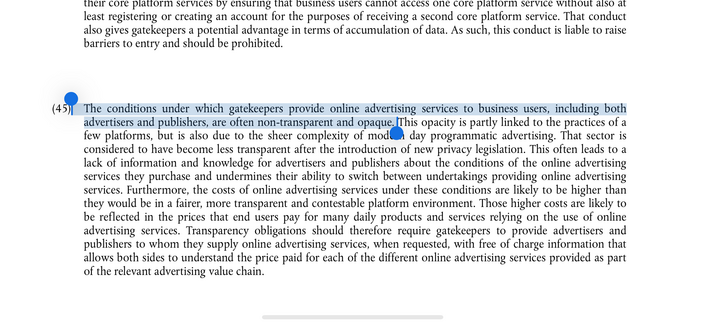
Paragraph 45 shows a very rare insight into how dodgy the business of online advertisement really is:
"The conditions under which gatekeepers provide online advertising services to business users, including both advertisers and publishers, are often non-transparent and opaque."
Yes. It's a black box. The money you pay to Google and Facebook and the value you get out of it are extremely intransparent. It boils down to "believe me."
This may trigger free market advocates.
A) If you don't like Google's or Facebook's results you can go elsewhere.
B) Millions of businesses use them, so they probably work.
C) You can see it in your sales performance. If it didn't work, no one would book them.
Did you choose them because you really have the choice? How good is the return? Why clicks really? Who measures?
I've had the eventual seller of Rosemary Macho Soap or Fish Oil startup telling me how beautifully their FB or Google ads pay off. Our clients throughout tell us, that they always end up spending way more than they measurably get in terms of resulting sales (the original proposition of online ads). And they all say the reports are, in the end, completely opaque. The only exception is AppStore ads, which have their own economic, moral and legal issues (don't get me started on them).
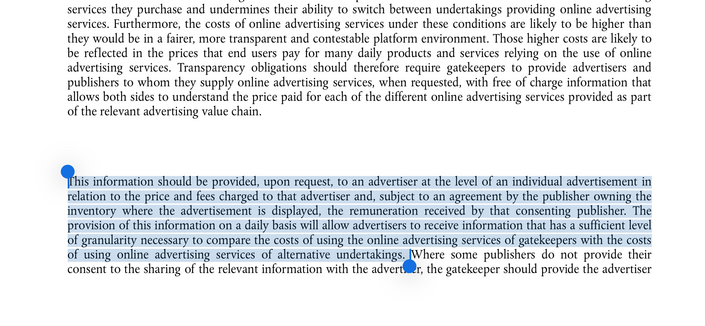
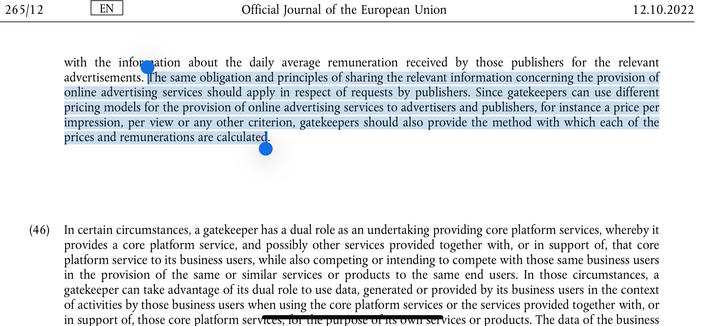
Still Paragraph 45. People writing these laws know much better how online ads work than your average blogger. Transparency for the revenue they get from online publishers for placing your ads through their platform. Google and Facebook must fear this like the Great Irish Potato Famine.
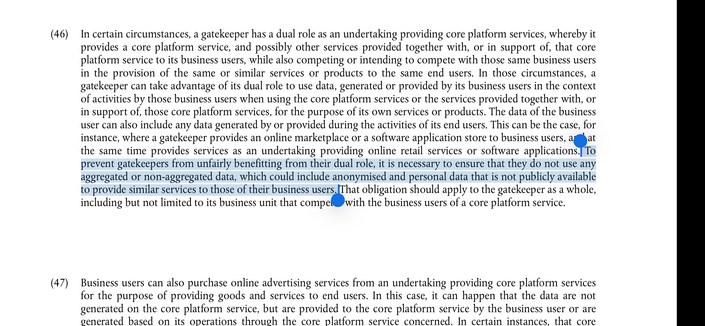
46) Apple is not allowed to look at Netflix' AppStore business data or any other businesses they compete with. Again, 100% reasonable. Of course Apple thinks this is a bad bad law. Fan boy: "But to a certain degree Apple/Google/MS compete with almost all the apps on the their app stores!" Oh, don't you say... 🧐
I won't comment on every paragraph. But I'll mention good or bad things when I find them. No really bad things so far (12/66 pages). 49) Again completely reasonable:
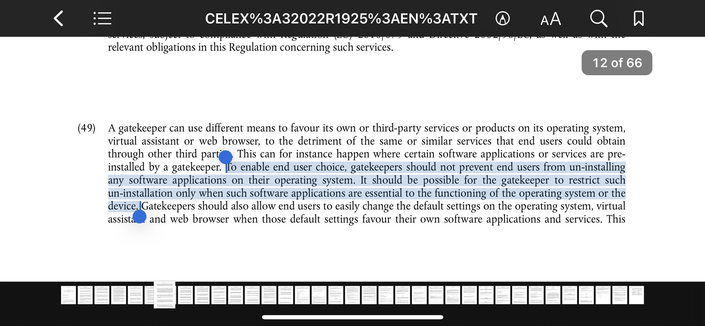
"To enable end user choice, gatekeepers should not prevent end users from un-installing any software applications on their operating system. It should be possible for the gatekeeper to restrict such un-installation only when such software applications are essential to the functioning of the operating system or the device."
Whoa, great news for camera, calendar or mail apps:
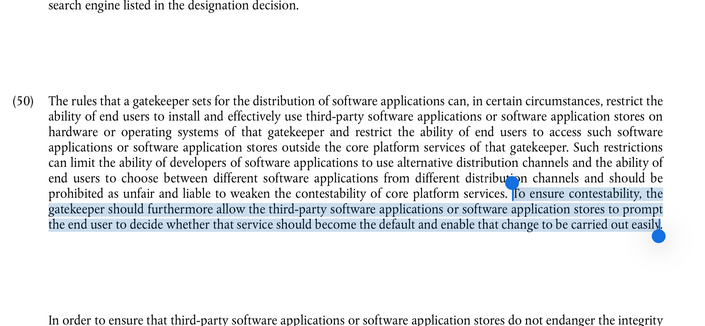
"To ensure contestability, the gatekeeper should furthermore allow the third-party software applications or software application stores to prompt the end user to decide whether that service should become the default and enable that change to be carried out easily"
Critiques of DMA suggested focus and modesty like "They should have focused on 'allow apps to communicate directly with their customers'" or some other minor details. LOfuckingL.
If you oppose the DMA as an indie dev you probably haven't read it. Look: No more private APIs:
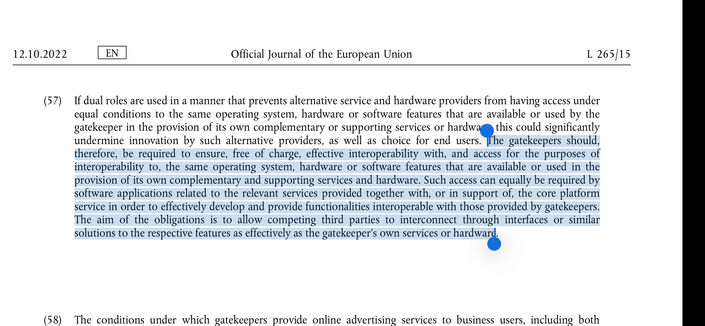
"The gatekeepers should, therefore, be required to ensure, free of charge, effective interoperability with, and access for the purposes of interoperability to, the same operating system, hardware or software features that are available or used in the provision of its own complementary and supporting services and hardware." 🎉
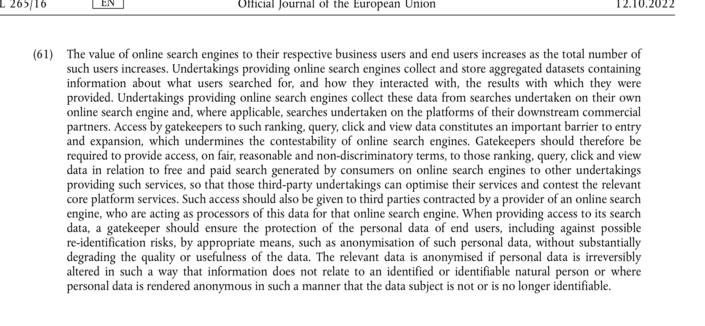
Unfortunately, this is a really hard to understand passage, and, unless I misunderstood, also one of the most extreme. What it proposes is that search gatekeepers (Google) should be obligated to provide access to ranking, query, click, and view data to other providers of search engine services on fair, reasonable, and non-discriminatory terms. This access would enable third-party providers to optimize their services and compete effectively. 😳
Zeus wrote this paper. First, set the rules for pricing, then: "And don't think you can abuse these laws to evade your responsibility for misinformation!" 🤩
What is short sighted, unrealistic or unreasonable about 63?
"Closing an account or un-subscribing should not be made be more complicated than opening an account or subscribing to the same service. Gatekeepers should not demand additional fees when terminating contracts with their end users or business users."
64 is one for Mastodon:
"gatekeepers should therefore ensure, free of charge and upon request, interoperability
with certain basic functionalities of their number-independent interpersonal communications services that they provide to their own end users, to third-party providers of such services"
Again, in a nitty gritty American interpretation you can spin flaws into it. If you read it as it was meant, you know it's the right thing to do.
It goes on admitting between the lines that tech protocols can get complicated, and then suggesting that if gatekeepers have doubts whether it not they comply they can directly ask to avoid all speculation. Again they undermine that regulations cannot be a reason to get sloppy about security. (Still 64)
66 defines reasonable exceptions, but I also read it as a warning to not use the shock resulting from instant implementation of EU laws to drum up resistance from the user base. It says that if one of our laws is really unreasonable, appeal and we can excerpt you until the unproportional law gets revised and modified. If you can't get your deserved kicks take Route 66. it's not a cope out, for every one to Rock'n'Roll on, but an exceptional and provisory fairness measure. 67-68 specify.
Winner takes it all? Not in mama EU's house! Inform us of your planned acquisitions, give us all the relevant data and we'll use that data to understand market trends to prevent all your planned predominance tactics.
"gatekeepers should inform the Commission of all of their intended acquisitions, prior to their implementation, of other undertakings providing core platform services or any other services provided within the digital sector or other services that enable the collection of data."
72 dedicated to ensure privacy is one for the books:
"gatekeepers should at least provide an independently audited description of the basis upon which profiling is performed"
'At least'!🤣 I can only imagine the shock on US business people's faces when listening to their lawyers explaining what is in there and what it means for their business in Europe. "We'll just shut everything down in the EU!" Turns to BA: "Right?" BA silently shakes head.
The following paragraphs mostly regulate how the commission can ensure compliance. Okay, so what happens if they still don't comply? 86 gets more concrete:
"Compliance with the obligations imposed by this Regulation should be enforceable by means of fines and periodic penalty payments."
As we know penalties now speak big tech language and use the Billions, not the Millions scale.
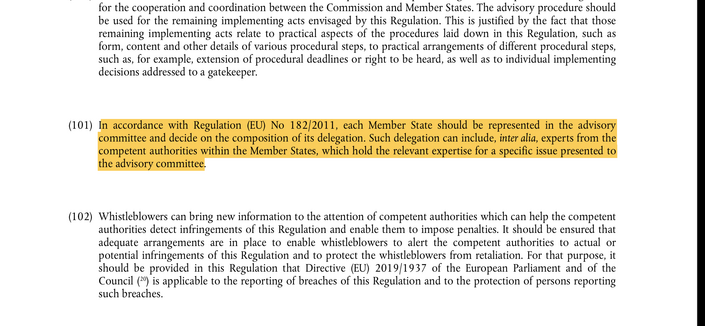
Nothing spectacular or unusual in the following paragraphs, still focusing on execution of the strong rules specified before. 101 is somewhat interesting maybe: Who are the experts?
"…each Member State should be represented in the advisory committee and decide on the composition of its delegation. Such delegation can include, inter alia, experts from the competent authorities within the Member States, which hold the relevant expertise for a specific issue presented to the advisory committee."
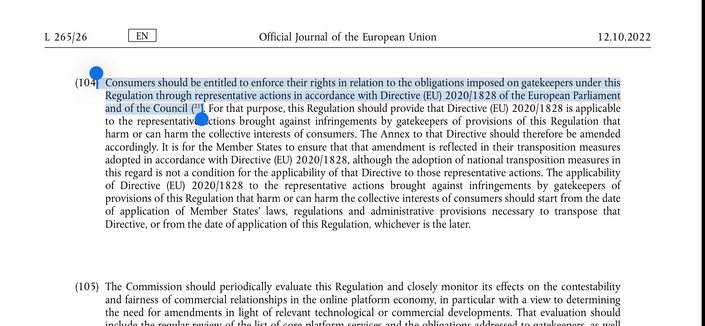
Coming to a close for the regulations part. 104 explains that if you think that things go wrong you don't need to wait for the parliament to notice and act, but that as a consumer you can enforce your rights:
"Consumers should be entitled to enforce their rights in relation to the obligations imposed on gatekeepers under this Regulation through representative actions"
A good reminder in a time where the law seems to be different for the affluent and the common citizen. 😊
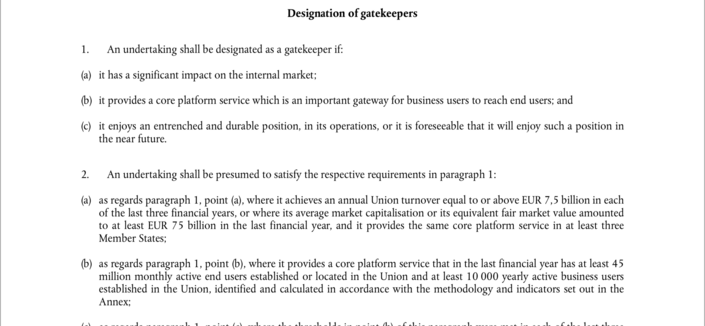
Ha, looks like I'm through the main part. What follows are definitions. Mostly around what a gatekeeper is and how the EU defines them officially as such. Should be fast now.
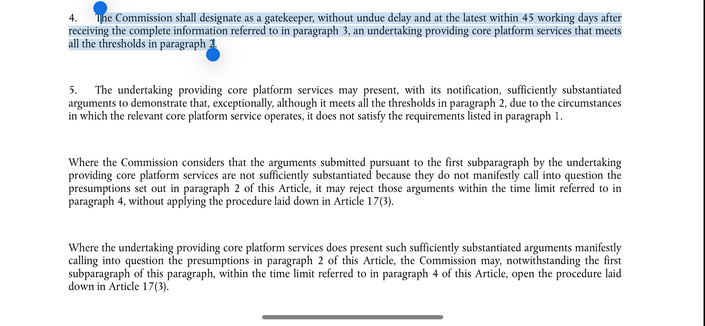
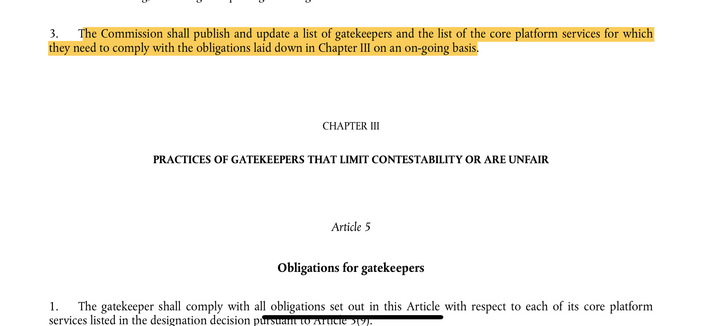
Oops, no, not done at all. Now we learn was gatekeepers are not allowed to do. Again, the EU shows that it knows the bad actors and their tactics. Plenty of bad news for big tech. For us it reads as common sense. Taking a break now. I'll finish it later. This has been way more interesting, informed and informative than I thought.
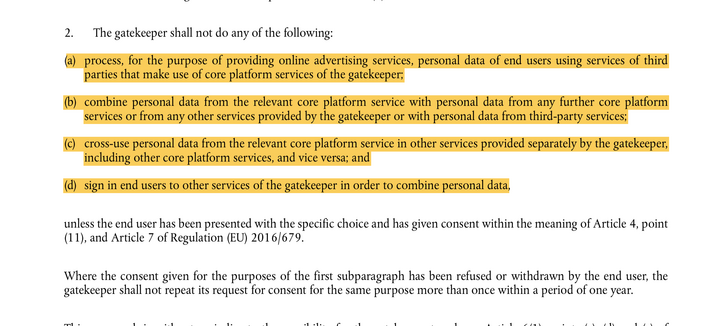
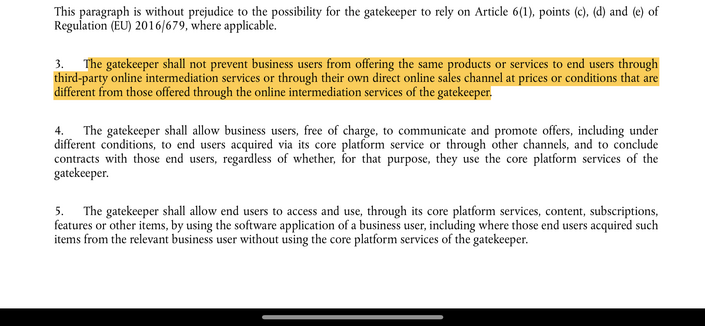
Okay, let's finish this up:
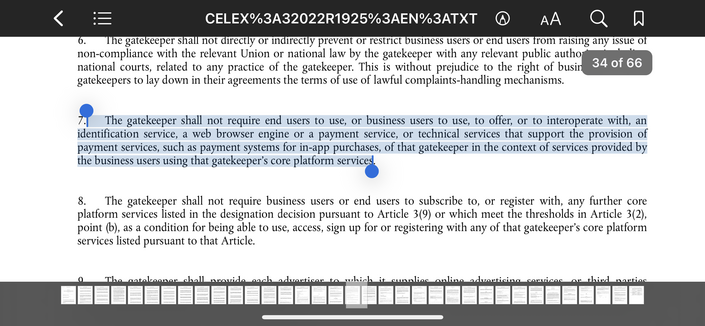
"III.5.7. The gatekeeper shall not require end users to use, or business users to use, to offer, or to interoperate with, an identification service, a web browser engine or a payment service, or technical services that support the provision of payment services, such as payment systems for in-app purchases, of that gatekeeper in the context of services provided by the business users using that gatekeeper’s core platform services"
 matti has moved
@reichenstein Thanks for doing this. I never found the time to even touch the surface, but through your posts I know way more than I did before today about this.
 Kirk van Gorkom
@reichenstein thanks for sharing all these highlights with your commentary. A helpful and thought-provoking thread.
 Ricardo Brenelli
@reichenstein this is great for Samsung users, my (budget) phone comes with Meta and Microsoft software that you can disable but not uninstall.

@rbrenelli Precisely. I'm not an Android user but I deal with that crap on our testing devices.
 Photo Ewen 📷
Both of these companies are happy to take money from the never ending conga line of mugs who desperately hope to get a return. It's just a matter of how much they'll fork out before they realize the cards are marked.
Better off throwing your money down at the casino.
 Rafael “Akai” Masoni
@reichenstein Back in 2016 Facebook ads worked really well, so we committed. Today it’s but a sliver of what it once was, and the worst part is we’re dependent on it.
Apart from prices, what we gathered after countless meetings with both Meta and Google representatives is that nobody has the slightest idea about how these systems actually work.
One time, a Google representative offered to build the ad campaign for us as we were having some difficulties. It was rejected by Google.
@rmasoni Representatives don't know. But... Someone knows... We know two things:
1. they don't work for us
2. they work really well for them
That there's something dodgy if not outright fraud happening somewhere in between is almost as clear as an Aristotelian enthymeme.