 Dan Sadler
 Robert McNees
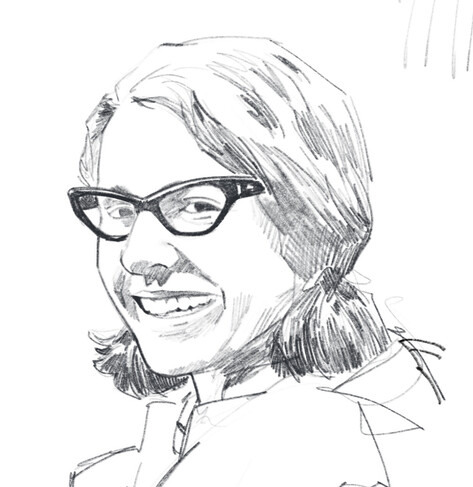
Astrophysicist Jocelyn Bell Burnell was born #OTD in 1943. As a grad student at Cambridge in 1967, she discovered an entirely new type of celestial object: Pulsars!
Photo: National Science & Media Museum / Science & Society Picture Library
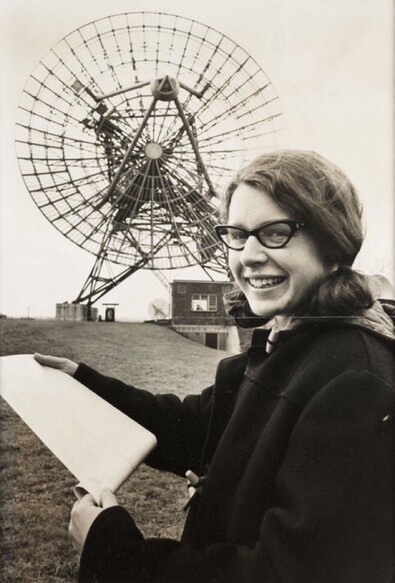
Astrophysicist Jocelyn Bell Burnell was born #OTD in 1943. As a grad student at Cambridge in 1967, she discovered an entirely new type of celestial object: Pulsars!
Photo: National Science & Media Museum / Science & Society Picture Library
Bell was a graduate student in 1967 when she and her doctoral advisor Antony Hewish constructed a low frequency radio array to study the effect of the solar wind on nearby radio sources.
During the commissioning phase of their array, while analyzing long readouts of data by hand, Bell discovered a regular signal with a very stable period of about 1.33s.
Bell and Hewish quickly ruled out a problem with the instrument or human-made interference as explanations.
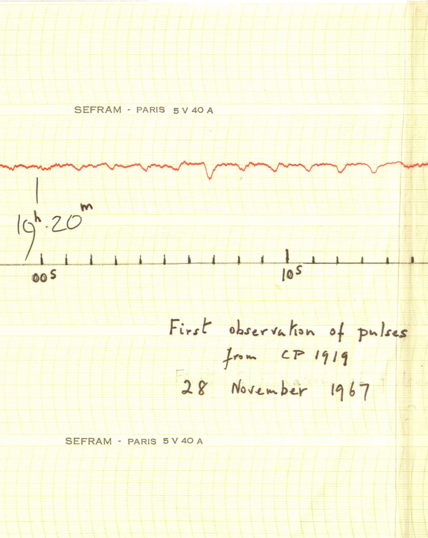
Imagine seeing that remarkably regular signal and not knowing of an astrophysical source that might explain it.
They jokingly nicknamed it LGM-1, for "Little Green Men."
Here is a transcript of Jocelyn Bell Burnell's after-dinner speech at the Eighth Texas Symposium on Relativistic Astrophysics, recounting the discovery.
The sources were soon identified as rotating, magnetized neutron stars. A tightly collimated beam of radiation is ejected along the neutron star's magnetic axis. We see regular pulses as it rotates, hence the name "pulsar."
The discovery of pulsars provided an extraordinary new laboratory for physics. For example, a gradual decay in the orbit of the pulsar-neutron star binary PSR B1913+16 matches the prediction of general relativity, with energy lost via gravitational waves.
Image: NASA
Antony Hewish received the Nobel Prize in 1974 for his "decisive role in the discovery of pulsars." In a move that can only be described as gratuitous sexism, the Nobel Committee decided not to include Jocelyn Bell Burnell on the prize.
A younger graduate student (Brian Josephson) had received a share of the prize the previous year, so it's not like there was a prohibition against awarding students.
But that's not all. It gets worse.
In 1974, the year Hewish got the prize, there was another important pulsar discovery.
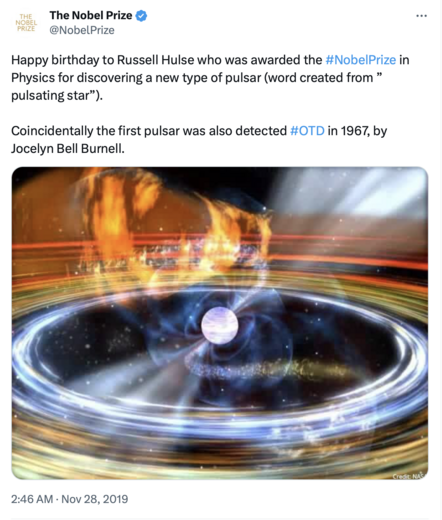
That year, Russell Hulse and Joseph Taylor discovered an important binary pulsar pair. They were rightly awarded the 1993 Nobel Prize for this discovery!
Russel Hulse was 24 year old graduate student at the time, just like Jocelyn Bell Burnell when she made her discovery. Taylor was Hulse’s advisor.
But Hulse was a man, so he was given a share of the prize.
The Nobel folks always leave this bit out.
"Although I was not included, I celebrated that first award in 1974 of the Physics Prize for an astronomical discovery. Now I celebrate the fact that we have a better understanding of the teamwork necessary for scientific progress."
Jocelyn Bell Burnell has received just about every other award under the sun, including the 2018 Special Breakthrough Prize in Fundamental Physics. She used the prize money —about £2.3 million— to establish a scholarship for white women, minority, and refugee students in physics.
Anyway, happy 80th birthday to Dame Jocelyn Bell Burnell, who discovered pulsars!
Important pulsar fact!
The cover of the Joy Division album "Unknown Pleasures" was adapted from a plot that radio astronomer Harold Craft made for his PhD dissertation, using data collected at Arecibo while studying the pulsar discovered by Jocelyn Bell Burnell.
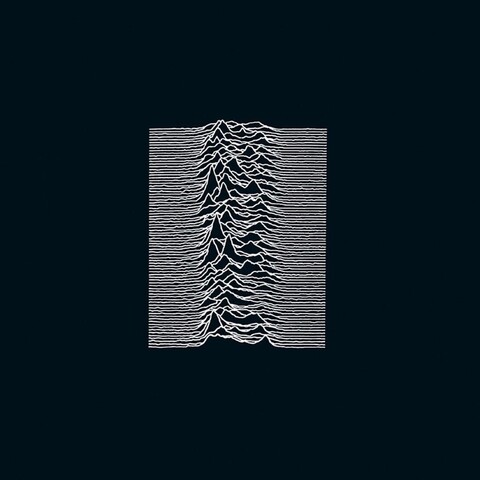
I know this is a tangent, but here's an excellent Scientific American piece explaining how the album cover came about.
And here is a short documentary where Peter Saville explains how he designed the cover after seeing Craft's plot in a copy of the Cambridge Encyclopaedia of Astronomy. The video uses the same image of Jocelyn Bell Burnell that I included in the first post.
The Story of Joy Division's "Unknown Pleasures" Album Design: https://www.youtube.com/watch?v=reEQye0EOAw&t=1s

Sure, I was familiar with the graphic—and I’m not alone. Drop this image (right) on someone’s desk and chances are they’ll reflexively blurt, “Joy Division.” The band’s 1979 Unknown Pleasures album cover leaned entirely on a small mysterious data display, printed in white on black.
@mcnees
Was it astronaut Gordon Cooper who said:
You don't have to be the best known to be the best?
@Juan_Kinda_Guy @Akshay @mcnees Exactly. The Nobel committee got a lot of flack almost immediately. For example, from Sir Fred Hoyle. From Wikipedia:
“Yes, Jocelyn Bell was the actual discoverer, not Hewish, who was her supervisor, so she should have been included." This remark received widespread international coverage. Worried about being misunderstood, Hoyle carefully composed a letter of explanation to The Times.”
@mcnees IIRC it was seen as blatant sexism even at the time!
Chien-Shiung Wu and Lise Meitner would be other Nobel snubs which embarrassed even their male contemporaries.
Vera Rubin missing out is a head-scratcher, though not sure it was sexist, and I guess nobody understood Noether’s Theorem…
@mcnees "We did not really believe that we had picked up signals from another civilization, but obviously the idea had crossed our minds and we had no proof that it was an entirely natural radio emission. It is an interesting problem - if one thinks one may have detected life elsewhere in the universe how does one announce the results responsibly? Who does one tell first? We did not solve the problem that afternoon, and I went home that evening very cross here was I trying to get a Ph.D. out of a new technique, and some silly lot of little green men had to choose my aerial and my frequency to communicate with us."
Absolutely fantastic, thank you for linking it.
Wonderful thread: informative, exciting, infuriating, and ultimately so encouraging. The Nobel prize committee blew it big time in this case (and in many others), other institutions did better, progress is painful, a great scientist succeeded. Thanks for writing this account, it tells us so much.
 whereisk
 BettinaKoza
 Stargeezer Smith
 STEMcoding Project
 Michael Porter
 Juan Cabanela
 Akshay
 AstroMike
 neville park
 SabrinaDent
 RossS
RossS Kenneth
 spencercmd
 vibhor 🍑 🏳️🌈
 the roamer
 maxelcat