@drifthood @chrisnelder @TransitionShow @supernovae just looked at one of their reports again: https://www.vibrantcleanenergy.com/wp-content/uploads/2020/12/WhyDERs_TR_Final.pdf
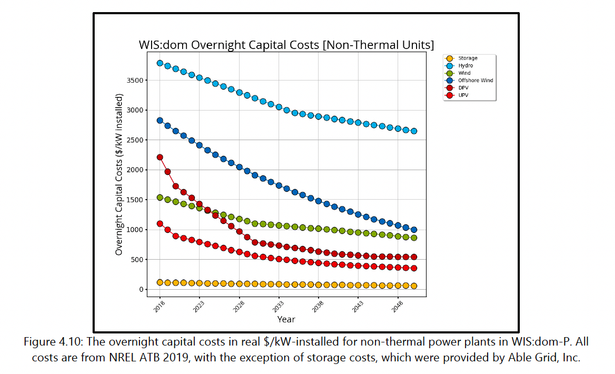
Chart 4.10 shows their cost assumptions. For distribution solar and especially, storage, the numbers quoted are grossly low- no wonder using #'s like this he obtains cost for distributed solar < utility scale. He's just not grappling with reality here but needs to go talk to developers what real costs are- not NREL or academics

@drchrisclack @chrisnelder @drifthood @TransitionShow @supernovae
database of actual distributed solar costs is available on the link to "Solar PV Systems in MA" here: https://goclean.masscec.com/article/solar-costs-and-performance/
@chrisnelder @drifthood @TransitionShow @supernovae @drchrisclack the developer's costs include the transmission, thus inclusive of the full system costs (with proposals some places to make developers responsible for ancillary services costs).
Looking at Clack's cost assumptions for generation- they are 1. low for PV (developers say $1-1.50/W for utility scale, and $2.50 for the cheapest large scale rooftop; Massachusetts shows an average of $3.80/W across distributed < 30kW); 2. a narrowing cost differential between utility scale & distributed that's hard to believe- with only a 25% premium for distributed past 2030. The time and effort getting permits for a 6 kw project, design & engineering, signoff from the utility... I've worked on a couple of these and don't see how distributed could ever come close but if there is a specific roadmap with feasible milestones would like to look at
@drchrisclack @chrisnelder @drifthood @TransitionShow @supernovae
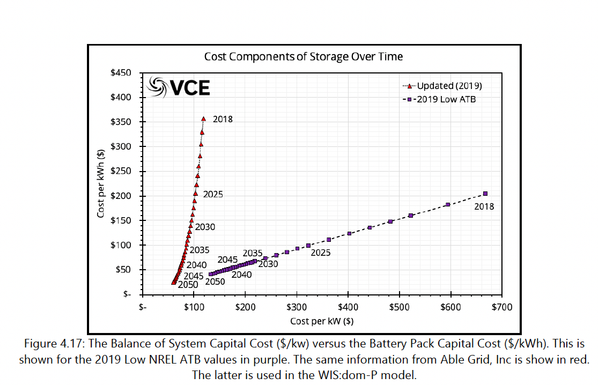
you are right that storage has power & energy cost components- it's helpful to reference for example costs/kwh in terms of a 4-hr duration resource. I'm not as sure costs have come down a lot. 10 years ago a couple famous (now bankrupt) startups were quoting at $400/kwh for a 4-hr system but it's still in that ballpark (they had to work hard to get the costs down to $400/kwh).
A good public source is PNNL in the unlikely case you haven't already seen it: https://www.pnnl.gov/ESGC-cost-performance
they seem reasonable for pre-supply-chain issue #'s.
At $100/kwh it makes sense to use local storage to peak shave the transmission system but peak shaving is uneconomical at costs anything close to $400/kwh unless you have dependably frequent $3000/MWh power market spikes (ERCOT). I still don't understand how developers there get financing even if their financial models are OK