@drifthood @chrisnelder @TransitionShow @supernovae my recollection was, he gave local solar considerable value over utility scale due to "flexibility," but without attributing significant costs for the flexibility (eg costs of storage)

@drifthood @chrisnelder @TransitionShow @supernovae just looked at one of their reports again: https://www.vibrantcleanenergy.com/wp-content/uploads/2020/12/WhyDERs_TR_Final.pdf

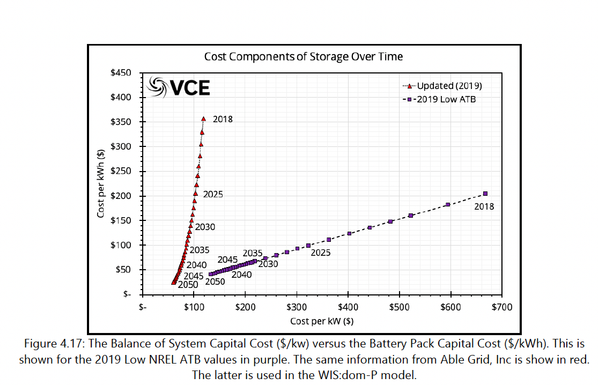
Chart 4.10 shows their cost assumptions. For distribution solar and especially, storage, the numbers quoted are grossly low- no wonder using #'s like this he obtains cost for distributed solar < utility scale. He's just not grappling with reality here but needs to go talk to developers what real costs are- not NREL or academics

@smokeygeo @drifthood @TransitionShow @supernovae I’m sure @drchrisclack can explain where the cost figures come from.
@chrisnelder @smokeygeo @drifthood @TransitionShow @supernovae the costs were from Developers views from NREL numbers. The costs are much higher (installed costs) than utility by 2-3x. So not low at all.
@chrisnelder @smokeygeo @drifthood @TransitionShow @supernovae To be additionally clear. We had Costa for distributed solar & storage split to residential and commercial/industrial. There was additional interconnection costs as well. AND the connection to the utility grids as well. All co-optimised.

@drchrisclack @chrisnelder @drifthood @TransitionShow @supernovae

database of actual distributed solar costs is available on the link to "Solar PV Systems in MA" here: https://goclean.masscec.com/article/solar-costs-and-performance/

Solar Costs and Performance - Massachusetts Clean Energy Center

Massachusetts Clean Energy Center
@smokeygeo @chrisnelder @drifthood @TransitionShow @supernovae yes, and match ours very nicely. Since our costs are in $/kWdc. Before interconnection to the grid.
@drchrisclack @chrisnelder @drifthood @TransitionShow @supernovae I think the issue is by 2028 the cost projections for distributed solar drop off like a rock, if I am not missing anything... the storage costs quoted there are puzzling- perhaps cell only costs (around $150/kwh). It's practically against all laws of physics and engineering to say distributed solar costs less than utility scale, where there are huge economies of scale in construction, procurement and permitting. What am I missing??
@smokeygeo @drifthood @TransitionShow @supernovae I suspect you are still missing the original point that I was making. You are still looking at what a developer's costs might be. The point is that the full system costs--a superset of the developer costs--can make local solar cheaper (i.e., to society) because of co-optimization, as @drchrisclack's model shows.
@chrisnelder @drifthood @TransitionShow @supernovae @drchrisclack and Clack's assumptions showing storage costs dropping like a rock- I've been working on storage 10 years and the cost has only budged a little. Supply chain issues have pushed utility scale costs over $400/kwh for now, with smaller projects (1-2MWh) in the $500-600/kwh range. Sure, $100/kwh has been the storage nirvana target for a long time. In the meantime, distribution companies are not excited about heavily subsidized rooftop solar lowering their system demands because their substation equipment is not setup for low or reverse flows, where costly upgrades would be needed to fix. Taking power delivery at a 115kV substation is easier than dealing with the issues and is certainly not higher cost. I just don't understand charts like this. But yes, if storage costs get that low then I can see how distributed solar could complement utility scale renewable generation by relieving congestion during peak demand times. The headline here would be showing storage costs could ever get this low.
@smokeygeo @chrisnelder @drifthood @TransitionShow @supernovae we have also modeled this a LOT with many different costs for solar, storage and other technologies and it all still holds true!