🚨BIG SCIENCE NEWS 🚨

And our results (along with our international colleagues) have dropped!

Our team (and others) have started to see the strongest evidence as yet of the stochastic gravitational wave background - ripples in space-time cause by ALL the supermassive black holes in the history of the Universe colliding!

We use pulsars to study these riplles and we needed almost 20 years of data to even get the first hints! It's the long game!

I'm a co-author on the Aussie papers (as part of my work) but I also wrote about it here in my latest feature article on #SpaceAustralia

This is why I have been going on about pulsars for a few weeks now - this was coming!

Check it out here: https://www.spaceaustralia.com/feature/australian-scientists-help-uncover-cosmic-gravitational-rumblings

📸 Shanika Galaudage

#Astrodon #Astrophysics #RadioAstronomy #GravitationalWaves #Science #Pulsars

Australian Scientists Help Uncover Cosmic Gravitational Rumblings | Spaceaustralia

Australian astronomers, using CSIRO’s Parkes radio telescope, have today announced the best evidence yet of the stochastic gravitational wave background, opening up a new chapter into gravitational wave astronomy. As the fourth and final instalment of this series, we spoke with the two scientists leading the Australian papers in this exciting discovery.
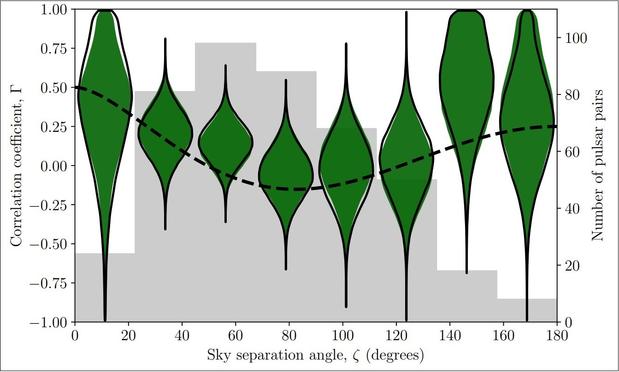
The smoking gun signature of detection is this violin plot, known as the Hellings & Downs correlation. It tells us that all the pulsars across the sky are showing a correlated signal that is expected to be produced by the gravitational wave background of supermassive black hole binaries.

We're seeing the Universe shake, rattle and rolling!

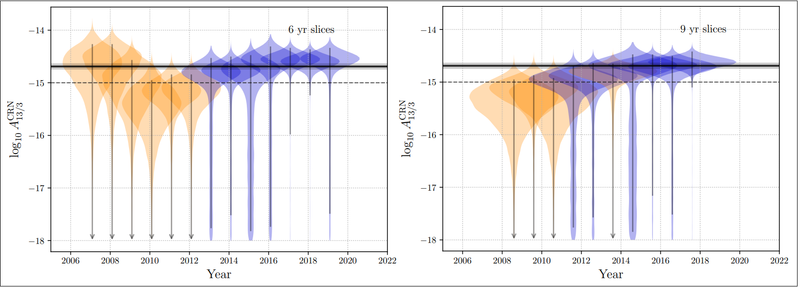
Interestingly, data from our PPTA paper - the amplitude signal strength is time-dependent, which is not expected if gravitational wave signals are equally isotropic.

Could be a processing issue, or the pulsars (weirdos) OR potentially GWs stronger in one part of the sky! 🤯

This is wild to me!

#Astrodon #Astrophysics #RadioAstronomy #GravitationalWaves #Science #Pulsars

📸Reardon et al. 2023

@CosmicRami could a pair of SMBHs in say M31 swamp the data and skew it in one direction? Or would that be too obvious, so it must be further away?
@Dtl yeah, we can't resolve individual sources as yet, but 'loud' binaries are likely to be resolved once several more years of data is collected. I'm not sure M31 has more than 1 SMBH though? An example of one I am keeping my eye out for is OJ287 - eccentric orbit, short period, radiating GWs and we have an EM counterpart signal we can try to fit with it as well!
@CosmicRami I just picked M31 as a big nearby chunk of stuff. Interesting, I didn't know about OJ287. Will do some reading, thank you.
@Dtl no worries! Any galaxies that have their supermassive black holes 'relatively' near each other are going to be fascinating to look out for. High eccentricity orbits aswell, as these could emit GW burst like signals.
@CosmicRami I wish Ron Hellings had lived long enough to see this.
@TMEubanks yeah, this would have been a huge humbling moment!

@CosmicRami This is amazing work!

I especially am interested in the modeling of the pulsars' behavior as changes in their timing would affect the estimate of the GWB. How does one do that? Pulsars are so precise, but when you are trying to measure such fine changes...wow!

I don't have the expertise to have a feeling for the numbers involved. But, could something like the expansion of the universe explain the time-dependent signal seen? That would affect all measurements...maybe? 😃

@CosmicRami This is…. AWESOMEEEE!!
@CosmicRami As an inveterate nerdy observer of astrophysics, your article is like candy to me. Congrats on the paper, and thank you for the outstanding article!

@CosmicRami Holy shit! Congratulations to you and the team. This is extremely exciting news.

I have a huge interest in this stuff but I’m not an expert so I do have a question: With enough measuring we could see further back in time with the GWB vs the CMB correct?