
Josh Universe 

@admin@science.social
390 Followers
33 Following
1,087 Posts
STAG3-Cohesin's Role in Fertility and Cancer

Summary: Recent genetic research at Kyoto University has identified the STAG3-cohesin complex's crucial role in DNA organization within spermatogonial stem cells, impacting fertility and highlighting therapeutic paths in cancer, particularly B-cell lymphomas, by inhibiting STAG3 expression.

Read More:
https://biohackers.media/stag3-cohesins-role-in-fertility-and-cancer

#health #science #biology @medical@lemmy.science.social @news@lemmy.world @health@lemmy.world
STAG3-Cohesin's Role in Fertility and Cancer

Discover STAG3-cohesin's role in DNA organization within SSCs, linking fertility and cancer; a breakthrough from Kyoto University researchers.

Biohackers Media
Join my community Space Discord server to chat with like-minded people and participate in events! https://discord.com/invite/QgjFy8wQST #space #astronomy #physics
Join the Josh Universe - Space Discord Server Discord Server!

Josh Universe is an analog astronaut, science communicator, biohacker, and CEO of Astrochain. | 408 members

Discord
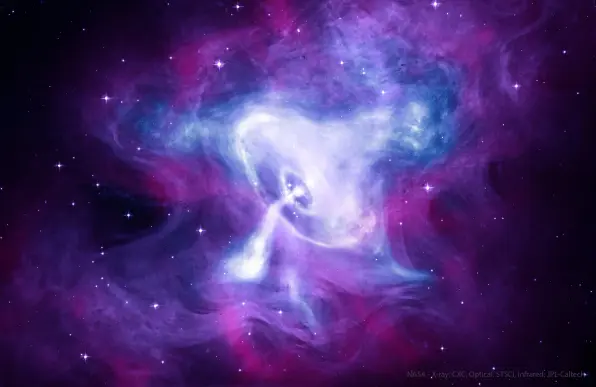
The Spinning Pulsar of the Crab Nebula

https://apod.nasa.gov/apod/image/2508/Crab_HubbleChandraSpitzer_1080.jpg

At the core of the Crab Nebula lies a city-sized, magnetized neutron star spinning 30 times a second. Known as the Crab Pulsar, it is the bright spot in the center of the gaseous swirl at the nebula's core. About twelve light-years across, the spectacular picture frames the glowing gas, cavities and swirling filaments near the Crab Nebula's center. The featured picture combines visible light from the Hubble Space Telescope in purple, X-ray light from the Chandra X-ray Observatory in blue, and infrared light from the Spitzer Space Telescope in red. Like a cosmic dynamo, the Crab pulsar powers the emission from the nebula, driving a shock wave through surrounding material and accelerating the spiraling electrons. With more mass than the Sun and the density of an atomic nucleus,the spinning pulsar is the collapsed core of a massive star that exploded. The outer parts of the Crab Nebula are the expanding remnants of the star's component gases. The supernova explosion was witnessed on planet Earth in the year 1054. Sky Surprise: What picture did APOD feature on your birthday? (after 1995)

Attribution:

@space@lemmy.science.social @science@lemmy.world @science@beehaw.org @space@beehaw.org @space@lemmy.world @science@lemmy.ml @science @space @space@lemmy.ml #space #science #nasa #astronomy
View my website to see upcoming events, follow me on other platforms, join my online groups and community pinterest boards, and see my freelance services, some stuff I'm building, and more! Visit here: https://joshuniverse.com/ #space #astronomy #physics #science
Josh Universe - Official Website

Josh Universe is an analog astronaut, science communicator, biohacker, and CEO of Astrochain. This is the official website of Josh Universe.

Fishing for the Moon

https://apod.nasa.gov/apod/image/2508/1000212902_bellelli1024.jpg

How big is planet Earth's Moon? Compared to other moons of the Solar System, it's number 5 on the largest to smallest ranked list, following Jupiter's moon Ganymede, Saturn's moon Titan, and Jovian moons Callisto and Io. Continuing the list, the Moon comes before Jupiter's Europa and Neptune's Triton. It's also larger than dwarf planets Pluto and Eris. With a diameter of 3,475 kilometers the Moon is about 1/4 the size of Earth though, and that does make it the largest moon when compared to the size of its parent Solar System planet. Of course in this serene, twilight sea and skyscape, August's rising Full Moon still appears small enough to be caught in the nets of an ancient fishing rig. The telephoto snapshot was taken along the Italian Costa dei Trabocchi, on the Adriatic Sea.

Attribution: How big is planet Earth's Moon

@space@lemmy.science.social @science@lemmy.world @science@beehaw.org @space@beehaw.org @space@lemmy.world @science@lemmy.ml @science@newsmast.community @space@newsmast.community @space@lemmy.ml #space #science #nasa #astronomy
Advanced Lipid Imaging in C. elegans Unveiled

Summary: Recent research at Okayama University and Maastricht University introduced a groundbreaking method using MALDI-MSI to map lipid distributions in C. elegans. This technique preserves spatial structures, advancing studies in lipid-related diseases and aging by visualizing lipids with unprecedented precision.

Read More:
https://biohackers.media/advanced-lipid-imaging-in-c-elegans-unveiled

#health #science #biology @medical@lemmy.science.social @news@lemmy.world @health@lemmy.world
Advanced Lipid Imaging in C. elegans Unveiled

Innovative lipid imaging in C. elegans reveals crucial insights into metabolism, aging, and disease mechanisms.

Biohackers Media
Follow me over on substack for high-quality editors and my podcast: https://joshuniverse.substack.com/ #space #astronomy #physics #science
Josh Universe | Substack

Josh Universe is an analog astronaut, science communicator, biohacker, and CEO of Astrochain. Click to read Josh Universe, a Substack publication. Launched a year ago.

Incentives Boost Alzheimer's Trial Enrollment

Summary: A USC study revealed that a $25 gift card increased Alzheimer’s trial enrollment among low-income adults by almost 40%. This suggests small, immediate incentives are effective for boosting diversity in clinical research, as published in JAMA Health Forum on Aug 22, 2025.

Read More:
https://biohackers.media/incentives-boost-alzheimers-trial-enrollment

#health #science #biology @medical@lemmy.science.social @news@lemmy.world @health@lemmy.world
Incentives Boost Alzheimer's Trial Enrollment

USC study finds $25 gift card boosts Alzheimer's trial enrollment among low-income groups by 40%, highlighting innovative recruitment strategies.

Biohackers Media
A Tale of Two Nebulae

https://apod.nasa.gov/apod/image/2508/M57_LRGB_1K.jpg

This colorful telescopic view towards the musical northern constellation Lyra reveals the faint outer halos and brighter central ring-shaped region of M57, popularly known as the Ring Nebula. To modern astronomers M57 is a well-known planetary nebula. With a central ring about one light-year across, M57 is definitely not a planet though, but the gaseous shroud of one of the Milky Way's dying sun-like stars. Roughly the same apparent size as M57, the fainter and more often overlooked barred spiral galaxy at the left is IC 1296. In fact, over 100 years ago IC 1296 would have been known as a spiral nebula. By chance the pair are in the same field of view, and while they appear to have similar sizes they are actually very far apart. At a distance of a mere 2,000 light-years M57 is well within our own Milky Way galaxy. Extragalactic IC 1296 (aka PGC62532) is more like 200,000,000 light-years distant. That's about 100,000 times farther away than M57 but since they appear roughly similar in size, former spiral nebula IC 1296 must also be about 100,000 times larger than planetary nebula M57. Look closely at the sharp 21st century astroimage to spot even more distant background galaxies scattered through the frame.

Attribution: Kent Biggs

@space@lemmy.science.social @science@lemmy.world @science@beehaw.org @space@beehaw.org @space@lemmy.world @science@lemmy.ml @science@newsmast.community @space@newsmast.community @space@lemmy.ml #space #science #nasa #astronomy
Innovative Biliverdin Technique Enhances Tissue Imaging

Summary: Researchers from Duke University and Albert Einstein College of Medicine improved deep tissue imaging in mice using biliverdin, enhancing imaging depths to 7 mm and improving clarity. The technique also reduced blood glucose levels by 60% in diabetic mice using NIR light to stimulate insulin production.

Read More:
https://biohackers.media/innovative-biliverdin-technique-enhances-tissue-imaging

#health #science #biology @medical@lemmy.science.social @news@lemmy.world @health@lemmy.world