My colleague Kevin Gross and I have a new preprint up on the arXiv.

Just for fun, rather than a simple text explainer, a thread with some slides for a talk I'm giving at https://www.icssi.org/ tomorrow.

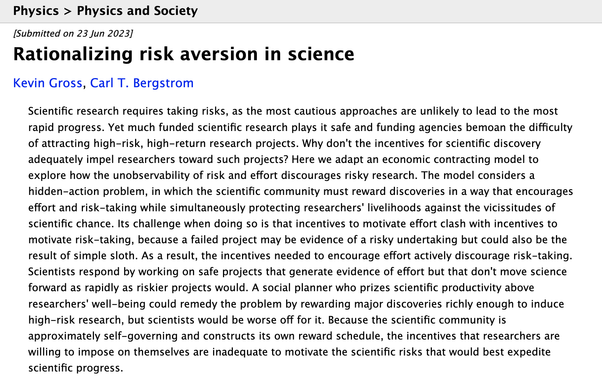
Here's the paper itself: Rationalizing risk aversion in science. https://arxiv.org/abs/2306.13816

International Conference on the Science of Science and Innovation

International Conference on the Science of Science and Innovation
The basic issue at hand is high-risk, high-return science. There is widespread sentiment, and even some scattered empirical evidence, that scientific research within academia is too cautious and that higher-risk, higher-return research would yield more progress more quickly.
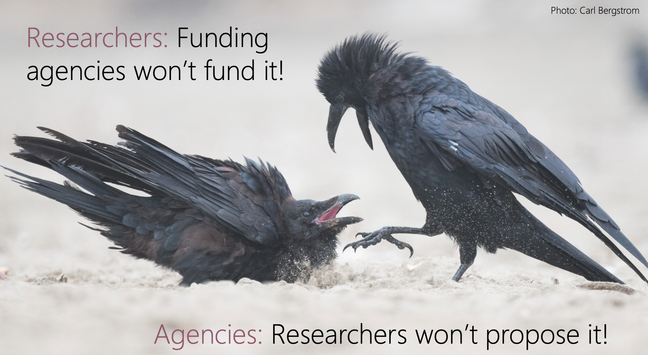
If you ask people why we don't see more high-risk science, you get different answers. Researchers tell you that granting agencies won't fund it. Funders tell you that researchers won't propose it.

A couple of years ago, we published a PNAS paper that tackles the researchers' side of the story, explaining why grant review panels may be unlikely to fund risky studies.

https://www.pnas.org/doi/10.1073/pnas.2111615118

The present paper addresses the funding agencies' side, and looks at why researchers may be reluctant to take on high-risk projects even if they are funded.

To get at this, we have think about the incentives that academic researchers face.

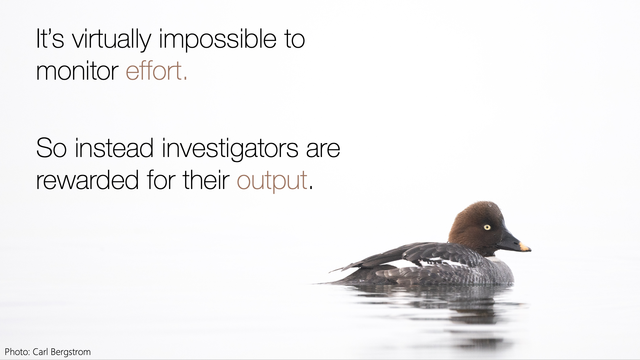
Because it's very difficult to monitor the effort that researchers put in, academic scientists are rewarded almost exclusively for their research output.

Rewards come in the form of jobs, promotions, salary, and prestige, for example. We'll refer to these all as wages.

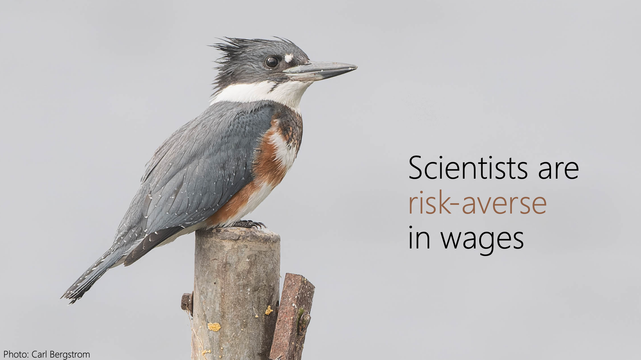
We note that particularly where job security and salary are concerned, scientists are risk-averse in wages.
When investing in risky research, funding agencies can hedge their bets across a portfolio of large-scale high-risk projects. Individual scientists can't typically do this.

Researchers might be willing to take on risky projects if they could be insured against that risk, with wages that didn't depend on the vicissitudes of scientific fortune.

But you can't completely ensure against the failure to get results, because bad luck is indistinguishable from loafing and you need to somehow incentivize effort.

Thus the scientific enterprise is caught in a bind. Measures necessary to incentive effort necessarily dissuade researchers from taking enough risks.

A social planner might induce effort and risk by paying large bonuses for major results.

But given any budget to allocate among researchers, this is inefficient from the researchers' perspective because risk aversion means that to increase the utility of a high earner even modestly, you have to take a lot of wages away from low earners at high utility cost.

But here's the thing: science has no external social planner.

Scientists themselves determine what results are considered worthwhile, and how worthwhile. They decide who is hired, promoted, given wages, is awarded prizes, and garners esteem. In other words, they set their own wages, of course subject to a budget constraint.

What we prove in this paper is that (in a simple model of the scientific enterprise), when left to their own devices scientists will choose for themselves a wage scheme that results in below-optimal risk-taking.

This is an inevitable consequence of the unobservability of effort and risk, coupled with the lack of an external social planner.

In other words, the rewards the science collective offers are not sufficient to motivating socially optimal levels of scientific risk.

@ct_bergstrom is there anything specific to science here? would the same argument apply to other sectors with the same principal-agent kind of tension? any large scale project portfolio has this dynamic, doesn't it? and collective governance tending away from variable rewards sounds pretty common too. WDYT?
@joeltruher yes, where you cannot monitor effort, where at least some level of risk is desirable, and where are you have collective governance, I think this would apply.

@ct_bergstrom
Fascinating paper and thread, thank you.

Are all scientists equally capable / appropriately trained to design or execute high risk research?

Is the long run utility of high risk research undoubtedly superior to incremental progress? (cf training early career researchers and students; managing potential societal harm and other inadvertent consequences; understanding the 'signal' in fields with high methodological uncertainty).

@christakou All excellent questions. I think we need to better understand what high-risk research is. It’s not obvious to me that we are underinvesting in it because it’s not obvious to me that we actually are good at judging the level of risk of a project and I wonder if high reward is conflated with high risk ex post.

@ct_bergstrom this all makes a lot of sense to me, and i think may help guide changes. One criticism is the assumption that higher risk level equates with higher reward. You can never know something will be a paradigm shift going in. Breakthroughs, by their nature, have to happen organically.

I would argue that a well designed study is reasonably low risk at producing scientifically useful information. It just may not match the hypothesis. Which is usually the more interesting path

@ct_bergstrom
YES! making labor more visible especially in the case of failure is the way. when the only unit of work is the glam paper, we are all worse off, personally and collectively. gonna take a cruise through this now
@ct_bergstrom this is not the full story - depending on the higher education system: Academic administrators play an enormous role in setting conditions for tenure processes. E.g. For a long time in Germany ministerial bureaucracy had a say in appointing professors. Additionally, rules against academic inbreeding are implemented.

@ct_bergstrom Re: "science's social planner".

I'm wondering at a glance, the role that major prizes might play in this, such as the X-Prize for the HGP or similar.

@ct_bergstrom
Incentivize effort, or incentivize results.

Effort: Punch clock at the lab. No non-work websites, minimum 20 pages worth of papers published per semester.

Results: Sum citation index of last years publications for an "index/day" metric. How, where or why the publications were produced is irrelevant.

Both approaches suck. Just like they suck in industry, and have been largely abandoned in favour of psychologically better grounded management methods.

@ct_bergstrom Thanks for sharing and congrats on the gorgeous slides!
@ct_bergstrom Is it more important to discourage loafing than it is to encourage risky projects?

@ct_bergstrom

Is that always so? I think a diligent researcher who gets off on the wrong track should be able to come back with a coherent, possibly insightful, explanation of what went wrong where a lazy one wouldn't.

@ct_bergstrom i think this is the basic argument for tenure or academics as public servants. They are freed from fear of being fired and are guaranteed a certain academic minimum wage.
@ct_bergstrom can you not just count preprints and divide by number of PhD and postdoc? It's only the positive result publication bias that makes this a thorny issue isn't it?
@neuralreckoning yes, I think the idea is that high risk research often yields very little that’s publishable despite large amounts of work.
@ct_bergstrom right so if we told people we were measuring them based on preprints (including negative results that wouldn't be journal publishable) and not on journal publication they could still have a mechanism to show they had been working hard even if they didn't get journal publications.
@neuralreckoning @ct_bergstrom also, if you get a “non-working” experiment, or just a “negative result”, you might be less likely to take the time to turn it into a preprint because you know it might not be accepted for peer-review publication anyway… so the measure you suggest will (unfortunately) not detect all of the work that has been done…
@elduvelle @ct_bergstrom right but if you know you were being judged on that basis and not on the basis of published work you'd have the incentive to do it!

@elduvelle @neuralreckoning @ct_bergstrom

People get all worked up over negative results, but a real negative result is actually really hard to show. The problem is that a negative result can be negative for lots of reasons, most of them boring.

For example, maybe the DREADD didn't affect rat behavior because there was no DREADD in the virus. (That happened to us once.) Or maybe the human subject pool was tasked wrong because they didn't understand the instructions. (That happened to us once.)

To get a real negative result, you have to have positive controls to show that all of the techniques are doing what you think they are and that the negative result is not a consequence of a trivial outcome.

Yes, you need controls for positive results as well, but it's easier to determine what those controls are, and reviewers tend to demand those controls. People who try and fail to publish negative results almost never have the right controls for those negative results (which are not the same at all as the controls you need for the positive results). A well-structure negative result experiment should be very publishable.

@ct_bergstrom this is key - and how they should operate.
@ct_bergstrom I wonder if that would be affected by a more fluid job market with high-risk failure recovery paths.

@ct_bergstrom
One structural issue is that research papers are used for two incompatible purposes: Disseminate research results; and evaluate the researcher who wrote them. The spread of citation indexes makes it far worse.

You do need to evaluate or rank researchers. For that, a robust way independent of published results is really necessary. Of course that's a tall order; I have no idea how to do it.

@ct_bergstrom
But this is (part of) what tenure is for, isn't it? Having shown you can do publishable research, you get to try some longshots, which may pay off hugely, but will quite probably fail, in which case you still have your tenured full professor job.
That doesn't help if you really need a lot of funding, I admit
@ct_bergstrom
Interesting paper, reminds me of one reason why I felt lucky to work at Bell Labs in its heyday:
https://archive.nytimes.com/dotearth.blogs.nytimes.com/2008/12/12/r2-d2-and-other-lessons-from-bell-labs/
Researchers didn’t really make grant proposals, although might make project proposals evaluated by (very technical) management chains, who’d sometimes send them around to other labs for comment (i got a few of these). Of course, some R1 researchers worked for years on topics that might not pay off for decade or two or ever. “Monopoly money is nice.”
'R2-D2' and Other Lessons From Bell Labs

Dot Earth Blog

@ct_bergstrom
In my (limited) experience part of the problem is that if you *do* propose a high-risk project, the reviewers come back with "Interesting, but unlikely to work". and scores it lower than safer projects, so it doesn't get funding.

And since a proposal submission is expensive - in time, in opportunity cost (can often submit only one proposal) - you need to optimize for the best likelihood of getting funded. Submitting a low-chance proposal hurts you all by itself.

@ct_bergstrom I did some work with Thomas Sinkjær when he was at the Villum Foundation to try and address the funding side of this with the ‘Villum Experiment' grant scheme.

https://veluxfoundations.dk/en/technical-and-scientific-research/villum-experiment

Short anonymous applications, ‘golden ticket' for reviewing panel members so you don't need consensus. We talked a lot about the problem of researcher incentives - but didn't come up with a way to fix it.

Villum Experiment

THE VELUX FOUNDATIONS