My colleague Kevin Gross and I have a new preprint up on the arXiv.

Just for fun, rather than a simple text explainer, a thread with some slides for a talk I'm giving at https://www.icssi.org/ tomorrow.

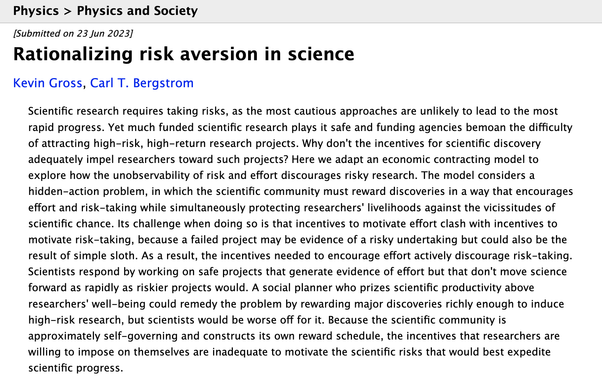
Here's the paper itself: Rationalizing risk aversion in science. https://arxiv.org/abs/2306.13816
International Conference on the Science of Science and Innovation

International Conference on the Science of Science and Innovation
The basic issue at hand is high-risk, high-return science. There is widespread sentiment, and even some scattered empirical evidence, that scientific research within academia is too cautious and that higher-risk, higher-return research would yield more progress more quickly.
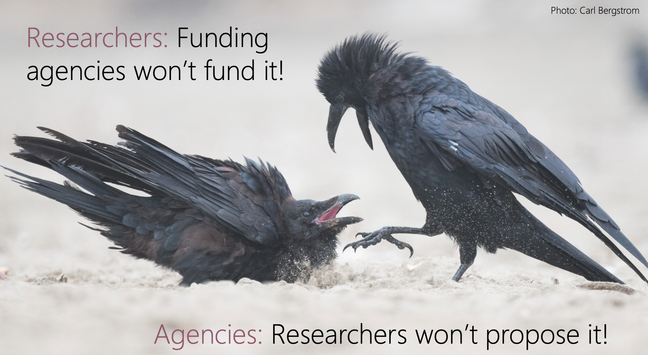
If you ask people why we don't see more high-risk science, you get different answers. Researchers tell you that granting agencies won't fund it. Funders tell you that researchers won't propose it.

A couple of years ago, we published a PNAS paper that tackles the researchers' side of the story, explaining why grant review panels may be unlikely to fund risky studies.

https://www.pnas.org/doi/10.1073/pnas.2111615118

The present paper addresses the funding agencies' side, and looks at why researchers may be reluctant to take on high-risk projects even if they are funded.

To get at this, we have think about the incentives that academic researchers face.

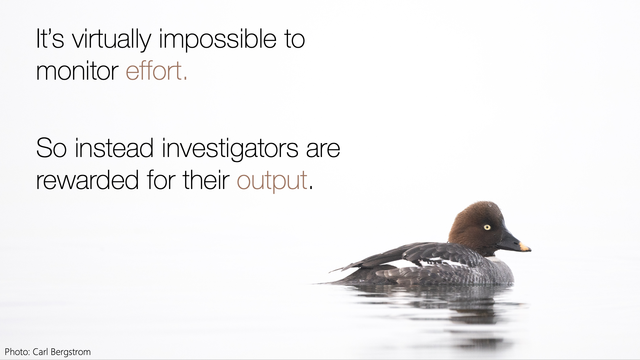
Because it's very difficult to monitor the effort that researchers put in, academic scientists are rewarded almost exclusively for their research output.

Rewards come in the form of jobs, promotions, salary, and prestige, for example. We'll refer to these all as wages.

@ct_bergstrom
But this is (part of) what tenure is for, isn't it? Having shown you can do publishable research, you get to try some longshots, which may pay off hugely, but will quite probably fail, in which case you still have your tenured full professor job.
That doesn't help if you really need a lot of funding, I admit